Friday, April 25, 2008

World's oldest oil paintings in Afghanistan

ScienceDaily, Apr 22, 2008

Ancient Buddhist Paintings From Bamiyan Were Made Of Oil, Hundreds Of Years Before Technique Was 'Invented' In Europe

Bamiyan, Afghanistan -- The world was in shock when in 2001 the Talibans destroyed two ancient colossal Buddha statues in the Afghan region of Bamiyan.

Behind those statues, there are caves decorated with precious paintings from 5th to 9th century A.D. The caves also suffered from Taliban destruction, as well as from a severe natural environment, but today they have become the source of a major discovery.
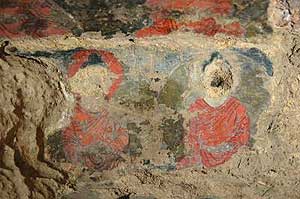
Scientists have proved, thanks to experiments performed at the European Synchrotron Radiation Facility (ESRF), that the paintings were made of oil, hundreds of years before the technique was "invented" in Europe.

In many European history and art books, oil painting is said to have started in the 15th century in Europe. But scientists from the National Research Institute for Cultural Properties in Tokyo (Japan), the Centre of Research and Restoration of the French Museums-CNRS (France), the Getty Conservation Institute (United States) and the ESRF have recently identified drying oils in some of the samples they studied from the Bamiyan caves.

Painted in the mid-7th century A.D., the murals show scenes with Buddhas in vermilion robes sitting cross-legged amid palm leaves and mythical creatures. The scientists discovered that 12 out of the 50 caves were painted with oil painting technique, using perhaps walnut and poppy seed drying oils.

A combination of synchrotron techniques such as infrared micro-spectroscopy, micro X-ray fluorescence, micro X-ray absorption spectroscopy or micro X-ray diffraction was crucial for the outcome of the work. "On one hand, the paintings are arranged as superposition of multiple layers, which can be very thin. The micrometric beam provided by synchrotron sources was hence essential to analyze separately each of these layers. On the other hand, these paintings are made with inorganic pigments mixed in organic binders, so we needed different techniques to get the full picture" Marine Cotte, a research scientist at CNRS and an ESRF scientific collaborator explains.

The results showed a high diversity of pigments as well as binders and the scientists identified original ingredients and alteration compounds. Apart from oil-based paint layers, some of the layers were made of natural resins, proteins, gums, and, in some cases, a resinous, varnish-like layer. Protein-based material can indicate the use of hide glue or egg. Within the various pigments, the scientists found a high use of lead whites. These lead carbonates were often used, since Antiquity up to modern times, not only in paintings but also in cosmetics as face whiteners.

"This is the earliest clear example of oil paintings in the world, although drying oils were already used by ancient Romans and Egyptians, but only as medicines and cosmetics", explains Yoko Taniguchi, leader of the team.

The paintings are probably the work of artists who traveled on the Silk Road, the ancient trade route between China, across Central Asia's desert to the West. However, there are very few studies about this region. "Due to political reasons research on paintings in Central Asia is scarce. We were fortunate to get the opportunity from UNESCO, as a part of conservation project for the World Heritage site Bamiyan, to study these samples and we hope that future research may provide deeper understanding of the painting techniques along the Silk Road and the Eurasian area", says Taniguchi.

The results were presented in a scientific conference in Japan last January and published April 22 in the peer-reviewed Journal of Analytical Atomic Spectrometry.

Adapted from materials provided by European Synchrotron Radiation Facility, via EurekAlert!, a service of AAAS. (Courtesy of Buddhist Channel)

Developing Nalanda to improve Sino-India ties

IANS, April 23, 2008

Patna, India -- The development of Nalanda, the ancient seat of learning in Bihar, will help improve ties between India and China, an expert has said. “Nalanda’s proper development will help improve India-China ties due to its importance in both countries,” said R. Pant, vice chancellor of Nav Nalanda Mahavihar.


Pant, who was here in connection with a talk Tuesday, said Nalanda still attracts attention of China and other southeast Asian countries for its historical and cultural legacy. “India had initiated the move to develop Nalanda. China then showed keen interest in this project,” said Pant.

Nalanda is about 90 km from Patna.

Pant said China was taking keen interest in buddhist sites and there is a place named ‘Rajgir’ in China’s Lingsa province where a 200 ft statue of Lord Buddha has been installed.

He said Nepura village in Silao block was also being developed for its specialisation in silk weaving as silk bags were quite popular among the Buddhist monks in China and other countries.

Nalanda pottery, which was also popular among the Buddhist tourists, would be given due attention.

A cultural village and the Nalanda International University are being set up with the help of foreign countries including China and Japan.

According to Pant, a hall built last year in memory of 7th century Chinese traveller Xuan Zang (Huen-Tsang) in Nalanda, inaugurated by Chinese foreign minister Li Zhaoxing, is a sign of growing India-China friendship. The hall was built in memory of Xuan Zang’s visit to India.

Xuan Zang is famous for his 17-year-long trip to India, during which he studied with many noted Buddhist masters, especially at Nalanda. He was a student at Nalanda for five years and taught for a year.

While returning to China, he carried 657 Sanskrit manuscripts with him and translated them in Chinese, laying a strong foundation of Buddhism not only in China, but also in Korea and Japan.

Monday, April 21, 2008

More call for disruption-free event

The Star, Monday April 21, 2008

KUALA LUMPUR: More Buddhist groups have come up to say that the Beijing 2008 Olympic Games torch relay in Kuala Lumpur today should not be disrupted.

The Vajrayana Buddhist Council of Malaysia urged its member organisations and other Tibetan Buddhist Societies and Centres in Malaysia and the public not to cause disruptions.

Its president Eddie Wong Eng Tat said this was consistent with the Dalai Lama’s advice.

“We pray that the Beijing Olympics will be a peaceful and most-successful Olympic Games in its series and achieves the Olympic Charter goal in contributing towards the building of a healthy, peaceful and better world through sports,” he said in a statement.

A Tibetan monk exiled in India, Chokhor Rimpoche, said his group of 10 Tibetan monks on a religious visit in Malaysia would not hold any protest.

“We urge the Chinese Government to hold dialogues with the Dalai Lama to resolve conflicts,” he said at the Multi Faiths Prayers for Tibet: Olympics Torch Relay in KL and Olympics 2008 event yesterday.

A good platform with the involvement of a third party was needed to facilitate the talks, he said.

Buddhist chief high priest of Malaysia K. Sri Dhammaratana Maha Nayaka Thera also agreed that talks should be held.

Interfaith Spiritual Fellowship chairman Dr Amir Farid Isahak said history showed that fighting only created more problems.

Torch relay runner Datin Paduka Marina Mahathir said she hoped there would be no disruption but acknowledged that people had the right to express themselves.

Saturday, April 19, 2008

Buddhists to hold interfaith prayers

The Star, April 19, 2008


PETALING JAYA: A multi-faith prayer for peace in Tibet, a successful Olympics torch relay in Kuala Lumpur and the Olympic Games in Beijing will be held at the Buddhist Maha Vihara temple in Brickfields on Sunday, beginning at 8.30am.

Chief High Priest of Malaysia The Most Venerable K. Sri Dhammaratana said religious leaders from all major faiths – Buddhism, Christianity, Islam, Hinduism and Sikhism – have been invited for the prayer session.

He also urged all Malaysians to join in prayer to “propagate compassion in a non-violent way for the peace and harmony of the human race”.

“The Olympic torch is going around the world, and the relay has not been free from trouble. Sometimes, the flame is blown out,” he said. “As a Buddhist leader, it is my duty to calm the situation. My advice is for the public to not make any trouble.”

He said people should refrain from mixing sports and religion with politics.

Wednesday, April 16, 2008

A splashing good time

By YENG AI CHUN and LOOI SUE-CHERN, The Star, April 14, 2008

Bukit Mertajam, Penang (Malaysia) -- A FUN atmostphere prevailed at the Penang-level Songkran Festival at Wat Rajaphohong Buddhist Temple in Ara Kuda, Bukit Mertajam, yesterday.


Festival of fun: Revellers spalshing water at one another at the Chaiya Mangalaram Buddhist Temple.

Some 2,000 people turned up for the event which marks the Thai New Year and is also known as the Water Festival. Water features prominently in the festival with devotees pouring scented water over Buddha figurines. Younger folk also poured water on the hands of their elders as a sign of respect.

Later in the day, revellers spread festive joy by drenching each other using water guns or buckets of water. Many also threw talcum powder on each other.

Jointly organised by the Malaysian Siamese Association’s Penang branch, Royal Thai Consulate-General in Penang and Wat Rajaphohong, it was the first time that the state’s Songkran Festival was held on the mainland.

The festival kicked off in the morning as devotees prayed at the temple and later congregated at the main hall for the chanting of Pali prayers by Buddhist monks.

There were also stalls selling food and various items while many tried their luck in a traditional Thai game called Soi Dow. Brightly coloured boxes were hung from the ceiling with participants picking one to get the number inside which indicated the prize to be won.

A highlight was a sand pagoda contest where contestants were given two hours to create their masterpieces.

Chief Minister Lim Guan Eng and the Thai Consul-General of Penang Monopchai Vongphakdi opened the festival by pouring scented water on a Buddha figurine.
A sand pagoda built by a contestant.

Over on the island, thousands thronged the Thai Chaiya Mangalaram Buddhist Temple and Bur-mese Buddhist Temple to celebrate the festival which is known as Thingyan to the Burmese and also marks their New Year.

Traditionally a time for visiting elders, relatives, friends and neighbours, Songkran has evolved into a water-splashing celebration.

Armed with water guns, water containers, plastic bottles, pails and hoses, the revellers drenched each other.

Images of Lord Buddha in the temples were cleansed in religious bathing rites to bring good luck and prosperity. There were also cultural dances and band performances.

Present were state Tourism Development, Culture, Arts and Heritage Committee chairman Danny Law Heng Kiang, Deputy Thai Consul-General Songsap Kachenchai and former Pulau Tikus assemblyman Datuk Dr Teng Hock Nan.

Buddha relics may be fake, says association


Wednesday April 16, 2008

PENANG: The authenticity of Buddha relics to be exhibited in Penang starting on Friday has come under question.

Malaysian Buddhist Association (MBA) president Ven Jit Heng said the association was, therefore, not in favour of the three-day ”Nine Countries Genuine Buddha Relics Exhibition” to be held at the Che Hoon Khor Uplifting Society.

“Buddha relics are the remains of Buddha and are sacred treasures which are revered and respected by Buddhist devotees,” Ven Jit Heng, who is also the abbot of Kek Lok Si temple, told a press conference here yesterday.

Temples, he said, would have to spend more than RM10mil on security and transportation to bring in these relics.

Ven Wimala, the deputy chief of Myanmar temples in Malaysia, said Buddha relics were sacred objects and should not be sold or used for fund-raising or commercial projects.

Penang Thai Sangha Governor chief Ven Pra Kru Panyafasa Nurak said many groups of people had held similar exhibitions for commercial purposes in several countries, including Malaysia.

Exhibition organising committee chairman Angie Chan said that although there was no certificate by certified archaeologists, there were letters of certification by the Thailand Chief Monk from Wat Arun in Bangkok.

She said the letters stated that the Thailand Chief Monk had received the relics for Wat Arun for the Thai King’s 80th birthday celebration.

She said the relics were exhibited at Wat Arun for 80 days from Dec 5, 2006, and exhibited all around Bangkok for a year.

She said donations collected would go to local charity organisations Pure Lotus, Jubilee Perak Old Folks Home and the Penang Cheshire Home, and to the Wat Arun Building Fund and to Loinanglei, a temple in Chiang Mai, Thailand.

(From TheStar.com, for original article please click here)


Tuesday, April 15, 2008

Lotus

Wesak Month is around the corner... Thinking about kick-starting with this picture. If you like this picture, you can see the collection here.

Friday, April 11, 2008

The Praying Dog

The Associated Press

NAHA, Japan — At a Zen Buddhist temple in southern Japan, even the dog prays.

Mimicking his master, priest Joei Yoshikuni, a 1 1/2-year-old black-and-white Chihuahua named Conan joins in the daily prayers at Naha's Shuri Kannondo temple, sitting up on his hind legs and putting his front paws together before the altar.

It took him only a few days to learn the motions, and now he is the talk of the town.

"Word has spread, and we are getting a lot more tourists," Yoshikuni said Monday.

Yoshikuni said Conan generally goes through his prayer routine at the temple in the capital of Japan's southern Okinawa prefecture (state) without prompting before his morning and evening meals.

"I think he saw me doing it all the time and got the idea to do it too," Yoshikuni said.

The priest is now trying to teach him how to meditate. Well, sort of.

"Basically, I am just trying to get him to sit still while I meditate," he explained. "It's not like we can make him cross his legs."

(Story and picture from Associate Press)

Thursday, April 10, 2008

We are Back


After a very long while since the last update, we are finally back.

Some of you might notice that we have actually revamp the blog and surfing around, you will notice that our website has also been through a revamp.

With new contributions from all over, we hope to be able to keep you updated with the latest news from us and all over.

So, do return to this blog more regularly.

If you want your blog to be listed here, please e-mail to kcbadyc@gmail.com. You can send articles that you want to be publish here as well to the same e-mail address.


Wednesday, May 23, 2007

Wesak Day

Picture taken during Wesak Day at KCBA. The KCBA Dhamma Youth Circle's members promoting the Annual KCBA Dhamma Youth Camp.