Camp photo...


Petaling Jaya, Malaysia -- Kechara Soup Kitchen finds a different and meaningful way to celebrate the new year which goes far beyond the family’s reunion dinner dining table.
On top of celebrating with family and welcoming the new year with a bang, let the start of 2010 be one that will really make a difference to someone. Or will it just be another day filled with oranges, nosy relatives and food to make your cholesterol levels soar again?
KECHARA SOUP KITCHEN (KSK) is organising its annual fundraising dinner on Sunday FEB 7 2010, at Sunway Pyramid Convention Centre, to raise funds for its new renovations and maintenance of its new permanent base in the city. With this new building, KSK will be able to go out to DONATE FOOD TO THE HOMELESS more often, FORGE FRIENDSHIPS and give people on the streets a RENEWED LEASE OF LIFE.
Already, they are working hard to find placements for the homeless in old folks homes and find them jobs, thus giving them new opportunities in society. Since 2006, come rain or shine, KSK volunteers have been going out every weekend, bringing hot vegetarian and dry food to the hungry on the streets, regardless of their race, culture or creed. Over the last three years, the number of packets they have been distributing each week has increased from a mere 20 packets to 700 PACKETS.
Read the incredible stories of how they are literally taking people off the streets and into new homes and jobs: www.kechara.com/ksk
Imagine how much more they can do with their new permanent base in the city! You could make this a reality and be a part of giving people not just a new year greeting but a whole new life again.
This KSK fundraising dinner is offering you a night to celebrate the spirit of sharing, giving and hope for the many people who don't even know when they will have their next meal. Among the many fantastic celebrations you'll be having with your loved ones, let at least one dinner make a profound difference in someone's life.
Tables are available for sponsorship at RM2,500 and RM5,000. There are further details here: http://www.kechara.com/ksk/event_view.php?a=0&p=47
For tickets to the event, or for further information on how you can help, please contact our Project Director Justin Cheah at justin.cheah@kechara.com or +6012 203 2135.

 Having fun time!
 Most of us there... A few went missing at this time...


PRINCE Siddhartha – The Musical, premiered in Kuala Lumpur in 1999 but 10 years later, the intricate scenes depicting how the young Buddha gave up luxuries in search of the truth in life are still dearly remembered by many.
The production is making a comeback and not only that, it will be staged at Istana Budaya.
Written, produced and directed by Ho Lin Huay of Musical On Stage Productions, the show aims to raise funds for the construction of the interior and other amenities for the Great Compassion Building, an extension to the Shan Dao Jing She Temple in Petaling Jaya Old Town.
“It means a lot to us to bring the production back to its homeland again on our 10th anniversary. Making it into Istana Budaya is a significant milestone and we are doubly delighted that it can be shown during the Wesak month,” she told a press conference held at the temple on May 6.
“More than 18,000 individuals watched the production in Malaysia with many saying that they were touched by the story. Overseas audience gave rave reviews, too,” she said.
Apart from Prince Siddhartha, her other productions, Above Full Moon and Jewel of Tibet, are also appreciated as delicate works disseminating the teachings of Buddhism.
Abbot Shi Kai Shan said the extended building was necessary to cater to the growing number of disciples participating in the temple’s activities.
A 4.6m-tall Avalokitesvara-Sahasrabhuja-Locana Bodhisattva status will soon grace the new three-storey building, to make it “a place of solemn worshipping and a place where those who feel depressed can find peace.”
He said the Shan Dao Welfare, Arts and Cultural Fund was founded upon four main pillars, to purify the human heart through studying together, to cultivate talents through the Buddha’s teachings, to propagate Buddha’s teachings through cultural activities and to create a caring society through compassion. The temple is also involved in the provision of health care and community welfare activities.
Shi added that the temple targeted to raise another RM500,000 to complete the project.
The Prince Siddharta - The Musical charity show proceeds would go to the Shan Dao Welfare, Arts and Cultural Fund and would be held on May 31 at 1.45pm at Istana Budaya. Those interested in buying tickets for the charity show can call 03-7783 9536.
Vesak is also known as the Thrice-Blessed Day because it commemorates the birth, enlightenment, and passing away of the Buddha. It is observed by Buddhists all over the world on the full moon day in the month of Visakha, from which it derives its name and which usually corresponds to May. Variations of the name are Wesak, Vaisakha, and Vesakha. Vesak (or Vesakha) is the Pali form and Vaisakha is the Sanskrit form of the name of a month in the Indian lunar calendar.
Buddhists who follow the Mahayana tradition observe the birth, enlightenment and passing away of Gautama Buddha on separate days. For example in China, Taiwan and some South-East Asian countries like Malaysia, the birth is celebrated on the 8th day of the 4th Moon, the enlightenment on the 8th day of the 12th Moon and the passing away on the 15th day of the 2nd Moon according to the Chinese lunar calendar. In Japan, Buddha Day (the birth) is observed on 8th April, the enlightenment is marked at Jodo-e in December and the passing away at Nehan-e in February.
The Birth
The following is reproduced from The Life of the Buddha by Venerable Dr. H. Saddhatissa (Unwin Mandala 1988)
In the year 560 BC there was great excitement in the land of the Sakyans because Queen Mahamaya was to bear a child. According to the custom of the time a woman expecting a baby would return to her parents' home for the birth, and in due course it was arranged for Queen Mahamaya to make the journey to the neighbouring kingdom of her father. The King sent soldiers ahead to prepare the way and the Queen set out, carried in a decorated palanquin and attended by a large company of guards and retainers.
On the way to Koliya the party passed by a garden called Lumbini Park where, attracted by the trees and flowers, the Queen ordered a halt. It was intended to be only a rest, but while the Queen was lying in the leafy and fragrant shade of a Sala tree in full blossom she went into labour and gave birth to a son.
There was no longer any reason to continue the journey to Koliya and the party returned to Kapilavastu, where the new prince was greeted with great rejoicing. He was named Siddhartha (which means `wish fulfilled') by a proud and doting father.
Note: there are many legendary and symbolic elements in the accounts of the birth of Siddharta Gautama, who was to become the Buddha. Two of these are quoted here from Edward Conze's translation of the Buddhacarita by the first century Indian poet Ashvagosha
* He came out of his mother's side, without causing her pain or injury. His birth was as miraculous as that of Aurva, Prithu, Mandhatri, and Kakshivat, heroes of old who were born respectively from the thigh, from the hand, the head or the armpit. So he issued from the womb as befits a Buddha.
* When born, he was so lustrous and steadfast that it appeared as if the young sun had come down to earth. And yet, when people gazed at his dazzling brilliance he held their eyes like the moon. His limbs shone with the radiant hue of precious gold, and lit up the space all around. Instantly he walked seven steps, firmly and with long strides. In that he was like the constellation of the Seven Seers. With the bearing of a lion he surveyed the four quarters and spoke these words full of meaning for the future:`For enlightenment I was born, for the good of all that lives. This is the last time that I have been born into this world of becoming.'
The Enlightenment
To quote again from Ven. Saddhatissa
The time had indeed come for Gautama to achieve what he had been seeking for so many years, and the events of that day as described in the texts, are imbued not only with symbolic meaning but with peculiar calm and dignity. Taking the offering (ed: a very special bowl of milk rice prepared by Sujata), he went to a nearby river called Neranjara, and putting the bowl on the bank he entered the water to bathe himself. He then returned to the bank, sat down with the bowl in his lap and began his last meal as an aspirant to Buddhahood. The meal over, he washed his hands and the bowl and placed the bowl on the water to float. Then he said:`If today I am to attain full enlightenment, may this golden bowl swim upstream.' The bowl immediately did so. Gautama spent the rest of the day relaxing in the woodland along the river bank.
In the evening Gautama got up and made his way to the Bodhi tree -the `Ficus Religiosa', another tree sacred in India and known as the `Tree of Enlightenment' -which he had chosen as the place for his great act of meditation. On the way he met a grass cutter called Sotthiya who gave him some bundles of `kusa grass'. This grass was regarded as sacred and was used by Brahmins for sitting on. Gautama spread this grass at the foot of the Bodhi tree, turned to face the East and sat down in a meditating posture. Thus began the great trance from which he was to emerge on the full moon day of the month of Vesak as a Fully Enlightened One, a Buddha.
The course of Gautama's meditation is elaborately recounted in the ancient texts. At an early stage he was confronted with worldly temptations in the form of demons -an episode markedly similar to the temptations of Jesus in the wilderness. He then moved through various stages of spiritual ecstasy, called to mind all his previous forms of existence, and pondered how things come into being and disappear. With his mind purified, he then considered the nature of defilement, how it is caused and how it can be destroyed. In doing so he shed from his mind the various forms of defilement -the defilement of sensual desire, of the wish for continued existence, of delusion - and finally achieved the deliverance that he had sought for so long. `Now the cycle of rebirth is ended for me,' he said afterwards, when talking about his experience. `For me this world no longer matters.'
Note: this took place at what is now called Bodhgaya. There are also legendary and symbolic elements in the accounts of the Buddha's enlightenment. We quote again from Edward Conze's translation of the Buddhacarita in his book Buddhist Scriptures.
* Because the great Sage, the scion of a line of royal seers, had made his vow to win emancipation, and had seated himself in the effort to carry it out, the whole world rejoiced - but Mara, the inveterate foe of the true Dharma, shook with fright. People address him gladly as the God of Love, the one who shoots with flower-arrows, and yet they dread this Mara as the one who rules events connected with a life of passion, as one who hates the very thought of freedom. He had with him his three sons - Flurry, Gaiety, and Sullen Pride - and his three daughters - Discontent, Delight, and Thirst.
But Mara could achieve nothing against the Bodhisattva, and he and his army were defeated, and fled in all directions - their elation gone, their toil rendered fruitless, their rocks, logs, and trees scattered everywhere. They behaved like a hostile army whose commander had been slain in battle. So Mara, defeated, ran away together with his followers. The great seer, free from the dust of passion, victorious over darkness' gloom, had vanquished him. And the moon, like a maiden's gentle smile, lit up the heavens, while a rain of sweet-scented flowers, filled with moisture, fell down on the earth from above.
*When, through his Buddhahood, he had cognized this fact, the earth swayed like a woman drunken with wine, the sky shone bright with the Siddhas who appeared in crowds in all the directions, and the mighty drums of thunder resounded through the air. Pleasant breezes blew softly, rain fell from a cloudless sky, flowers and fruits dropped from the trees out of season - in an effort, as it were, to show reverence for him. Mandarava flowers and lotus blossoms, and also water lilies made of gold and beryl, fell from the sky on to the ground near the Shakya sage, so that it looked like a place in the world of the gods. At that moment no one anywhere was angry, ill, or sad; no one did evil, none was proud; the world became quite quiet, as though it had reached full perfection. Joy spread through the ranks of those gods who longed for salvation; joy also spread among those who lived in the regions below. Everywhere the virtuous were strengthened, the influence of Dharma increased, and the world rose from the dirt of the passions and the darkness of ignorance. Filled with joy and wonder at the Sage's work the seers of the solar race who had been protectors of men, who had been royal seers, who had been great seers, stood in their mansions in the heavens and showed him their reverence. The great seers among the hosts of invisible beings could be heard widely proclaiming his fame. All living things rejoiced and sensed that things went well. Mara alone felt deep displeasure, as though subjected to a sudden fall.
The Passing Away (Parinirvana)
Again quoting from Ven. Saddhatissa
The Buddha carried out his ministry for forty-five years. The first intimation that he could not continue for much longer came while he was visiting a village called Beluva to spend the rainy season. During his stay there he fell ill, and began to suffer severe pain. He bore the pain uncomplainingly, but he thought to himself:`It is not right for me to pass away and finally attain nirvana until I have spoken to my attendants and taken leave of the Sangha.' So by force of will he fought the illness and found the strength to go on.
Then the Buddha summoned Ananda and said to him:`Ananda, what does the Sangha need from me? The Law I have taught is clear, there is no secret version of it distinct from the one I have explained; I have not kept a closed fist on anything. Now I am old, Ananda, I am past eighty. So, Ananda, let each of you make a refuge for himself, an island; and let that refuge be the Law and nothing else.'
Their retreat ended, the Community once more set out and in due course came to a mango grove belonging to a man called Chunda. On learning that the Buddha was present, Chunda went to see him, and after hearing instruction from him invited the Community to take food with him the next day. The following morning the Buddha went with his followers to Chunda's house, where they were served a rich meal which included mushrooms. It was after, and perhaps because of, this meal that the Buddha's sickness returned. This time there was to be no recovery.
Despite his illness, the Buddha went on his way, coming eventually to a place called Kusinara. Here he settled in a grove of sala trees on the bank of the river Hirannavati. Ananda prepared a couch for him between two sala trees and the Buddha lay down. Then, addressing Ananda, he again make the point that it was not he himself, but what he said, that mattered. `It may be, Ananda,' he said,`that in some of you the thought will arise "the word of the Master is ended; we have no teacher any more". But that is not the way to look at it, Ananda. The Law which I have explained and laid down for you all, let that, afer I am gone, be your teacher.'
The Buddha then addressed the monks around him. `It is in the nature of all things that take form to dissolve again. Strive earnestly'(to attain perfection). These were the last words of the Buddha who then, it is said, moved through various rapturous stages of meditation until he passed away. His remains were cremated with the honours due to a royal person.
Note: as with other significant events in the life of the Buddha, there are many symbolic and legendary embellishments to the story of the Parinirvana. Again we quote from Conze's translation of the Buddhacarita by Ashvagosha
* And when the Sage entered Nirvana, the earth quivered like a ship struck by a squall, and firebrands fell from the sky. The heavens were lit up by a preternatural fire, which burned without fuel, without smoke, without being fanned by the wind. Fearsome thunderbolts crashed down on the earth, and violent winds raged in the sky. The moon's light waned, and in spite of a cloudless sky, an uncanny darkness spread everywhere. The rivers, as if overcome with grief, were filled with boiling water. Beautiful flowers grew out of season on the Sal trees above the Buddha's couch, and the trees bent down over him and showered his golden body with their flowers. Like as many gods the five-headed Nagas stood motionless in the sky, their eyes reddened with grief, their hoods closed and their bodies kept in restraint, and with deep devotion they gazed upon the body of the Sage. But, well-established in the practive of the supreme Dharma, the gathering of the gods round king Vaishravana was not grieved and shed no tears, so great was their attachment to the Dhamma. The Gods of the Pure Abode, though they had great reverence for the Great Seer, remained composed, and their minds were unaffected; for they hold the things of this world in the utmost contempt. The kings of the Gandharvas and Nagas, as well as the Yakshas and the Devas who rejoice in the true Dharma - they all stood in the sky, mourning and absorbed in the utmost grief. But Mara's hosts felt that they had obtained their heart's desire. Overjoyed they uttered loud laughs, danced about, hissed like snakes, and triumphantly made a frightful din by beating drums, gongs and tom-toms. And the world, when the Prince of Seers had passed beyond, became like a mountain whose peak has been shattered by a thunderbolt; it became like the sky without the moon, like a pond whose lotuses the frost has withered, or like learning rendered ineffective by lack of wealth.
Buddhists Join in Temple Services to Celebrate Buddha’s Birthday
Seoul, South Korea -- Millions of Korean Buddhists on May 2, 2009 took time out to celebrate the birth of Buddha some 2,500 years ago in a garden in India.
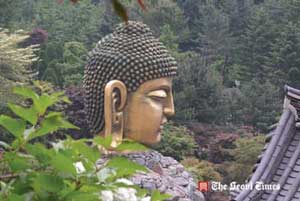 Buddhism is one of the world's major religions and the Buddhist way of life of peace, loving kindness and wisdom is evident today throughout the world.
Articles and pictures courtesy from Youth2 and Metro of The Star Publication. (Combination of a few articles)
What is Earth Day?
First Earth Hour, now Earth Day, what next? Earth Week?
Hate to break it to you, but in many countries, it really IS Earth Week now.
Don’t worry, it’s not about turning off electricity for a whole day. Earth Day is simply an event to remind everyone about the importance of protecting and appreciating our planet.
This year, the US-based Earth Day Network will be starting a Green Generation campaign which will slowly build up towards Earth Day’s 40th anniversary next year.
According to Wikipedia, the theme 40 years ago was overpopulation. In spite of that, world population has almost doubled since then, so imagine what would happen if we ignored the current themes of sustainability.
To find out more about the Green Generation campaign and how you can get involved, log on to earthday.net/node/13475.
The following are some examples of green business initiatives by several companies:
Waterless urinals in men’s washroom
At the Sunway Pyramid, there is no more need to flush at the urinals in the men’s toilets as each urinal is coated with BioCare liquid, a special chemical that breaks down urine into environment-friendly components without using water.
“This is part of the mall’s effort to conserve water and reduce wastage to help the environment. As the breakdown of the urine takes place immediately upon contact, this system ensures the urinals are always hygienic for use,” said the mall’s leasing and marketing general manager Kevin Tan.
 According to Tan, the chemical is changed weekly to ensure its effectiveness.
 Other green activities by the mall include a car park guiding system, the Alam Flora Recycling Buy Back Centre, and the Bring Your Own Bag campaign.
The parking system uses red/green LED (light emitting diodes) light to guide motorists to the nearest available parking bay.
“This system helps drivers to save time in locating available parking bays and reduces the time spent on finding available parking bays means less carbon monoxide emission from running vehicles,” Tan said.
“Shoppers and tenants can also recycle old cardboard boxes, newspapers, can and hard plastic for cash at the Alam Flora Recycling Buy Back Centre (BBC), which is open daily from 10am to 5pm except Thursday,” he said.
“A recycling buyback centre in the mall encourages not only the public but the retail outlets to trade in recyclables for cash as well.
In addition, the Sunway Pyramid will be rewarding shoppers with free parking every Tuesday (except public holidays) for supporting the environment. To qualify for the scheme, shoppers need to bring their eco-friendly bags (paper or plastic bags are not allowed) and buy product-based goods worth a minimum of RM50. They then have to present their receipts to one of the concierges and exchange their parking ticket for a free ticket.
 “The main message of the campaign is not solely about the mall going green for the long-term, but that its shoppers take ownership and do their part for Mother Nature,” Tan said.
 100% PCR PET Bottles
The Body Shop, known for its environment-friendly initiatives, is no stranger to the concept of green business.
According to The Body Shop marketing communication manager Jennifer Chan, one key value at The Body Shop is to protect the planet.
“Early last year, 100% recycled plastic bottles were introduced. That’s because some people still discard the packaging the usual way even if there’s a recycling centre or the option to return it to our outlets. The bottles are also 100% recyclable, from the cap to the label, even if it ends up in a landfill,” Chan said,
She said The Body Shop paper bags were made from 100% recycled paper with printing using water-based ink that did not harm the environment.
For the Green Office concept, the company’s workers are encouraged to practice the 3R — reduce, reuse and recycle.
Recycle bins are placed in the office for used paper and empty bottles.
Employees are advised to switch off all electrical appliances such as lights, air-conditioners, and computers when not in use, print emails or documents only when necessary and print all documents double-sided where possible, as well as publish, distribute or copy documents electronically.
As for reuse, the workers are encouraged to use scrap paper for taking notes and printing, re-use envelopes from internal mail and use own coffee mugs or water bottles for water and beverages instead of plastic/paper cups.
Up next is the “Kick The Bag Habit” on World Environment Day on June 5. Launched on Earth Day last year, the campaign raised RM91,953 towards the protection of the Temengor rainforest and over 77,000 paper bags saved over the period of the campaign.
For each shopping bag declined by every customer during the campaign, The Body Shop donated 50 sen to its campaign partner Malaysia Nature Society (MNS). Customers who requested a bag donated 50 sen towards the campaign.
“The concept is same for this year, but customers can now have the choice to purchase a limited edition tote bag at RM5, where RM2.50 will be donated to the MNS for the Save Temengor campaign,” Chan said.
Reducing carbon dioxide emissions
Panasonic Malaysia Sdn Bhd is committed to reducing carbon dioxide (CO2) emissions from its production activities by 300,000 tonnes globally over three years from fiscal year 2008 to 2010.
According to its assistant general manager (corporate communication and branding), Azizah Wahid, as part of the company’s environmental sustainability management activities, it will focus on three initiatives: Eco ideas for manufacturing, Eco ideas for everybody and everywhere, and Eco ideas for products.
Internally, the company has adopted a series of activities such as “no overtime” day, saving energy by switching off air-conditioners and lights, “no driving out for lunch” day to save petrol and reduce carbon footprint as well as recycling and office cleaning to maintain a clean and healthy work environment and work culture.
Azizah said the company was also striving to develop technologies for resource conservation while improving product functions.
To reduce CO2 emissions in the group’s activities, Panasonic will improve productivity in all manufacturing processes, including product planning, procurement, marketing, logistics and recycling.
“Reducing resources will reduce the amount of material used; reduce the rate of non-circulating resources over their life cycles; use more recycled resources; and increase recyclable resources. At the same time, Panasonic will reduce CO2 emissions,” Azizah said.
For the Clean Factories initiatives, Panasonic emphasises preventing global warming, reducing total waste, and reducing the release and transfer of chemical substances.
The company is endeavouring to minimise all input and output and to make all their manufacturing sites into Clean Factories.
Panasonic also promotes green logistics and recycling waste to help prevent global warming and reduce air pollution.
Panasonic will expand its eco- activities to local communities around the world. The company is promoting awareness-raising activities such as Love the Earth Citizens Campaign to encourage employees and their families to be active participants in eco-initiatives at home, the workplace and local communities.
Panasonic is aiming to establish factories co-existing in harmony with local communities and societies.
In addition to giving environmental consideration to materials and promoting recycling-oriented designs, Panasonic will accelerate development of energy conservation technologies while eliminating products with low energy efficiency.
Green crusaders
FROM rearing their own chickens to adopting lightbulbs, the young people of Malaysia have sure risen to the challenge of preserving our planet.
It’s one thing to turn off your lights for an hour every year to reduce your carbon footprint as was done in the recent Earth Hour global campaign, and another altogether to spend your weekends saving the natural habitats of turtles, or cleaning up waterfalls.
But that’s exactly what some young people have been doing; and in conjunction with Earth Day today, R.AGE checked out some of the activities our youth are getting involved in to help protect our little blue planet.
Can’t adopt a tree? Try a lightbulb!
Planting trees may not be something everybody can afford to do in the concrete jungles that we have built around ourselves, so why not try something else more creative?
 A group of 18 A-Levels students in Kolej Tuanku Ja’afar (KTJ), Negri Sembilan, came up with an idea for people to start living an environmentally sustainable lifestyle.
 The students organised an “Adopt-A-Lightbulb” campaign as part of their school’s Eco Fair (taking place today at KTJ), and have so far raised enough money to sponsor over 200 energy-saving lightbulbs to various schools and charity homes.
“These lightbulbs are actually much more practical,” said Tai Yang, 19, one of the students.
“A Grade A energy-saving bulb can save up to 80% energy, and they have a lifespan of 6,000 to 15,000 hours, while normal bulbs last a maximum of 1,000 hours.
“That’s why a lot of businesses use energy-saving lightbulbs. They’re more expensive, but if you consider how long they last, it actually comes up to about the same price.”
Tai initiated the campaign as part of the Global Debate competition (organised by United Nations Foundation initiative The People Speak), a worldwide project that encourages youth to speak out about pressing global issues.
Tai hopes that the event won’t just impact his fellow schoolmates, but that it will help others beyond the school realise the benefits of even small acts like switching lightbulbs.

He said: “I used to think global warming was a myth. That’s what a lot of young people are still like. They don’t believe it’s a serious problem.”
Rearing to go
While the KTJ students are working on a campaign as a group, others choose to do it their own way.
Take Mah Chong Ee, 25, for example,whose hobby of rearing chickens ensures that he and his friends not only have healthy food to eat but also helps to do away with commercial waste associated with purchasing poultry from say, a supermarket.
“I just find it sad that we barely know what real chicken tastes like anymore. Once you have tried free range or kampung chicken, you’ll taste the difference. It’s like the birds we eat these days aren’t even real chickens anymore,” said Chong Ee who, together with his father, has been rearing a few small chicks for their meat.
Free range animals are those brought up in a more natural environment, compared to those mass produced in farms..
He was quick, however, to distance himself from those caught up in the organic food trend.
“I’m not some organic food freak. The rest of my eating habits are quite normal. I just feel that it’s a small step I can take to have a better lifestyle. I don’t expect people to start growing their own fruits and vegetables, but it would be great if they could,” he said.
Waterfall Survivors
In July 2008, nature enthusiast Joe Yap established a Facebook group called “Waterfall Survivors”, a group that would unite over 1,000 waterfall lovers in Malaysia.
“I found Kanching Waterfalls in Rawang, Selangor, online while searching for a perfect family outing venue,” Joe, 30, explained.
“I was immediately interested in locating more waterfalls, and decided it would be a good idea to hold waterfall expeditions.”
Waterfall Survivors organises regular waterfall exploration trips – day trips as well as overnight trips, where members gather to collect rubbish, socialise and, bathe in, as well as explore, the waterfalls.
Last Sunday’s expedition was the group’s most successful to date as 300 people, made up of the Facebook group members and their friends, showed up to clean up Kanching Waterfalls.
This was the first time Kong Yink Heay, a 25-year-old production executive, had taken part in a collective effort.
“Whenever I picked up a piece of rubbish during that campaign I feel I’ve given back something to nature. After clearing up the rubbish, the waterfall looks more undisturbed.”
Check out the Facebook page at tinyurl.com/dhjqe4 or e-mail waterfallsurvivors@hotmail.com for more information about the group.
PENYUinc
Mohd Amzari Abas, 29, last saw a Giant Leatherback turtle when he was a small child, on a trip to Rantau Abang, Terengganu, with his family.
“That was the first and last time I have encountered that mighty creature. From then on I vowed to do something to help preserve these beautiful sea turtles,” said the founder of PENYUinc.
In 2006, Amzari visited Turtle Sanctuary in Cherating, Pahang, and to his shock discovered that the Giant Leatherbacks no longer lay eggs on Malaysian shores. He decided then that he would set up a volunteer group to help the sanctuary out.
“At first it was just me and a few friends, but now we have around 600 members from all over the world who are passionate about saving the turtles,” Amzari said.
At the centre, volunteers clean up the beach, give information to tourists, learn about turtles and release baby turtles into the sea.
“The best part is helping the beach rangers during their night patrols on the beach and coming across sea turtles! The most valuable experience would be watching them lay eggs and learning about the process,” Amzari noted.
“I don’t want my grandchildren to only encounter turtles as figurines in a museum. They should have the same experiences we do,” Amzari added.
Those interested to take part in the programme must be over the age of 18. Visit myspace.com/penyuinc or e-mail penyuinc@yahoo.com.au for details.
Sri KDU River Rangers
At 17, nature lover Richard Liew already knows how to test water pollution levels, and, along, with 30 other students of Sri KDU, has cleaned a river.
Not many 17-year-old teenagers, let alone adults, have experienced anything quite like the River Rangers at the Sri KDU school in Selangor, who recently attended a training session run by the Global Environment Centre.
Prior to the river clean up last month, the students were given theoretical sessions at the school to educate them on the status of rivers in Malaysia, the main sources of pollution and its impact on our drinking water and health.
Richard and his peers went to Sungai Penchala in Petaling Jaya and were astounded by the strange things they discovered submerged in the river.
“Apart from regular rubbish, there were bicycles, cables, even a mattress floating in the river!” Richard shared.
“Being a part of this programme makes me feel useful. As a teenager, I have a role to play in society, and I’ve done my part and will continue to do it.”
The River Rangers will continue to carry out periodic checks and river cleanups and in the process learn to appreciate that rivers are the lifeblood of the environment.
Green on screen
THESE movies and songs will get us all in the right frame of mind, and strengthen our resolve to be good to Mother Earth.
This eye-opening and much talked about documentary is former US vice president Al Gore’s personal project to save Mother Nature. It captures viewers’ attention from the start with its predictions on the catastrophes waiting to befall humanity as a result of global warming.
The Inconvenient Truth explores climate change and how it affects humans today and in the years to come. Great lesson from this movie – don’t take too long to conserve Earth. Start now.
We may be a little tired of Eddie Murphy and his crazy antics but credit should be given where it’s due. Dr. Dolittle 2 has a strong message to share. Eddie reprises his role as Dr. Dolittle, the vet with the ability to talk to animals, who in this movie are preparing to launch a strike to save their woods.
 Dolittle works with the animals to stop land developers bent on destroying the jungle and comes up with a brilliant plan to save the animals’ homes.
 Who can forget this movie? Not only did it show the world that Julia Roberts has a great cleavage, it also tackled some serious environmental issues.
Based on a true story, Julia plays Erin Brokovich, a single mother who takes on a gas company which she believes is responsible for polluting the town’s water supply. She goes on to bust a cover-up that had taken place and almost single-handedly brings the gas company down.
Melting ice, rising waters and flooding are the issues this movie tackles. Manny the Mammoth, Sid the Sloth and Diego the Sabretooth Tiger discover that the ice wall surrounding their valley is melting and will soon flood their home.
The trio embark on a journey to save their lives and learn why their world is ‘melting’ around them. Okay, so we don’t have mammoths and sabretooth tigers roaming the Earth anymore, but what they face relates to the animals today nonetheless.
Leonardo DiCaprio has long outgrown the love-struck boy in Titanic. Now, the environmentally-conscious actor does movies that don’t necessarily make money but are educational.

The 11th Hour is a documentary, hosted by DiCaprio, featuring prominent scientists and environmental experts looking into how humans can stop destroying Earth and undo the damage we’ve inflicted upon it.
Okay, so the movie basically tells you not to dump pigs’ waste into lakes, but hey, that’s a lesson there. Springfield’s lake is so polluted that when Homer drops his pet pig’s poo container in it, the town becomes a dangerous zone.
The vengeful townsfolk, angered by Homer’s stupidity, descend on the Simpsons and wouldn’t rest until they see blood. The United States Environmental Protection Agency comes to the rescue and cleans up the town in a dramatic and dictatorial manner.
It’s up to Homer to save the town and reunite with his family ... and pet pig.
Unusual hailstorms and tornadoes hit Earth and the entire northern hemisphere is covered with a sheet of ice. Life as we (okay, the characters in the movie) know it ends, and the only one genuinely worried is scientist Roland Emmerich (played by Dennis Quaid).
The movie tries to scare us into taking global warming seriously, but unfortunately, it just comes out looking illogical at times.
Nevertheless, it’s a great step towards making people more aware of global warming and its consequences.
Also, check out these earth-friendly tunes that teach us a lesson or two about keeping nature they way it should be.
This tween queen discusses what most songstress her age don’t. Wake Up America, asks America(ns) to do just that – wake up, and see the destruction that they’ve wreaked on Earth. A catchy tune loaded with Earth-friendly messages, this song should definitely be on everybody’s MP3 playlist.
Our very own wake-up call song, Hijau is still remembered for Zainal Abidin’s smooth voice and its educational lyrics. Hijau bears a conservation message telling us to love our lush and green environment before we lose it all. Yikes!
Jacko is not only wacko for gloves and monkeys but also for the environment, apparently. This 1995 hit song got us all charged up about saving the Earth and watching its video clip still brings a tingle down our spine. Good job, Michael!
Jay Kay has always been passionate about the environment and this song (featured in the movie Godzilla) in particular, pokes fun at people’s indifference when it comes to environmental issues. Don’t let the funky music and beat fool you, this is a real save-the-Earth-now kind of song.
Showing the way
Everyone can do their bit to save the Earth. You can hold an environmental awareness event, design a poster or sign a petition to save endangered animals.
ONE Earth. Environment First. Action Now.
OK, fine, you figured out where that came from – it’s inspired from Prime Minister Datuk Seri Najib Tun Razak’s slogan for his team of cabinet ministers.
But consider the above slogan again. With climate change, depletion of natural resources and loss of habitats for animals happening around the world, we really need to take action now and make conscious decisions to protect this planet we’re living on.
 You don’t have to be a scientist, researcher or activist with expertise in environmental issues to get started. At the Generation Green event in Sunway University College last week, students took part in big and small ways to conserve and protect the environment.
 The two-day event was jointly organised by the Sunway Alumni Office and the Canadian International Matriculation Programme (CIMP) in conjunction with Earth Day today.
“Generation Green was organised to raise funds to help an environmental organisation. We also wanted to raise awareness of environmental issues and ways to solve the problems,” said CIMP student Ayesha Hannah Amer, 19.
 According to her, the students stepped up to volunteer for the project. They also designed and voted for the best brochure to be used for the event.
 At Generation Green, students stopped by to check out the exhibition booths set up by various NGOs and environmental groups. At the booths, they discovered composting techniques, learnt about water pollution and were made aware of the threats that coral reefs are facing.
Grace Sim found out about the conservation and community programmes held by Raleigh International Kuala Lumpur in Sabah, while her friend Sarah Chong took part in a signature petition to call for comprehensive federal laws to protect turtles, at the WWF Malaysia booth.
“This is something that everyone could do. It didn’t cost a thing to sign it,” said Sarah, 19.
Others pledged to cut down on plastic bag usage at the Project Daily Million booth and purchased reusable shopping bags and T-shirts with green messages such as “I do my part. Do yours too!”. There were also food sales, games, forums and screenings of documentaries and animated films such as The 11th Hour, The Story of Stuff, Kilowatt Ours, The Man Who Planted Trees and An Inconvenient Truth.
 Ayesha, who had watched The Story of Stuff previously, now thinks carefully before buying an item. The videos screened showed how much impact each consumer has on the environment when seen collectively, and she hoped they will help students, as consumers, make better choices that will benefit the Earth.
 “We don’t know how much we waste until we see it through a third person’s life (in documentaries),” she said.
Student Goh Yee Yin, who also volunteered at the event, said that while they can’t stop their friends from shopping, campaigning and having such an event on campus will raise their awareness and convince them to adopt good habits. For that to happen, students need incentives, geology student Kiret Singh suggested.
“They can introduce programmes such as giving some money to customers who return soda cans or giving bonus points to shoppers who reuse plastic bags in malls. Hopefully, people will make it a habit to reduce, reuse and recycle (3R) and less resources will be used,” said Kiret.
His poster on 3R and 3P (Plan, Play, Plant) was among those exhibited at Green Generation. Its tagline “Reduce as priority, reuse as a back-up and recycle as an alternative” encouraged students to cut down on unnecessary consumption of resources and keep recycling of the unwanted items as a last resort. The 3Ps, meanwhile, were about planting trees to make our world greener.
This generation of youths play a role to help make the Earth a better place for themselves and the generations to come, Ayesha believed.
“We have to take the initiative to learn about the various issues. There is information everywhere. We can make a difference.”
The Abbot & The Orphan is a new cartoon series with a mission
Kuala Lumpur, Malaysia -- IN this age of the Internet, printed literature may not be as effective as multimedia in reaching out to the young.

That is why Ng Lid Sine, 47, has come up with a cartoon series, The Abbot & The Orphan, to capture the interest of children and teach them moral lessons along the way.
Ng has come up with a cartoon series, The Abbot & The Orphan, to capture the interest of the young and teach them moral lessons along the way.
“Children today are so privileged. They have everything, so they may find it difficult to grasp the dhamma (Buddhist teachings). I want to share with them the story of a child who has nothing, not even parents,” says Ng, who wrote the script for the series, inspired by his observations around the Buddhist Maha Vihara in Brickfields, Kuala Lumpur.
“The characters of the abbot and the orphan are a reflection of the unsatisfactory nature of life. The whole drama becomes a stage to display and unfold Buddha’s teachings,” explains Ng, who is animation director of Cartoon Workshop, a Selangor-based local production house for animated and educational series.
The Abbot & The Orphan – The Shrine, Episode 1 in English and Mandarin was recently released on DVD in conjunction with the 80th anniversary of the Buddhist Institute Sunday Dhamma School (BISDS) housed in the Buddhist Maha Vihara.
The school was set up in 1929 by the Sasana Abhiwurdhi Wardhana Society. The oldest Buddhist Sunday School in the country, it has over 1,300 students (aged six to 20) and 200 volunteer teachers and staff.
Vandana, a collection of Buddhist recitals in Pali during the puja (offering) ceremony, was also launched. This DVD includes Karaniya Metta Sutta, the discourse on loving-kindness recited by Buddhist monks to bless devotees. Both DVDs are produced by Cartoon Workshop and BISDS.
Cartoon Workshop executive producer Catherine Heng says: “The Abbot & The Orphan series consists of eight episodes. A team of animators took four months to produce the first 20-minute episode of the 3D animated series. Voice talents come from students and staff members of BISDS.”
Heng, a volunteer teacher at BISDS, says: “Some 4,000 copies of Vandana and The Abbot & The Orphan have been produced with donations from sponsors. The second DVD,
The Abbot & The Orphan – Belief, Episode 2, is in the post-production stage and scheduled for release by middle of the year.
“In this episode, Butterfly is tricked by a fortune-teller who gave him two magic stones in exchange for goats. The storyline is aimed at instilling awareness that one should not believe blindly but investigate the truth.”
heng adds that there are plans to host the animation series on the BISDS website (www.bisds.org) to make it easily available to the Buddhist community.
The animation project also nurtures the creative talents of the Sunday school attendees, especially the children.
Vineeta Serisena, deputy principal of BISDS and animation series consultant, says: “The animation series is appealing, yet simple enough for children to understand. It has a deeper meaning within.”
To coincide with the BISDS anniversary and to commemorate the 90th birthday anniversary of the late Ven K. Sri Dhammananda on March 18, CDs containing dhamma talks by Dhammananda were launched.
Dhammananda had given 5,600 dhamma talks locally and abroad. Those interested in sponsoring The Abbot & The Orphan series can contact 03-2274 1141.


