Tuesday, February 08, 2011
Thousands of visitors throng Buddhist temple for Chinese New Year
Monday, September 27, 2010
Thich Nhat Hahn urges parliaments, corporations, schools and families to adopt 5 mindfulness training
The Buddhist Channel, Sept 26, 2010
Article from Buddhist Channel, click here.
Tuesday, July 07, 2009
The Angkor Wat of Malaysia
Translated by LIM LIY EE, Guang Ming Daily, July 4, 2009
Ulu Tiram, Johor (Malaysia) -- Large numbers of Singaporean faithfuls flock to Buddhist temples in Johor to pay homage, pray and make donations, and these donations have expedited the development of temples there.

Thanks to the contribution of a Singaporean collector who is also a devout Buddhist, thousands of ancient Buddha statues as well as time-honoured stone, wooded and copper statues have been placed at the Fa Yu Chan Si temple in Ulu Tiram.
These relics include 500 Luo Han statues, thousand-year-old stone tortoise statue, statues of Bodhidharma and the God of Mercy, among others. Such a rich collection has made the temple look like an ancient temples teeming with ancient ruins.
Penang in the northern part of the country, is renowned for its Kek Lok Si temple, and now in the country's southern gateway Johor, a garden-style temple with hundreds of stone, wooden and copper statues as well as epitaphs, the Fa Yu Chan Si temple is fast taking shape.
Other than the Sakyamuni Valuable Palace, the God of Prosperity Temple, Di Zhan Dian Cinerarium Pavilion and the Hall of Spirit Tablets which have been completed within the compound of the Fa Yu Chan Si temple, the remaining buildings such as Buddhist Relics Hall, Cultural Relics Hall and the Bodhidharma Pavilion are under construction.
Rare collection
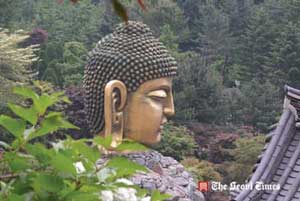
Even though Fa Yu Chan Si is still undergoing beautification, renovation and further development at this moment, once you step inside the temple, you will be able to find countless of stone statues of Buddha. Other than the most notable Big Buddha's Head and half-body Buddha statues, the most eye-catching relics are the Buddhist columns and pagoda. These masterfully crafted carvings have created an atmosphere of a thousand-year-old ancient temple.
Besides, rows of intricately carved Buddha statues have been neatly placed on both sides of the pagoda and Buddhist Columns.
The Cultural Relics Hall, meanwhile, looks like a relic site full of inscribed texts, stone statues of Buddha, etc, the most outstanding being the 500 Luo Han statues in different postures, costumes, and names. There are also relics from the Tang, Yuan and Han dynasties.
In an interview with Guang Ming Daily, the temple's admin secretary Ms Chen Yi Ping said there are currently many different kinds of relics in the temple, and the most notable include the Crystal Sarira Pagoda containing the sarira of Buddha and and other Buddhist masters, relief carved with the Heart Sutra, the dragon statue said to be the incarnation of Bu Dong Ming Wang, the thousand-year stone tortoise, the five hundred Luo Han, the statue of Bodhidharma made of thousand-year old Longan wood, Buddhist pagodas, etc.
She also disclosed that there is a special statue of the God of Mercy in the temple. Unfortunately, due to technical problems, the statue is not ready for public viewing.
Age of statues yet to be verified
Chen said many of the stone carvings in the temple have been inscribed with the years of manufacture, including the stone tortoise, which almost a thousand years old. According to findings, it is within the period of the Tang Dynasty and it contains thousands of years of history. However, she said as these relics have not been verified by specialists, the temple is unable to ascertain the authencity of these historical items.
She said since the historical backgrounds of these stone carvings have yet to be verified, she advised the public to view these carvings as works of art.
Devotee from land-scarce Singapore builds temple across the Causeway
Land is a scarce commodity in Singapore. Other than the existing temples, there isn't much land to build new temples in the city-state. As a result, Buddhist devotees and monks build their temples on the side of the Causeway, or contribute towards the expansion of the existing temples in Johor.
The abbot of the temple Master Shi Zhen Guan told Guan Ming Daily the thousands of Buddha statues and artworks in the temple have been contributed by a Singaporean Buddhist cum collector.
"By chance I came to know this collector. Originally I only intended to purchase the statues of Hua Yian Shan Shen (Three Sages), i.e. Buddha, Manjuri Bodhisattra and Pu Virtuous Bodhisattva for display at the Sakyamuni Valuable Palace for the purpose of veneration. I never expected that after knowing about my concept of developing the temple, he kindly contributed his collection to Fa Yu Chan Si."
"To me, these relics are invaluable, and their market value is not important to me because the owner's offering came when we were going through the toughest time building the temple. Nothing can replace his generosity and I truly appreciate his kind contribution."
Public viewing welcome
Master Shi Zhen Guan said that initially he felt that many devoted Buddhists gave up their faith when they got old. So he had a vision to build a this Buddhist enclave to provide a quiet retreat for these people.
"Although the temple has already been given a large number of cultural reliefs, due to insufficient funds, we have problem fulfilling the concept of a Buddhist enclave. However, it will remain the focus of our development in the future."
The Master said he hoped to develop the temple to something similar to the renowned Kek Lok Si temple in Penang. While encouraging Buddhist devotees to study the Doctrine and retreat, he also hoped to open the temple for public viewing so that more people could appreciate the relics of great artistic values.
Founder of Fa Yu Chan Si, 38-year-old Master Shi Zhen Guan became a monk when he was only 19. A Malaysian, he used to do his religious studies at Guan Yin Shan in Bukit Timah, Singapore. He moved back to Johor after he decided to build a Buddhist enclave.
He said, "We faced a lot of problems initially, such as the sudden suspension of work due to insufficient funds. Nevertheless, the public have given us their generous support and assistance so that the temple could eventually be completed."
As for the origins of the thousands of stone and wooden carvings in the temple, the Master said he could not be sure whether the collection included those which were hundred or thousand years old.
"The Singaporean collector who presented the relics to us did not reveal the origins of these carvings. Therefore I cannot confirm the values of these items"
Contact
Fa Yu Chan Temple
Lot 380, Jalan Sungai Tiram
Batu 133/4 Kampong Sungai Tiram
81800 Ulu Tiram, Johor, Malaysia
Contact: 016-717 9633 (Ms Chen Yi Ping)
Friday, June 05, 2009
Swindlers in saffron robes cashing in on people’s generosity
by TAN KARR WEI, The Star, June 4, 2009
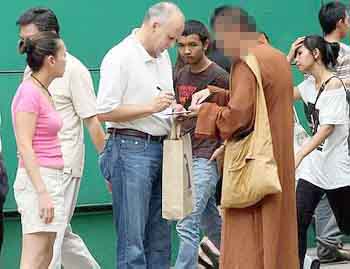
"Bogus monks" becoming a big menace in the streets of Malaysia
Kuala Lumpur, Malaysia -- BOGUS monks are roaming the streets of the Klang Valley, cashing in on the generosity of the people to make money.
These imposters can be seen going from table to table in restaurants in the commercial areas, and even approaching people at the public car parks.
According to Buddhist Chief High Priest of Malaysia, Venerable K. Sri Shammaratana, monks who begged for money are violating the Buddhist code of ethics. The alms bowl is strictly meant for food.
According to the owner of a coffee shop in Damansara Utama, who asked not to be identified, the imposters would make their rounds at the various eating places in the commercial area at various time.
There were also reports of such monks stationing themselves at the morning and night markets.
StarMetro also observed the movements of these spurious monks at the busy Bukit Bintang area on a Saturday afternoon.
A man wearing an ankle-length saffron robe with a cloth bag on one shoulder was seen taking a breather outside the Lot 10 shopping centre when a security guard motioned him to move away.
He then walked across Jalan Bukit Bintang and stopped at the junction just in front of the Pavilion Kuala Lumpur.
The man, in his mid-30s, targeted only foreign tourists and would not even bother to stop locals who walked past him.
He seemed to be holding a small amulet in one hand and trying to sell it to the foreigners.
After about 20 minutes, he then walked back to the area in front of Lot 10 to sit down for a short rest.
Bro. Wei Han: I am not sure if this is the first time this thing is being highlighted in the newspaper but I do believe that I have been telling everyone that I know that it is best not to be fooled by these bogus monks. They are definitely someone who tried to make easy money from the public and we, are the public, should not be encouraging them by giving them donations or buy anything from them in the name of Buddhism.
So, the only thing that I can tell you here is STOP being fooled by these scums!
Thursday, May 07, 2009
A momentous meeting gives reel life to extraordinary monk
by Kumudini Hettiarachchi, Sunday Times (Sri Lanka), May 3, 2009
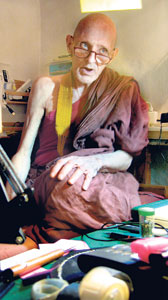
An encounter between an artist and Venerable Bhikkhu Sumedha gives rise to a film ‘The Truth is Unbelievable’
Colombo, Sri Lanka -- Their paths were not meant to cross until 20 days before his passing away, although many were the times she attempted to contact him.
That single defining moment has yielded not only a very moving exhibition but also a meaningful film for posterity. As Sri Lanka celebrates the thrice-blessed day of the birth, attainment of enlightenment and passing away of Lord Buddha, audiences here will be able to witness not only the life and times of a man who cast aside worldly pleasures to follow in the footsteps of the Master but also messages and links between Buddhism and the modern world.
‘The Truth is Unbelievable’ is the result of that one and only “encounter of a different kind” between Venerable Bhikkhu Sumedha and dynamic Argentinian painter Cora de Lang.
Bhikkhu Sumedha passed away when he was 75 years old. His body had been ravaged by cancers that he had overcome but when I met him he was after a bad bout of pneumonia, says Cora who is in Sri Lanka with husband Richard Lang, the Director of the German Cultural Centre. Cora had got to know of Bhikkhu Sumedha through Richard who had to read up about important and interesting people when he took up a new posting.
Soon after, when she was in Kandy on a painting trip she tried to contact him but was not able to meet him, for he was in hospital. However, later she had got an address and a phone number for his humble abode, Manapa Dassana Lena, hidden away from the madding crowds up 108 steps, in Dulwela village close to the Getambe temple from Ven. Metta Vihari whom they were in contact with.
Richard, however, had gone to the cave earlier to invite Bhikkhu Sumedha to a conference and also to exhibit his paintings on the theme ‘Buddhism in Art’ during the 50th anniversary celebrations of the German Cultural Centre.
The monk while explaining that he was just a hermit had declined to attend the conference but agreed to the exhibition as he was “trying to paint the Dhamma”. Painting for Bhikkhu Sumedha was a form of meditation, says Cora. “It was a spiritual exercise. He sacrificed his art to Lord Buddha.”
He indulged in some “incredible works where you could actually go inside the paintings” and did sell some of his works, while also giving away many to friends and relatives, but Cora believes that as an ardent follower of the Buddha he did not handle cash. He had made arrangements for the funds to go to charities and to develop the Intensive Care Unit of the Peradeniya Hospital.
Although he agreed to be part of the exhibition to be held in August 2007, he clarified one small detail. “I will participate but I won’t be there,” he told Richard, who couldn’t believe his ears. Soon after, Cora had an exhibition in 2006 at Barefoot and it was then that Bhikkhu Sumedha, even though he had never met her, laid down a small condition, sending an e-mail to Richard asking whether she would agree to be the curator of his exhibition.
She was surprised -- it was a very Buddhist thing. Could she handle it?
Why did he pick her? She was assailed by doubts.
The exhibition was held in the meditation room of the Sambodhi Viharaya in Colombo 7, but he had passed away by that time, recalls Cora. If certain things were not meant to be they were not meant to be, she says adding that it was as if he was guiding the whole thing. She cites the example of a huge table that couldn’t be taken out of the room. Wracking her brains how to deal with it she had decided to cover it with white cloth, bought metres of it and hired a tailor to stitch it up. The day before the exhibition when they attempted to fit the cloth, it just would not. Desperate she wondered what to do when an idea crossed her mind – why not use his robes and “that was perfect”.
Cora reveals how Bhikkhu Sumedha who was Aja Iskander, a good artist back home, across the seas, in Switzerland came to don the robes of a monk in Sri Lanka forfeiting all worldly comforts and living in a wet and insect-filled cave. Born to a German mother and Egyptian father, Aja had lived a comfortable life with his mother in Switzerland, after his parents separated. “He held a German passport but never lived in Germany,” she says.
Life took its usual course for Aja – he married twice, had children. “He was very fond of his grand-daughter,” says Cora explaining that many were the visits they paid him in the cave.
Suddenly, as young people do, he decided to travel the world and came to Sri Lanka. Getting into the whirl of Colombo’s social circuit, it was at a party that something happened and he decided, “that life was over”. He went to Kataragama, thinking he would become a Swami and lived in a cave there, only to realize that the only path for him was the path of the Buddha.
Bhikkhu Sumedha was in touch with Ven. Nyanaponika – who was the Editor of the Buddhist Publication Society – in Kandy and it was he who invited him to the Manapa Dassana Lena, earlier occupied by a German Bhikkhuni. That was where he lived for 26 long years until his passing away.
The one and only meeting Cora had with Bhikkhu Sumedha is vivid in her mind. She was painting in Galle when Richard called her and said that he had received a message that the monk who was very ill had left hospital saying that he had certain things to do.
Richard felt it was time to see him as Bhikkhu Sumedha had contacted him and said that the time was close. She came back home to Colombo from Galle and early next morning it was that they journeyed along with Ven. Metta Vihari to Dulwela. Having heard before that he was averse to being filmed, she just grabbed a not-so-sophisticated camera, more for taping his voice.
As they climbed the 108 steps, others had beaten them to it. A crowd had gathered, bringing with them small offerings such as king coconuts. Two nurses were also there, one weeping softly.
“He was very kind to simple people and helped the villagers, attending to their wounds,” says Cora.
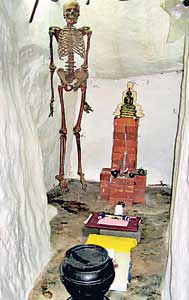
The moment they entered, he started speaking. “He was expecting us,” says Cora, explaining that he was sitting on his bed and in one corner of the cave there was a skeleton moving gingerly. When she gestured carefully that she would like to tape what he was saying he gave a sign that it was okay.
The simple cave seemed like a message……there was a bronze statue with the words scribbled on a piece of paper, “DNR” indicating do not resuscitate. Art installations were scattered everywhere. Even a small toilet constructed by Jagath Wijesiri who was by his side until the very end, had been turned into a work of art.
“He saw in advance his death,” says Cora who felt as if she was part of the process of accepting her own father’s death.
For 12 long hours he spoke, “heavy matter – non-stop”, while they filmed and wondered how this frail monk could hold forth like this. “First part was more for us and the second a kind of message to the world,” she says…..lot of material, speaking in German, English, Sinhala, Pali et al. He spoke of modern things – parallel worlds, the modern world with internet and the teachings of the Buddha. He was full of energy – sometimes provocative, also providing his own answers because he had experienced it all, marriage, kids, love, hate, separation.
As the evening shadows lengthened, they sensed he was tiring out and bade him goodbye, with the hope that they would see him again. But as they went down the steps, his voice rang out and still she hears the echoes in her mind ……..“Remember, remember, everything is anichcha (impermanent)”.
It was his final goodbye.
Cora knows of a wish Bhikkhu Sumedha had. He wished to be known as that “Sri Lankan monk” and not a German monk, truly reflecting his love for this land.
---------------
‘The Truth is Unbelievable’ will be screened on May 11 at 5 p.m. and 7.30 p.m. at the BMICH as part of the Vesak Film Festival. It was shown at the Swansea Bay Film Festival in Wales in 2008 and will go to the International Film Festival in Phuket, Thailand and also to Cairo and South Africa.
Tuesday, May 05, 2009
2,553rd Birthday of Buddha
The Seoul Times, May 4, 2009
Buddhists Join in Temple Services to Celebrate Buddha’s Birthday
Seoul, South Korea -- Millions of Korean Buddhists on May 2, 2009 took time out to celebrate the birth of Buddha some 2,500 years ago in a garden in India.
At Wawoojeongsa Temple, situated 48Km south of Seoul, hundreds of Buddhists observed the Buddha's Birthday with members of foreign diplomats corps accredited to Korea in memory of Buddha achieved enlightenment.
Foreign envoys included Amb. Myo LWIN of the Union of Myanmar and Amb.John Asitha Ivon PERERA of the Democratic Socialist Republic of Sri Lanka and their family members.
Buddha's Birthday should not only be about celebrating with parades and lanterns, but thanking him for believing and spreading his wisdom, a Buddhist follower said.
When Siddartha Gautama Buddha was born in Lumbini Garden, his father was a king and his mother was a queen. His name, Siddartha, was given to him by the king because it meant "every wish fulfilled."
Queen Maya, Buddha's mother, was en route to her parents' home to give birth, as was the custom of that time, and during a stop at Lumbini Garden, the child was born amidst flowering trees, plants and a gentle rain.
Legend tells us that when he was born, he took seven steps, pointed with his right hand to the heaven, pointed to the earth with his left hand, and declared ‘In the heaven above and below them, I shall be the one to save the universe."
Buddha was declaring the worthiness of having received unto himself, the life and blessing of the entire universe and having been born as a human being. He said this voice is not only of Buddha, but of each and every one of us who are born with our one and only human body and mind.
The Buddha's Birthday falls on the eighth day of the fourth lunar month. On this day, Buddhists pay respect to the Buddha at temples, recite Buddhist scriptures and perform a special ablution ceremony on the Buddha's image.
As part of the festivities, brightly decorated lanterns will be hung at Buddhist temples and along the streets in cities and towns across the nation. Downtown, a large pagoda-shaped lantern is currently brightening Seoul Plaza in front of City Hall and nearby, the Cheonggye Stream is awash with color.
For believers, the illumination of the lanterns symbolizes the enlightenment of the Buddha. The light means wisdom and mercy that shakes to their senses those who are lost in a world of greed.
The bathing ceremony is a reflection of the legend that says when the Buddha was born, he was washed by fragrant rain that sprang forth from the mouth of a dragon. This is the reason why his birthday is also known as the Buddha's Ablution Festival .
The water used for performing the bathing ceremony is scented with perfume and is called Fragrant Water. The ceremony is usually performed within a temple or on hallowed ground in the open.
The abbot of the temple makes the first incense offering and chants a sutra. Then the rest of the monks offer their incense and sing the Ablution Hymn.
The monks then pour small ladleful of Fragrant Water on the Buddha's image. Afterward, the Buddha's image is rinsed with clean water.
The whole process is accompanied by the singing of the Ablution Hymn. At the end of the ceremony, participants and devotees will use some of the water that has been used to bathe the Buddha's image to sprinkle on their own heads.
The ceremony is performed to commemorate the Buddha's Birthday, show him respect, and to pray for a good life. In Korea the birthday of Buddha is celebrated according to the Lunisolar calendar.
This day is called Seokga tansinil, meaning "the day of Buddha's birthday" or Bucheonim osin nal meaning "the day when Buddha arrived." Lotus lanterns cover the entire temple throughout the month which is often flooded down the street. On the day of Buddha's birth, many temples provide free meals and tea to all visitors. The breakfast and lunch provided are often sanchae bibimbap.
Three Malaysians to get gift of sight
by Tan Yi Liang, The Sun, May 4, 2009
KUALA LUMPUR, Malaysia -- Three Malaysians will receive the gift of sight – thanks to corneas donated by the Sri Lankan government.
The corneas, which will benefit a Malay, Chinese and Indian, are part of the Buddhist Maha Vihara’s annual Caring and Sharing programme to commemorate Wesak Day.
About 1,000 underprivileged individuals were invited to the Buddhist Maha Vihara in Brickfields yesterday to take part in the celebration, which included food, gifts and entertainment.
Said the Buddhist Chief High Priest of Malaysia, K. Sri Dhammaratana: "This event will help foster unity among the races. It extends beyond race and religion."
Transport Minister Datuk Seri Ong Tee Keat, who was the guest of honour, received the corneas from Sri Lankan High Commissioner Dr D. Ranasinghe.
He thanked the Sri Lankan government for the donation.
Of yesterday’s celebration, he said: "It is truly an honour to witness a gathering of different cultures, religions and ethnicity in one place rejoicing in the act of giving, caring and sharing."
Ong also called for the concept of giving and sharing to be revived.
"In today’s hectic and changing world, the simple thought of stopping and observing our surroundings and extending a helping hand is long forgotten. We need to revive the thought of giving and sharing in each and every one of us," he said.
The cornea transplants will be carried out at Tun Hussein Onn Eye Hospital.
Tuesday, April 28, 2009
Swine Flu FAQ
Information taken from The Star Online
What is swine influenza?
It is a respiratory disease of pigs caused by type A strains of the influenza virus. It regularly causes high flu outbreaks in pigs but with low death rates. There are four main sub-types of the virus, but the most recent isolated influenza viruses from pigs have been H1N1 viruses.
How does it spread?
Swine flu viruses do not typically infect humans though they do occur through close proximity or contact with infected pigs or contaminated areas. Cases of human-to-human spread have been documented.
What are the symptoms?
The symptoms are similar to those of regular flu:
- Fever
- Lethargy
- Runny nose
- Cough
- Sore throat
- Lack of appetite
- Vomiting and diarrhoea in some cases.
How common is swine flu infection in humans?
In the past reports of about one human swine flu virus infection had been received every one to two years in the United States. From December 2005 till February 2009, 12 cases have been reported.
Has this strain of flu been seen before?
No. Flu mutates constantly, so it is common for new strains to emerge. Pigs can also be infected with both human and avian influenza, and the current circulating swine flu strain appears to contain genetic elements from all three.
Can swine flu be treated with antiviral drugs and flu vaccine?
The swine flu is resistant to two common drugs – Amantadine and Rimantadine. The H1N1 swine flu viruses are very different from human H1N1 viruses. Therefore, vaccines for human seasonal flu would not provide protection. However, a “seed vaccine” has been specifically tailored to this swine flu and will be manufactured if officials deem it necessary.
Can people catch swine flu by eating pork?
No. Swine influenza viruses are not transmitted by food. Eating properly handled and cooked pork and pork products is safe. Cooking pork to an internal temperature of 70ºC and above kills the swine flu virus.
How long is someone with swine flu considered contagious?
People with swine influenza virus infection should be considered potentially contagious as long as they are symptomatic; possibly for up to seven days following the onset of the illness. Children, especially younger children, might potentially be contagious for longer periods.
What can I do to protect myself from the swine flu?
There is no vaccine available right now to protect against the swine flu.
However, you can help prevent the spread of germs that cause respiratory illnesses like influenza by:
- Covering your nose and mouth with a disposable tissue or handkerchief when you cough or sneeze. Throw the tissue in the waste basket after you use it.
- Wash your hands often with soap and water, especially after you cough or sneeze. Alcohol-based hand cleaners are also helpful
- Try to avoid close contact with sick people. - If you get sick with influenza, stay at home and limit contact with others to keep from infecting them.
- Avoid touching your eyes, nose or mouth.
- Consult your nearest healthcare facility if you think you have any of the symptoms.
Which countries have had cases of the swine flu?
The World Health Organisation (WHO) has confirmed human cases of swine flu in Mexico, the United States, Canada and Spain. Only Mexico has reported deaths from the new strain.
Are there any travel restrictions or advisories for Malaysians?
The Health Ministry on April 27 advised Malaysians against travelling to certain places in the United States, Mexico and Canada which have been affected by the swine flu.
What precautions are in place in Malaysia?
- The Health Ministry’s operations room in Putrajaya has started a 24-hour monitoring of the situation. The public can call 03-8881 0200/300 for enquiries.
- Those returning from Latin American countries and found to have flu-like symptoms will be quarantined.
- Health Ministry officials are conducting health screenings on passengers arriving from the United States.
- Thermal scanners will be placed at international airports to speed up the screening process for swine flu.
- Public and private medical practitioners have been instructed to report to the district health office any patient with influenza-like illnesses or severe pneumonia symptoms and who had travelled to the affected countries after April 17.
- Owners of the 797 pig farms nationwide have been ordered to immediately contact the nearest Veterinary Services Department office or the Animal Disease Control Centre if their workers or animals show symptoms linked to the swine flu.
Where can I get more information?
For more information, go to the Health Ministry (www.moh.gov.my) or call the Ministry's hotline at (03) 8881-0200/300.
Useful Links:
World Health Organization: www.who.int
Centers for Disease Control and Prevention: www.cdc.gov
Homeland Security Department: www.dhs.gov
WHO swine flu page: http://www.who.int/csr/disease/swineflu/en/index.html
Thursday, April 02, 2009
Dalai Lama completes 50 yrs in exile in India
by Anand Sankar, Business Standard, April 1, 2009
New Delhi, India -- Tibetan spiritual leader in exile, the 14th Dalai Lama, Tenzin Gyatso, today called upon the Chinese government to throw open Tibet to “independent, impartial observers” immediately.
The 74-year-old Buddhist monk was speaking to journalists in New Delhi on the eve of the 50th year of his exile in India.
On March 31, 1959, he evaded Chinese troops and entered India through the region of Tawang in Arunachal Pradesh. The Dalai Lama said he wanted to use the occasion to “tell India how much it has done for the Tibetan refugee community and himself.” “We are burdened to thank India,” he said. The Indian government considers Tibet to be a part of the PRC.
Through the day he visited five places of religious importance in New Delhi to pray for “peace in India and happiness for its people.” The journey started at the Gandhi Smriti, the spot where Mahatma Gandhi was assassinated and halted at the Acharya Sushil Muni Ashram, Nizamuddin Chilan, Judah Hyam Synagogue, Gurudwara Rakab Ganj, The Cathedral Church of Redemption, Mahabodhi Society and the Laxmi Narayan Temple. At all the spots, he prayed according to the traditions prevalent there and explained later that during his 50-year stay in India he had gained “new knowledge from following traditions other than Buddhism.”
Recalling that he started taking his titular responsibility aged 16, he said he felt he has been correct on the major decisions and “many Tibetans agree also.” He said education is the key for the Tibetans to continue to fight for their rights.
The Dalai Lama said his fascination in the future was to learn more from science and science in turn to learn from Buddhism. “Meeting scientists makes me immensely happy,” he said.
Finally, the Dalai Lama was asked to comment on the upcoming general elections, especially the perceived “communalisation” of politics. He cheekily responded: “As far as Indian politics is concerned, I am happy to see it from a distance. A BJP leader came to seek my blessings during the last elections, as well as his opponents. I bless them all. I should be neutral.”
Wednesday, March 18, 2009
Buddhists Connect Online Through Video Sharing and New Community at eDharma.com
The Buddhist Channel, Matrch 16, 2009
Jakarta, Indonesia -- www.eDharma.com launches this week, connecting Buddhists worldwide through a free social networking and video sharing service.
The community opens with a collection of educational videos on Mahayana, Theravada, and other Buddhist sects, as well as a forum where Buddhists and those interested in learning about Buddhism can meet and discuss the Buddhist way of life.
“eDharma.com is about two things,” says Rudy Hadisentosa, owner of the new online Buddhist community. “The site serves as a social network and online community where Buddhists from all over the world can come together and share thoughts and ideas. In addition to connecting people, eDharma.com is designed to teach others about Buddhism in a more interesting and interactive way. We’re working to accomplish this through the video sharing aspect of the site. For example, through current videos, visitors can learn about things like moral or Zen Buddhist teachings or watch English webcasts of the True Buddha School"
Creating an account at www.eDharma.com takes only a few minutes. After registering for an account, members have the ability to upload Buddhist videos, photos, or news to share with the eDharma.com community.
Videos can be shared by uploading them directly to eDharma.com. The site also supports embedded videos from other video sharing services such as YouTube and Google Video. The Buddhist forum gives all new members a place to introduce themselves and share ideas with the entire community. Membership at eDharma.com is free.
About www.eDharma.com
eDharma.com is a free online Buddhist community, connecting members of various sects of Buddhism with each other and with non-Buddhists. Launched in March 2009, the mission of eDharma.com is to educate people about Buddhism while giving active Buddhists a place to meet and interact.
For more information about the www.eDharma.com community or Buddhist video sharing service, please contact Rudy Hadisentosa at +62 21 56999720.
Tuesday, February 24, 2009
A Happy Monk
By MAJORIE CHIEW, The Star, February 23, 2009
A Sri Lankan Buddhist monk is tickled as he recalls his early days in the United States
Kuala Lumpur, Malaysia -- BHANTE Walpola Piyananda, a Buddhist monk from Sri Lanka, arrived in the West Coast of America on July 4, 1976. He was 33 then. During his early days in the United States, people had never heard of a Buddhist monk. He was ridiculed, humiliated and ignored; at times, he was a victim of mistaken identity.
“I wanted to go to America for new experiences and to explore a way of life that’s different from conservative Asia,” said Piyananda, 66, during a short stopover in Malaysia en route to Sri Lanka. Opportunity came knocking when he was offered a scholarship to study Christianity at Northwestern University in Chicago.
“It’s rare for a Buddhist monk to study Christianity. My (late) uncle Dr Walpola Rahula, a Buddhist scholar, suggested that I study Christianity to find out the differences and similarities,” said Piyananda.
Today Piyananda is the author of two books, Saffron Days in LA (Shambala, 2001) and The Bodhi Tree Grows in LA (Shambala, 2008) which feature funny and poignant tales of his life as a Buddhist monk in the United States. His third book is in the works.
Piyananda is the founder-president and abbot of Dharma Vijaya Buddhist Vihara in Los Angeles, California. It is one of the oldest Theravada Buddhist temples in North America. He is also president of the Sangha Council of Southern California, Chief High Priest in the United States, and advisor to the President of Sri Lanka on international religious affairs.
Ordained at the age of 12, he took the name of his village, Walpola, and the Buddhist name, Piyananda, which means “pleasant joy”.
It was written in the stars that Piyananda was destined to be a monk. When his parents brought him to register his birth at the temple, the high priest worked out his astrological chart. “It showed Saturn in Ninth House which meant that I was destined to be a famous Buddhist monk. So the priest convinced my parents that I had to be a monk,” said Piyananda.
Piyananda has a BA (Hons) in Buddhist studies from Kaleniya University, Sri Lanka, and a Masters in Pali from Calcutta University. India.
After his post-graduate studies in India, he returned to Sri Lanka to serve as a monk but felt the urge to go to the United States which he saw as a “great land of freedom, equality and opportunity”.
Eventually, he realised his dream to go to the United States to further his studies and graduated from Northwestern University in Chicago in 1980, and the University of California, Los Angeles, in 1985.
Harrowing tales
Piyananda recalled his early days in the United States which were fraught with challenges. There was the shocking incident at a bus stop in which a gentleman in a Mercedes Benz pulled up next to a curb, ran up to him and spat in his face. He was told to “go away cos he did not belong in the country”.
The following year, in1977, five youths mistook him for a Hare Krishna devotee and accused him of being involved in the kidnapping of a girl. Piyananda showed them his Northwestern ID card, explained his monk’s robe and convinced the group that he was not a Hare Krishna devotee as he did not have a ponytail but a clean-shaven head.
Perhaps the most amusing tale was when someone thought he was suicidal. A year after his arrival in Los Angeles, a Thai family had invited him to their apartment for dana (requisite offering). While waiting in the lobby for the driver to park the car, he decided to adjust his robe and wear it differently. Within minutes, the siren blared. He found policemen and paramedics rushing towards him.
Apparently a woman had called the emergency line and reported that “an Indian guru was trying to suffocate himself with his long robe!”
En route from Los Angeles to Berkeley, Piyananda was stopped from entering the men’s toilet in a rest area. Wearing a knit cap and in traditional monk’s robe, he was mistaken for an Indian woman in a saree!
In another incident, while waiting to catch a flight to Minneapolis, Piyananda went up to a police officer and asked for directions to the departure gate after other people ignored him. He was threatened with arrest and had to produce his boarding pass.
There was another harrowing incident he encountered while strolling along a pier in Santa Monica. Piyananda encountered a group of punks who taunted him for being “an alien” and “a shaved pumpkin”.
Piyananda teased them and joked that he was the “new punk” with a clean-shaven head, while they only shaved the sides of their heads.
Extending his hand in friendship, he told them that his name Bhante meant “spiritual friend”, piya for “pleasant” and ananda for “happy one”. Soon they were happily chatting away and he invited them to his temple. They have since become his students and one, a Buddhist minister.
Piyananda also had brushes with women that probably left him red-faced. In August 1979, an American woman in her 30s sought his advice at the Buddhist Meditation Centre in Los Angeles, his home base then. She was misguided by her guru’s advice to have sex more often to lose weight. She put up two posters in the centre, offering sexual favours; this angered the abbot who chased her out. Piyananda listened to her story, helped her understand her foolishness and persuaded the abbot to allow her to stay on.
While attending Vesak celebrations in Berkeley, a desperate woman outside the women’s toilet asked him to go into the cubicle to help her remove her pants!
Piyananda later saw her predicament: both her arms were in plaster cast and she was unable to remove her pants to use the bathroom. He ran up the stairs to get a woman to help her out.
On another occasion, a woman at a meditation centre where he taught gave him a generous donation of US$300. He thanked her and asked what she did for a living. She told him she was a hooker. Not understanding what “hooker” meant, he praised her for a “wonderful career” and added that she “must be very happy”.
When he realised his blunder, he went in search of the woman and convinced her to turn over a new leaf. Eventually she became a case worker for the protection of abused children.
Tuesday, December 30, 2008
Kung fu kids – out of Africa
By WANI MUTHIAH, The Star, December 28, 2008
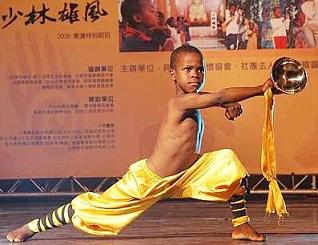
KLANG, Malaysia -- Enock Belo is every inch a Shaolin kung fu exponent. He throws flying kicks, jumps over obstacles and delivers his strikes smoothly. Belo is 10 years old. And he’s African.
The Malawian orphan, who is a resident of the Amitofo Care Centre (ACC) in Blantyre, southern Malawi, is one of the 200 children in the orphanage being trained in the ancient Chinese martial art.
ACC founder, Taiwanese Buddhist monk Hui Li, said Belo and the other children are being trained in the martial art form by three monks who are Shaolin kung fu masters brought in from China.
“The children are trained for three hours a day, six days a week by the Shaolin masters,” said Hui, who is currently here with 20 children from ACC.
The trip was made possible with sponsorship by several local Buddhist organisations, including the Ti-Ratana Welfare Society.
The monk and the children are putting up several shows around the country to raise funds.
Hui, who is known as the African monk within Buddhist circles, said he introduced the martial art form to the children to build their self-esteem.
“Most of the children here are either orphans or have only one parent and they come from very poor backgrounds.
“When they came to ACC, they were all very timid with very little confidence in themselves, and training them in Shaolin kung fu helps us counter this problem,” said Hui.
When asked why he liked Shaolin kung fu, Belo, who is the star of the troupe, said it helps him keep fit.
“Shaolin kung fu makes me strong and keeps me disciplined,” said the orphan, who has been living in ACC since it started operations in 2003.
Ti-Ratana Welfare Society founder and adviser Ven Rev K. Sri Dhammaratana said the group will be performing at the Buddhist Maha Vihara in Brickfields on New Year’s Eve.
“The event starts at 8pm and there will be dinner followed by the group’s performance, and a blessing ceremony starts at 11pm,” said Ven Rev Sri Dhammaratana, who is also the Buddhist Chief High Priest of Malaysia.
Monday, December 15, 2008
Upcoming Activities
Christmas Eve's Party
Date: 24th December 2008
Venue: Jessy's Place
Time: About 7.00 pm - 12.00 pm (maybe longer)
Remarks:
Bring something worth at least RM5 as part of a gift exchange.
We are not Christians but that wont stop us from celebrating Christmas.
Ho... Ho... Ho...
Skytrex Adventures
Date: tbc (in January 2009, around 17th)
Venue: Skytrex Adventures in Taman Pertanian Bukit Cahaya Seri Alam, Shah Alam
Time: Morning (time tbc)
Remarks:
Fee per person: RM35 (if less than 10 person going), RM31.50 (if we have more than 10 people)
Duration: 1.5 - 2 hours...
What you will do: Climb trees, going through obstacles in between trees, flying fox...
Wear sport shoes and bring hand-gloves [available for rent at RM1 per pair (limited)]
Please let me know (post a comment or e-mail me at kcbadyc@gmail.com or eztoyou@yahoo.com with your details: name, mobile no.) if you are interested...
2009 Chinese New Year House Visiting
Details to be announce here soon... interested to get updates, please provide me (e-mail me at kcbadyc@gmail.com or eztoyou@yahoo.com) your contact: name and mobile no.
Tuesday, November 04, 2008
Visionary leadership
The Buddhist Channel, November 2, 2008
The core challenge of leadership is for all of us to have visions and to come up with the tools and systems to get there
Petaling Jaya, Malaysia -- Datuk Dr. Victor Wee is a keynote speaker for the forthcoming WACANA conference, to be held on December 7 in Petaling Jaya, Malaysia. In the following interview, Datuk Dr Wee gave his views on Buddhist leadership outlook in the country, core challenges faced by Buddhist leaders, three main pillars of leadership
Buddhist leaders now are more mature compared with leaders of the past generation. They have become more exposed and skillful, and generally run organizations in a very competent way. But we are also saying that it is important for leaders to come together in order for us to focus our energies, so that we are able to do something really wonderful for the country. The Buddhist community for the future begins right now. Buddhist leaders must adopt good methodologies and mechanisms to produce competent future Dhamma workers. We must not think about ourselves for the present only; we should try to build the Buddhist community for the future.
What would be the core challenges for Buddhist leaders in Malaysia?
The core challenge of leadership is for all of us to have visions. We need to be able to know what we want in the next 5, 10 or 20 years' time. We need to think for ourselves about the ideal state for Buddhism in the future. The next thing we really require is to come up with the tools and systems to get there.
Can you briefly explain the three main pillars of leadership, i.e. vision, values, and vitality?
Firstly, I think this topic is very appropriate for our situation right now. The first principle is having vision. When you have vision, you can see very far ahead. We need our leaders to have that kind of vision to see the way forward for our community.
Values are important because without them, your integrity may be questioned; then the whole basis of Buddhist leadership is in question. Values are to ensure that as we move towards our vision, things do not go astray, that we are actually going the way we envisaged.
Vitality is the ability to generate that kind of creative energy to make things move. It is the force that provides the action for us to move from where we are right now into the shared vision. If you have a vision, it is not good enough if you do not have the vitality or you do not have the right values.
So, I believe it is very ideal that for this WACANA, we are getting speakers from neighbouring countries - from Thailand, Indonesia and Singapore - to come and share with us some of the situations which are occurring within our region that we may not know of.
And of course it is a great opportunity for our local Buddhist leaders, as well as those who are interested in the subject of leadership development, to attend WACANA 2008. We must begin to think of ourselves as a community. We should identify some things on which we can actually work together, so that it is not with just one pair of hands, but many pairs of hands working collectively towards a common goal.
As Co-organiser of WACANA 2008, what do you hope to achieve from the conference?
Well, I would like this conference to not only come up with a nice publication, and to hear people saying, "Oh, this has been a fantastic conference!" Actually this conference should have some kind of an impact. Five years from now when we look back, we say, "things have actually changed for the better because we had a WACANA."
Maybe 10 years from now, we can say WACANA itself has stimulated many other things which grew from this original idea. Perhaps a generation later, the Buddhist community will be different from what it is now, and we can say that we have reached a higher level because people with ideas have put together a mechanism and agreed to work together in order to produce this new situation.
Of course, if it happens, that would be ideal and something truly wonderful. If not, people will at least go back satisfied and say, "Wow! There were some very good ideas that we've picked up at WACANA!"
On the web: www.nalanda.org.my/wacana.
-------------
Friday, October 17, 2008
Limited "Seats" Available
For one, we would be limiting the number of participants for the KCBA English Dhamma Youth Camp to 80 person only. Furthermore, this would be done on a first come first serve basis as our all year round's preparation is done with this in mind.
So, if you are interested in joining our youth camp, please register early to avoid disappointment.
For your information, we have already received 12 participants, which means, there are only 68 "seats" left up for grab...
Thursday, September 25, 2008
In Need of Sponsorship...
Still, the organizing committees would be in need of help, one way or another... If you are interested, you can actually help by sponsoring the items below:
- Honey - 4 bottles (big)
- Fruits - depends on what fruits
- Condensed Milk - 6 cans
- Biscuits - 8 tins
- Milo - 8 packets (2kg per packet)
- Instant Cup Noodles - 3 boxes (6/8 cups per box)
If you are interested in sponsoring these items, please contact Bro. Wei Han at eztoyou@yahoo.com or 016-3631254.
Sadhu.
with metta,
Bro. Wei Han
Friday, July 25, 2008
Residents accept Buddhist project
However, the ceremony was marred by demonstration of a small group of residents from the neighbouring vicinity. The Desa Alam Residents Association objected to the upcoming construction of the temple as they claimed that it was located too close to the residential area.
Its chairman, Ahmad Shakri Tarmuchi, handed a memorandum from the residents to Housing and Local Government Minister Datuk Seri Ong Ka Chuan at the ground-breaking ceremony of Bodhi Park on the same day.
Ahmad Shakri told reporters the residents were not informed of the project by the City Council and there was no notice board at the site announcing the project from the time they had occupied the housing estate in December 2006.
However, when the protesting residents met the Member of Parliament (MP) for Shah Alam Khalid Abdul Samad at the Shah Alam Mayor's office on July 23, they were informed that the land for Bodhi Park was allocated years before any houses were built at the site and approvals were given by the local and state authorities.
Above all, all the houses buyers at at the point of purchase had been duly informed by the developer and was aware of the proposed site for the Bodhi Park.
After the briefing. the representative of the protesters from Residents Association, Ahmad Shakri and other residents who met Khalid Abdul Samad accepted the explanation by the MP and other officers from the Shah Alam City Council (MBSA).
Present during the meeting were representatives from the developer and also MBSA councillors responsible for the areas. The project will proceed as planned and construction expected to begin in September.
About the Bodhi Park project
The Bodhi Park is to be located on a 0.68-hectare site, and will comprise an auditorium, a centre for Buddhist research and studies, a multipurpose hall, and a main shrine for devotees. The project is undertaken by the Malaysian Buddhist Youth Foundation.
In the early 1990's, the foundation bought a 0.6-hectare piece of land in Section 24 for the project but the state government found it unsuitable for religious use and offered the alternative site in November 2002, he added. Goh said the development order for the project was approved on April 24 this year and construction was scheduled to commence in September.
Wednesday, June 25, 2008
When earthquake survivors got a taste of the Buddha's ways
by Saibal Dasgupta,TNN, Jun 20, 2008
BEIJING, China -- Wang Youqun, a devout 60-year old woman, had a glimpse of the Buddha's ways when she emerged out after spending 196 helpless hours in a confinement of rubble caused by the earthquake in China's southwest province of Sichuan.
She was praying to Buddha when a falling beam hit her leaving her unconscious. The first to discover her was a barking puppy which woke Wang out of unconsciousness by licking her face.
The puppy's barking drew the attention of the personnel of Chengdu Air Force who were looking for people trapped in debris caused by the May 12 earthquake.
The tragedy has proved to be the mother of miracles. Wang's case is one of the dozens of miracle stories emerging in Sichuan as survivors struggle to shake off the trauma of the earthquake. They also include stories of those who gave their lives to save others.
Rains hampered rescue work making it difficult to save lives in some of the affected areas. But it also helped Wang and hundreds of others to escape dehydration during their hours struck in broken parts of buildings.
When tragedy came, the only food available to another woman, Cui Changhui was a piece of Pear. She struck it out an unbelievable 216 hours eating earthworm, weed and drinking her own urine. She lived those nine days in the crushed building of her workplace, which had been deserted by other workers when the quake struck.
Chi was spotted by an overflying helicopter before relief worker identified the exact location of her debris-prison and saved her.
Coma overcame Lai Pingyuan, a miner, after being dashed around by the tremors. It took 1,200-ml of blood infusion to save the miner, who had spent eight long days in coma and with injuries.
An operation was also carried out to remove blood clotting in his head. When Lai came back, it took him quite some time to reorient himself to the fact that he was alive and begin to speak.
Roof collapsed over the heads of Tang Xiong, a medical doctor, and his wife in their own home. They were trapped in separate parts of the living room with rubble in between. His wife's constant encouragement kept up the spirits for Tang, local reports say.
It took the rescuers many hours to pull out Tang even after his wife had been rescued because relief workers did not have sufficient equipment to reach him within the depth of the debris.
A miracle of different sorts surfaced in the form of a school principal, Ye Zhiping, who has been credited with saving 10,000 students. Ye has been persuading the local government to reconstruct the dilapidated building in which the school was housed.
The reconstruction did take place. Ye had also been training his students to handle emergencies. These twin efforts by Ye is seen as important reasons why as many as 10,000 students of his school went unhurt when quake struck.
Thursday, May 22, 2008
Touching stories emerge of brave children
The Star, Thursday May 22, 2008
CHENGDU: Some of the most touching stories which have emerged from the Sichuan earthquake are from children who have acted bravely in times of adversity.
One was that of nine-year-old Lin Hou who saved two of his classmates by carrying them out of their classroom when the earthquake struck last Monday.
“I was not hurt then but only got myself hurt when I carried them piggyback,” he said.
The three then trekked on mountain roads to get out of the ruined area, he added.
What was more amazing was that Hou has yet to find his parents and does not even know whether they are still alive.
Another was that of a little boy who told rescuers to go ahead to save others first because he was “not scared.”
And there was a girl who was trapped in the rubble who shouted at rescuers: “Danger! Go out quickly!”
Despite all these bravery, experts believe that the children have been traumatised by the entire disaster.
Psychologists and therapists have been sent to the worst affected areas to take care of survivors.
Wednesday, May 21, 2008
Tales of unsung heroes in China quake aftermath
The Star, 21 May 2008
CHENGDU: Although she lost 10 family members, including her mother and two-year-old daughter, in the May 12 Wenchuan earthquake, a Pengzhou police officer has remained on duty as part of rescue operations in the affected areas.
“It’s unbearable to see the survivors suffering and I want to help them,” said Jiang Min, 28.
The sight of injured children is unbearable to her, but she has had little time to grieve, instead making every effort to help in rescue operations and earning the respect of many.
The state television station also broadcast news of a soldier who had to leave his pregnant wife in a roadside shelter without food to report for duty in rescue operations.
Later, he left a message in an earthquake relief and assistance forum for help to find his spouse, and members of the public and the media responded.
“The soldiers and other relief workers have helped us tremendously.
“We want to do our part to help them in return as they can’t take care of their own families for the time being,” said a member of the public.
It was reported that about 200 rescuers were buried in rubble when aftershocks struck again. One of them survived 178 hours in the rubble before being rescued.
Earlier, the Sichuan Provincial Government’s website ran a statement by the Sichuan Seismological Bureau informing residents to prepare for possible aftershocks.
Our hotel distributed leaflets late at night informing guests of the announcement and asked us to take precautions. A car park at ground level is serving as a temporary rest area for hotel guests.
The whole city looks like a campsite, with tents and makeshift shelters at every corner.
Since the main earthquake, there have been more than 7,000 tremors, big and small.
Experts have stressed that buildings here are earthquake-safe and people should remain calm.
The weather forecast was for heavy rain and thunderstorm in the quake zone last night, and there were Internet postings of another sighting of thousands of toads and frogs on Monday.
Some claimed this may not be a sign of another earthquake, while others argued that the sighting of thousands of toads in Mianyang on the eve of the Wenchuan earthquake was a warning.
Many residents here were as gloomy as the grey skies of Chengdu on Tuesday.