


Vesak is also known as the Thrice-Blessed Day because it commemorates the birth, enlightenment, and passing away of the Buddha. It is observed by Buddhists all over the world on the full moon day in the month of Visakha, from which it derives its name and which usually corresponds to May. Variations of the name are Wesak, Vaisakha, and Vesakha. Vesak (or Vesakha) is the Pali form and Vaisakha is the Sanskrit form of the name of a month in the Indian lunar calendar.
Buddhists who follow the Mahayana tradition observe the birth, enlightenment and passing away of Gautama Buddha on separate days. For example in China, Taiwan and some South-East Asian countries like Malaysia, the birth is celebrated on the 8th day of the 4th Moon, the enlightenment on the 8th day of the 12th Moon and the passing away on the 15th day of the 2nd Moon according to the Chinese lunar calendar. In Japan, Buddha Day (the birth) is observed on 8th April, the enlightenment is marked at Jodo-e in December and the passing away at Nehan-e in February.
The Birth
The following is reproduced from The Life of the Buddha by Venerable Dr. H. Saddhatissa (Unwin Mandala 1988)
In the year 560 BC there was great excitement in the land of the Sakyans because Queen Mahamaya was to bear a child. According to the custom of the time a woman expecting a baby would return to her parents' home for the birth, and in due course it was arranged for Queen Mahamaya to make the journey to the neighbouring kingdom of her father. The King sent soldiers ahead to prepare the way and the Queen set out, carried in a decorated palanquin and attended by a large company of guards and retainers.
On the way to Koliya the party passed by a garden called Lumbini Park where, attracted by the trees and flowers, the Queen ordered a halt. It was intended to be only a rest, but while the Queen was lying in the leafy and fragrant shade of a Sala tree in full blossom she went into labour and gave birth to a son.
There was no longer any reason to continue the journey to Koliya and the party returned to Kapilavastu, where the new prince was greeted with great rejoicing. He was named Siddhartha (which means `wish fulfilled') by a proud and doting father.
Note: there are many legendary and symbolic elements in the accounts of the birth of Siddharta Gautama, who was to become the Buddha. Two of these are quoted here from Edward Conze's translation of the Buddhacarita by the first century Indian poet Ashvagosha
* He came out of his mother's side, without causing her pain or injury. His birth was as miraculous as that of Aurva, Prithu, Mandhatri, and Kakshivat, heroes of old who were born respectively from the thigh, from the hand, the head or the armpit. So he issued from the womb as befits a Buddha.
* When born, he was so lustrous and steadfast that it appeared as if the young sun had come down to earth. And yet, when people gazed at his dazzling brilliance he held their eyes like the moon. His limbs shone with the radiant hue of precious gold, and lit up the space all around. Instantly he walked seven steps, firmly and with long strides. In that he was like the constellation of the Seven Seers. With the bearing of a lion he surveyed the four quarters and spoke these words full of meaning for the future:`For enlightenment I was born, for the good of all that lives. This is the last time that I have been born into this world of becoming.'
The Enlightenment
To quote again from Ven. Saddhatissa
The time had indeed come for Gautama to achieve what he had been seeking for so many years, and the events of that day as described in the texts, are imbued not only with symbolic meaning but with peculiar calm and dignity. Taking the offering (ed: a very special bowl of milk rice prepared by Sujata), he went to a nearby river called Neranjara, and putting the bowl on the bank he entered the water to bathe himself. He then returned to the bank, sat down with the bowl in his lap and began his last meal as an aspirant to Buddhahood. The meal over, he washed his hands and the bowl and placed the bowl on the water to float. Then he said:`If today I am to attain full enlightenment, may this golden bowl swim upstream.' The bowl immediately did so. Gautama spent the rest of the day relaxing in the woodland along the river bank.
In the evening Gautama got up and made his way to the Bodhi tree -the `Ficus Religiosa', another tree sacred in India and known as the `Tree of Enlightenment' -which he had chosen as the place for his great act of meditation. On the way he met a grass cutter called Sotthiya who gave him some bundles of `kusa grass'. This grass was regarded as sacred and was used by Brahmins for sitting on. Gautama spread this grass at the foot of the Bodhi tree, turned to face the East and sat down in a meditating posture. Thus began the great trance from which he was to emerge on the full moon day of the month of Vesak as a Fully Enlightened One, a Buddha.
The course of Gautama's meditation is elaborately recounted in the ancient texts. At an early stage he was confronted with worldly temptations in the form of demons -an episode markedly similar to the temptations of Jesus in the wilderness. He then moved through various stages of spiritual ecstasy, called to mind all his previous forms of existence, and pondered how things come into being and disappear. With his mind purified, he then considered the nature of defilement, how it is caused and how it can be destroyed. In doing so he shed from his mind the various forms of defilement -the defilement of sensual desire, of the wish for continued existence, of delusion - and finally achieved the deliverance that he had sought for so long. `Now the cycle of rebirth is ended for me,' he said afterwards, when talking about his experience. `For me this world no longer matters.'
Note: this took place at what is now called Bodhgaya. There are also legendary and symbolic elements in the accounts of the Buddha's enlightenment. We quote again from Edward Conze's translation of the Buddhacarita in his book Buddhist Scriptures.
* Because the great Sage, the scion of a line of royal seers, had made his vow to win emancipation, and had seated himself in the effort to carry it out, the whole world rejoiced - but Mara, the inveterate foe of the true Dharma, shook with fright. People address him gladly as the God of Love, the one who shoots with flower-arrows, and yet they dread this Mara as the one who rules events connected with a life of passion, as one who hates the very thought of freedom. He had with him his three sons - Flurry, Gaiety, and Sullen Pride - and his three daughters - Discontent, Delight, and Thirst.
But Mara could achieve nothing against the Bodhisattva, and he and his army were defeated, and fled in all directions - their elation gone, their toil rendered fruitless, their rocks, logs, and trees scattered everywhere. They behaved like a hostile army whose commander had been slain in battle. So Mara, defeated, ran away together with his followers. The great seer, free from the dust of passion, victorious over darkness' gloom, had vanquished him. And the moon, like a maiden's gentle smile, lit up the heavens, while a rain of sweet-scented flowers, filled with moisture, fell down on the earth from above.
*When, through his Buddhahood, he had cognized this fact, the earth swayed like a woman drunken with wine, the sky shone bright with the Siddhas who appeared in crowds in all the directions, and the mighty drums of thunder resounded through the air. Pleasant breezes blew softly, rain fell from a cloudless sky, flowers and fruits dropped from the trees out of season - in an effort, as it were, to show reverence for him. Mandarava flowers and lotus blossoms, and also water lilies made of gold and beryl, fell from the sky on to the ground near the Shakya sage, so that it looked like a place in the world of the gods. At that moment no one anywhere was angry, ill, or sad; no one did evil, none was proud; the world became quite quiet, as though it had reached full perfection. Joy spread through the ranks of those gods who longed for salvation; joy also spread among those who lived in the regions below. Everywhere the virtuous were strengthened, the influence of Dharma increased, and the world rose from the dirt of the passions and the darkness of ignorance. Filled with joy and wonder at the Sage's work the seers of the solar race who had been protectors of men, who had been royal seers, who had been great seers, stood in their mansions in the heavens and showed him their reverence. The great seers among the hosts of invisible beings could be heard widely proclaiming his fame. All living things rejoiced and sensed that things went well. Mara alone felt deep displeasure, as though subjected to a sudden fall.
The Passing Away (Parinirvana)
Again quoting from Ven. Saddhatissa
The Buddha carried out his ministry for forty-five years. The first intimation that he could not continue for much longer came while he was visiting a village called Beluva to spend the rainy season. During his stay there he fell ill, and began to suffer severe pain. He bore the pain uncomplainingly, but he thought to himself:`It is not right for me to pass away and finally attain nirvana until I have spoken to my attendants and taken leave of the Sangha.' So by force of will he fought the illness and found the strength to go on.
Then the Buddha summoned Ananda and said to him:`Ananda, what does the Sangha need from me? The Law I have taught is clear, there is no secret version of it distinct from the one I have explained; I have not kept a closed fist on anything. Now I am old, Ananda, I am past eighty. So, Ananda, let each of you make a refuge for himself, an island; and let that refuge be the Law and nothing else.'
Their retreat ended, the Community once more set out and in due course came to a mango grove belonging to a man called Chunda. On learning that the Buddha was present, Chunda went to see him, and after hearing instruction from him invited the Community to take food with him the next day. The following morning the Buddha went with his followers to Chunda's house, where they were served a rich meal which included mushrooms. It was after, and perhaps because of, this meal that the Buddha's sickness returned. This time there was to be no recovery.
Despite his illness, the Buddha went on his way, coming eventually to a place called Kusinara. Here he settled in a grove of sala trees on the bank of the river Hirannavati. Ananda prepared a couch for him between two sala trees and the Buddha lay down. Then, addressing Ananda, he again make the point that it was not he himself, but what he said, that mattered. `It may be, Ananda,' he said,`that in some of you the thought will arise "the word of the Master is ended; we have no teacher any more". But that is not the way to look at it, Ananda. The Law which I have explained and laid down for you all, let that, afer I am gone, be your teacher.'
The Buddha then addressed the monks around him. `It is in the nature of all things that take form to dissolve again. Strive earnestly'(to attain perfection). These were the last words of the Buddha who then, it is said, moved through various rapturous stages of meditation until he passed away. His remains were cremated with the honours due to a royal person.
Note: as with other significant events in the life of the Buddha, there are many symbolic and legendary embellishments to the story of the Parinirvana. Again we quote from Conze's translation of the Buddhacarita by Ashvagosha
* And when the Sage entered Nirvana, the earth quivered like a ship struck by a squall, and firebrands fell from the sky. The heavens were lit up by a preternatural fire, which burned without fuel, without smoke, without being fanned by the wind. Fearsome thunderbolts crashed down on the earth, and violent winds raged in the sky. The moon's light waned, and in spite of a cloudless sky, an uncanny darkness spread everywhere. The rivers, as if overcome with grief, were filled with boiling water. Beautiful flowers grew out of season on the Sal trees above the Buddha's couch, and the trees bent down over him and showered his golden body with their flowers. Like as many gods the five-headed Nagas stood motionless in the sky, their eyes reddened with grief, their hoods closed and their bodies kept in restraint, and with deep devotion they gazed upon the body of the Sage. But, well-established in the practive of the supreme Dharma, the gathering of the gods round king Vaishravana was not grieved and shed no tears, so great was their attachment to the Dhamma. The Gods of the Pure Abode, though they had great reverence for the Great Seer, remained composed, and their minds were unaffected; for they hold the things of this world in the utmost contempt. The kings of the Gandharvas and Nagas, as well as the Yakshas and the Devas who rejoice in the true Dharma - they all stood in the sky, mourning and absorbed in the utmost grief. But Mara's hosts felt that they had obtained their heart's desire. Overjoyed they uttered loud laughs, danced about, hissed like snakes, and triumphantly made a frightful din by beating drums, gongs and tom-toms. And the world, when the Prince of Seers had passed beyond, became like a mountain whose peak has been shattered by a thunderbolt; it became like the sky without the moon, like a pond whose lotuses the frost has withered, or like learning rendered ineffective by lack of wealth.
Buddhists Join in Temple Services to Celebrate Buddha’s Birthday
Seoul, South Korea -- Millions of Korean Buddhists on May 2, 2009 took time out to celebrate the birth of Buddha some 2,500 years ago in a garden in India.
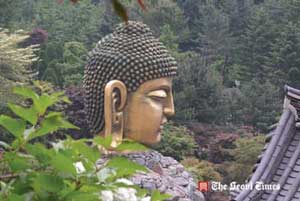 Buddhism is one of the world's major religions and the Buddhist way of life of peace, loving kindness and wisdom is evident today throughout the world.
KUALA LUMPUR, Malaysia -- Three Malaysians will receive the gift of sight – thanks to corneas donated by the Sri Lankan government.
The corneas, which will benefit a Malay, Chinese and Indian, are part of the Buddhist Maha Vihara’s annual Caring and Sharing programme to commemorate Wesak Day.
About 1,000 underprivileged individuals were invited to the Buddhist Maha Vihara in Brickfields yesterday to take part in the celebration, which included food, gifts and entertainment.
Said the Buddhist Chief High Priest of Malaysia, K. Sri Dhammaratana: "This event will help foster unity among the races. It extends beyond race and religion."
Transport Minister Datuk Seri Ong Tee Keat, who was the guest of honour, received the corneas from Sri Lankan High Commissioner Dr D. Ranasinghe.
He thanked the Sri Lankan government for the donation.
Of yesterday’s celebration, he said: "It is truly an honour to witness a gathering of different cultures, religions and ethnicity in one place rejoicing in the act of giving, caring and sharing."
Ong also called for the concept of giving and sharing to be revived.
"In today’s hectic and changing world, the simple thought of stopping and observing our surroundings and extending a helping hand is long forgotten. We need to revive the thought of giving and sharing in each and every one of us," he said.
The cornea transplants will be carried out at Tun Hussein Onn Eye Hospital.
Colombo, Sri Lanka -- Vesak is a very special time for Buddhists, because it depicts the themagula, birth, enlightenment and parinibbana (death) of Lord Buddha. Pandals, or better known among us as Thoran, take a prominent place during the celebrations. Thousands of multi coloured bulbs, emphasise the beauty of the paintings and brings the various Jathaka tales or, incidents in Lord Buddha’s life, alive.
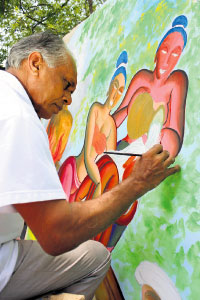 Not only Buddhists, but many others, irrespective of religion, are very enthusiastic of sightseeing during this season, just to view these vibrant pandals. The Nation met an artist, Somaratne Gomez, who has been making pandals for nearly two decades, to have an insight into the art of pandal making.


