Showing posts with label Article. Show all posts

Friday, February 25, 2011

Nun's devotion gives hope to orphan kids

VNS, Feb 22, 2011

Ben Tre, Vietnam -- Nearly 20 years have passed since the Pagoda's doors were opened to orphans under the guiding hand of nun Thich Ngo Mai, an orphan herself. Thu Trang report.

As visitors enter the pagoda, a smiling three-year-old boy with round eyes welcomes visitors and sings, "Grandmother, I love you so much. Your hair is white like clouds... "

Minh Thong is one of the 23 orphans who are being raised at Phat Minh Pagoda in Giao Hoa Commune, Chau Thanh District in the southern province of Ben Tre.

During the past 18 years, nearly 50 orphans have been raised in the pagoda, which is chaired by nun Thich Ngo Mai.

Mai, whose real name is Nguyen Thi Lieu, was born in Sai Gon. Her father died when she was only three years old and she was later abandoned by her mother.
 
Mai, enrolled at Bo De School – a Buddhist school and eventually became a Buddhist nun at Anh Quang Pagoda in District 10.

Eighteen years ago, she moved to the Phat Minh Pagoda when the structure still lacked running water and electricity.

Nun Ngo Mai partnered with charitable organisations and began reaching out to street children. She decided to open the pagoda's doors to down and out juveniles.

To date, Mai has helped raise about 50 orphans. Some of the children's parents died, while others left home because of abuse or neglect.

Nearly 20 years have passed since she opened her doors and some of the children that she helped raise have married, while others are studying at vocational schools and some have become Buddhist nuns and monks.

The first child to be raised at the pagoda, whose religious name is Minh Chi and real name is Nguyen Dinh Tien, now is a student at the Land Forces Military Academy No 2. Currently, there are more than 20 children living at the pagoda and studying in nearby schools.

Two siblings Dieu Tam and Dieu Tuong, whose real names are Nguyen Thi Nguyen and Nguyen Thi Thanh Chi, are from Dac Lac Province. They are happy living in the pagoda.

Tam is three years older than Tuong, but they are both third graders at Giao Hoa Primary School.

"I want to become a doctor or a nun because I love Ngo Mai so much," said 10-year-old Dieu Tuong.

Three ethnic minorities siblings H'Nhien, H'Lin and H'Uk also love Ngo Mai and there other mothers here.

"Sometimes I return home to visit my family, but I want to live here forever," said H'Nhien.

Older children often take care of the younger ones during meals and studying hours. They consider each other to be family. In the pagoda they also have fathers and mothers who provide the pagoda with donations. The donors set up a volunteer team with 20 members, 15 women and five men. The team helps Ngo Mai care for the children.

Ngo Mai said that watching the children eat and play brings her joy.

"Bringing happiness to others makes me happy," she said.

Although she raises several children, Ngo Mai lives off limited means. Phat Minh Pagoda is located in a remote area so few people visit the grounds. Moreover, local residents are not rich so their donations are modest.

A Buddhist named Hue said that every month, donations to the pagoda amount to about VND1 million (US$50).

"Ngo Mai has had to ask for donations from everywhere to have money to raise the children," she said.

Ngo Mai also recites Buddhist scriptures and cooks vegetarian food at parties to earn money.

She has suffered from heart disease, which required her to have surgery, but this set back has not dampened her enthusiasm.

The nun is not afraid to ask for money if the pagoda runs out of rice or if diseases break out among the children.

Ngo Mai said she worries the most about outbreaks.

"Last year, was the hardest year so far at the pagoda," she said.

Within a few months, a boy developed appendicitis, another was hit by acute gastritis, and nearly 10 children were hospitalised with fever. The pagoda did not have money to pay the hospital fees, so the Buddhists had to borrow money to make ends meet.

Some people used to ask Ngo Mai if they could adopt her orphans, but she refused.

"I do not want the children to be abandoned again. Although I have to work hard, the children still eat and can go to school," she said.

Monday, January 24, 2011

Where Is Your ‘Hereafter’?

by Shen Shi'an, The Buddhist Channel, Jan 24, 2010

Singapore -- ‘Hereafter’ proposes something ‘simple’ yet mysterious. It speaks of the great possibility of existence hereafter, which seems certain to exist, yet being beyond the scope of our clear understanding.


Even the protagonist psychic featured, who is masterful in communicating with the deceased is unsure of where they go to after ‘hanging around’ for a while. In the Buddhist teachings, ‘hereafter’ can be many places indeed, for there are 31 planes of existence, which are more broadly classified into 6 main realms. And there is no fixed hereafter in the ‘forever and ever’ sense, due to the cycles of rebirth and dynamic changes in karma. This is why it takes more than an ordinary psychic to be able to discern the whereabouts of long deceased ones.

While the nihilistically ‘pragmatic’ might feel that the question of what lies hereafter to be the most irrelevant existential question of all, a sound answer does however gives us crucial spiritual bearings. As uttered in the film, ‘a life about death is no life at all’. True, but to really live life is to be concerned with death too, for it puts this short and vulnerable life in perspective. 

The Buddha spoke against the erroneous romanticism of the hereafter as eternal nothingness (that’s nihilism), and as eternal heaven or hell (that’s eternalism). Well, the subtle life force that is the consciousness is too powerful to be simply snubbed out at the end of this physical life, and what natural or supernatural justice is there to deserve everlasting pleasure or pain due to limited good and evil done?

The hereafter depicted in the film is one that is supposedly experienced by many – of blurred silhouettes against bright white light. In the Buddhist context, these figures can be other denizens of the in-between, of the weightless bardo state (when the consciousness stripped free from the body), or even the (de)forming manifestations of personal demons and guardians. With many coloured lights representative of various spiritual tendencies, a precarious state this is, as described in great detail in the Bardo Thodol (‘The Tibetan Book of the Dead’). When one follows the lights or beings one is attached to, one would be reborn accordingly. In the Mahayana teachings, the safest way out is to be mindful of Amituofo (Amitabha Buddha) by reciting his name with utmost sincerity, to which he will manifest and lead one to his Pure Land, where enlightenment is guaranteed.

Dying is not universally blissful, as often relayed by those with Near-death Experiences (NDE). If death is always nice, there would be no encounters with woeful wandering spirits! Though there are many culturally conditioned NDE accounts due to collective perceptions, there are many other different ones too. Those with unpleasant experiences seldom return to share them. This is due to the intensity of their negative karma, that barred them from second chances at the expired lives. Perhaps accidentally, the film might promote the use of psychic services to communicate with the deceased. While this can be comforting as a means to relay final messages, it can be dangerous if attachment and regret on both sides of the living and dead is reinforced, which might prevent the deceased from taking a good rebirth. And yes, as the story warns, beware of false prophets, fake mediums and pseudo psychic scientists!

On the science of the afterlife, the recently deceased Dr. Ian Stevenson of Virginia University had meticulously documented more than 3,000 cases of those with recollections of their past lives. Many children were discovered with such detailed memories, which upon rigorous investigation, correspond to persons who lived before they were born. In over 40 cases, there were discoveries of unusual birthmarks and birth defects, which matched post-mortem records of those the children claimed to have been. They even displayed familiar habits towards their previous surviving family members. While playing, many would also incorporate elements of their claimed past professions! Tellingly, they also had phillias and phobias linked to their manner of death.

Curiously, the director Clint Eastwood featured a scene where a boy shook his head upon hearing a preacher say there is nothing to fear about death if one believes in Christ. Perhaps he is open-minded enough to explore the possibility of making his next movie based on the phenomenon of rebirth? Still skeptical of the existence of any hereafter (and the worth of doing good)? Here is a sound fourfold way of reasoning to solve this problem, as advised by the Buddha in the Kalama Sutta. Firstly, if there is afterlife, and if there is the law of karma, you will have a good rebirth if you do good. Secondly, if there is no afterlife, and if there is no karma, you will live happily now, as you are free of ill will (since you do good). Thirdly, if evil befalls the evil, it will not affect you as you do no evil. Fourthly, if evil does not befall the evil, as you do no evil and do good instead, you are pure both ways. There you have it, the very assuring Four Assurances!

Original article here.

Thursday, January 13, 2011

Music in Buddhism

The Bangkok Post, Nov 26, 2010

Bangkok, Thailand -- The first impression the general public may have of Buddhism is how it turns its back away from worldly pleasure. While that might be true, there is a role for music, one of life's worldly and heavenly pleasures, in Buddhism.


For example, when Prince Siddhattha left his worldly life behind and became an ascetic, he first studied under many respected gurus of the time and found no effective way to reach the end of all physical and mental sufferings. That was when he decided to embark on his own path and tried different experiments.

During his time, there were two major schools of thought regarding how to reach the end of sufferings. The first school taught that, in order to conquer all your mental defilements and thus reach the end of sufferings, you have to follow your heart's every desire. Their reasoning is that, once you have fed your desires to one point, you will feel bored of it all and would not have any more desires and become Enlightened.

But Prince Siddhattha was a crown prince who has had it all and still felt that he is nowhere near Enlightenment. Therefore, it was natural for him to choose the second school of thought, which is to deprive yourself of all worldly pleasures and to torture yourself to the extreme. This school of thought believed that, when you have deprived yourself of everything, your desires will become weak and eventually disappear.

Being a very determined man, the Prince took to his task seriously. It could be said that he took all the extreme measures of torturing and went even further. At one point, he went as far as not eating more than one single pea a day in order to starve his body and hopefully to kill his desires.
 
Again, as we now know, that extreme measure did not work. In fact, Prince Siddhattha was on the verge of dying as he collapsed one day. The Devas, heavenly sentient beings, saw what happened and thought they had to give the Prince some clues. So, one Deva disguised himself as a young man travelling on a boat along the river, passing by where the Prince was collapsing.

And what did the Deva-cum-young man do? He played a harp. At first, he tuned the strings of his harp too tight and the sound did not come out right. The second time, he tuned the strings too loose. Naturally, the sound was also awful. It was only the third time, when the young man tuned his strings just right _ not too tight and not too loose _ that the music came out perfect.

Upon hearing what happened, Prince Siddhattha , with his innate wisdom, knew instinctively what to do. He realised that neither the harshest way nor the most lax would yield the best result. It's got to be the Middle Path _ not too harsh, yet not too lax. That was when he decided to eat again, but moderately, and tried cultivating his mind along the same idea, meaning not getting too deep into the samadhi, or concentration, but merely observing things as they are in the present moment. The latter practice is vipassana meditation and is also the heart of Zen practice.

After the Prince changed to the Middle Path, it did not take long for him to become Enlightened. And since the harp playing helped trigger his wisdom, it can be said that music also held a great role in the Enlightenment of the Prince who would then be known as Lord Buddha.

Centuries afterwards in Japan, music also had a role in the spread of Buddhism. Around the 12th century, travelling monks would recite The Tale of the Heike, a war chronicle teaching the Buddhist Law of Impermanence, to the accompaniment of the biwa, a musical instrument similar to the lute.

Then, between the 13th to 19th centuries, there was this practice called suizen where Fuke monks would play the shakuhachi bamboo flute as a form of meditation in order to attain self-realisation. Fuke monks would play the shakuhachi while wearing a large woven basket hat that covered their entire head as they went on pilgrimage. The idea was perhaps to shield their eyes from the worldly pleasures and helped them concentrate better on their musical meditation.

However, the sect started to see its demise during the Tokugawa Period (1608-1868). Totally oriented to retaining their dictatorship, the Tokugawa government imposed a travel ban on the citizens. They could not travel to other provinces freely and needed difficult-to-obtain travelling documents. The exception, however, was given to the Fuke monks, since they were considered pilgrims. This way, the Tokugawa government disguised many masterless samurai, the ronin, as monks so they could travel across the country as spies.

After the demise of the sect with the modernisation of Japan, Fuke Zen has seen a slow recovery today. If the monks can play flutes as a form of meditation, so can we. Do you play any kind of musical instrument? If so, have you ever considered using it to cultivate your mind and develop your wisdom so that you might attain self-realisation and thus Enlightenment one day?

If you are interested in how music and the power of being here and now can turn your life around, you may want to consider going to a mindfulness meditation retreat first to learn the ropes of what it is like to practice vipassana or Zen meditation.

From there, you can easily apply the idea to your musical pastime. Hey, you never know - Enlightenment might just be around the next few notes!

Thursday, December 30, 2010

What would Jesus and Buddha do … on holiday?

by Jolyon Baraka Thomas, The Guardian, 22 December 2010

A new manga novel lightheartedly depicting the two as everyday young men may inadvertently raise interest in religion in Japan
 
Tokyo, Japan -- What would Jesus and Buddha do if they were suddenly thrust into contemporary society, and how would they react to what they found?

Japanese author-illustrator Nakamura Hikaru has sketched an answer to this provocative question in a very popular manga, or illustrated serial novel, entitled Saint Young Men (Seinto oniisan).


Nakamura (her surname) depicts the adventures of the two religious founders as they room together in Tachikawa (a suburb west of Tokyo) while vacationing in Japan.

Humour, rather than veneration, sets the tone for the series, which is replete with visual gags and puns. For example, when the roommates discover that the prizes they have won at a shrine festival are cheap imitations of coveted handheld videogames, Nakamura quips: "The two were enlightened as to the true flavour of Japanese festivals," playing on a double sense of the word daigomi, which can either mean sublime Buddhist teaching or – more colloquially – the "true charm" of something.

Similarly, quirky interactions that juxtapose episodes from Jesus's ministry with hilarious social faux pas provide opportunities to chuckle. When Jesus says that he "just wants to wash his [disciples'] feet," a local gangster who overhears him misinterprets this phrase in its figurative sense as an indication of one's desire to start afresh after a life of crime. Jesus, oblivious to this misunderstanding, unwittingly gains notoriety among the mob as a particularly tough villain.

Nakamura's protagonists, though saintly, are hardly infallible. Jesus's all-encompassing love makes him excessively enthusiastic (Nakamura portrays him as a compulsive shopaholic), while Buddha's ascetic tendencies make him seem – as the back of one volume states – like "the parsimonious lady next door". The roommates drink beer, update blogs, and play online games, generally trying to have a good time while assiduously attempting to blend into contemporary. Like many tourists, however, they stick out like sore thumbs.

Teenage girls swoon over Jesus because of his resemblance to Johnny Depp, while neighbourhood boys tease Buddha for the auspicious tuft of hair on his forehead. Inadvertent performance of miracles also threatens to reveal their true identities. Jesus, for example, mistakenly turns the water of the local public bath into wine, while Buddha literally glows in moments of excitement.

Nakamura's rather irreverent depiction of these religious founders may seem blatantly sacrilegious, but upon investigation something more intriguing is apparent in her work.

Statistically speaking, levels of religious belief and affiliation are strikingly low in contemporary Japan, and most people prefer to describe their participation in apparently religious activities as custom or amusement. This has led some observers to anticipate the incipient demise of religion in the country, and no doubt some might be tempted to use Nakamura's work as evidence in support of this hypothesis. However, whereas some author-artists have tended to downplay religion in their works or have used manga as a vehicle for criticism of the allegedly pernicious nature of marginal religious groups, Nakamura makes religion startlingly normal.

Her story is not an introduction to abstruse religious doctrines, nor does it feature much overt commentary on the role of religions in contemporary society. Rather, she invites her readers to view contemporary Japan through the eyes of protagonists who are unambiguously religious.

While Saint Young Men hardly exhibits strict fidelity to canonical sources, Nakamura has done her homework. She seamlessly weaves tales of the Buddha's former lives and gospel accounts of Jesus's ministry into her narrative, loosely citing the biographies of these founders while (literally) drawing those stories into the present. While it is doubtful that her audience reads the manga for religious inspiration (and it is similarly doubtful that Nakamura intends to proselytise), one possible result of the work may be increased audience familiarity with – and even interest in – such canonical stories. It is therefore not insignificant that Nakamura's farfetched plot demands willing and sustained suspension of disbelief.

While it remains to be seen how Saint Young Men will be interpreted over the long term, for the moment it has successfully captured the mercurial interests of contemporary Japanese audiences.

The incongruous juxtaposition of ostensibly sacrosanct figures with mundane situations such as overpriced cafes, busybody landlords and free refills at family restaurants is inherently humorous, and through their eyes quotidian Japan suddenly looks exciting and new. Jesus and Buddha enter the audience's imagination not as staid preachers, but rather as the adventurous boys who live next door. The manga therefore demonstrates that venerable religious figures lead active lives outside the hallowed halls of church and temple and beyond the margins of scripture.

While religion may be a laughing matter for Nakamura and her audience, the role this manga might play in building and sustaining familiarity with the biographies of religious founders is certainly not to be scoffed at.


Monday, December 27, 2010

How and why this Buddhist celebrates Christmas

by Judith Sainsbury, Guelph Mercury Community Editorial Board, December 22, 2010


Guelph, Ontario (Canada) -- I’ve been a practising Buddhist for almost 30 years now, and I often get asked if I celebrate Christmas. I do. I love Christmas.


I just don’t celebrate it the same way a devout Christian would. I was raised Christian, and there are some traditions I just won’t give up and Christmas is one of them. So how does a previous Christian and now Buddhist celebrate Christmas? First of all, let me get some things straight. Buddhism is not a religion that believes in a God. Buddha is not regarded as a God or a deity. Buddha was a human being, so there is no theistic God belief in Buddhism. Which means that I am an atheist as well as a Buddhist.

So, how do I reconcile Christmas which celebrates the birth of the son of God? Dec. 25th was chosen as the birth date of Christ because it is near the winter solstice and the church wanted to stop those darn pagans from celebrating the rebirth of the sun, so it changed it to celebrate the birth of the son. It was unsuccessful at wiping out all the pagan traditions such as Christmas trees and the various incarnations of Santa Claus, although it tried pretty hard with the inquisitions and witch burnings. But the traditions around the winter solstice prevailed. It is these traditions that I am most attached to and I’ve also created my own traditions.

Every Christmas Eve I cuddle up with my children and watch A Christmas Carol: the original, with Alastair Sim. I have never liked any of the remakes. They just don’t measure up to Alastair Sim’s incredible performance as Scrooge. We can now pretty much quote the movie word for word. But nothing puts me in the Christmas spirit more than this movie. It’s a story about human transformation. It is the scene where Jacob Marley’s ghost appears before Scrooge that affects me the most.
 
There he is, with his long chain of bad causes which he has forged in life. He says “I made it link by link and yard by yard; I girded it of my own free will, and of my own free will I wore it,” and he warns Scrooge that his chain is longer. Scrooge replies that they were only being good men of business, Marley passionately screams: “Mankind was my business. Their common welfare was my business; charity, mercy, forbearance, and benevolence, were all my business.” He then points Scrooge in the direction of the window where there are a number of spirits with huge chains similar to Marley’s surrounding a homeless women and her baby on the street below. They are screaming and moaning and Scrooge asks why they lament. Marley replies they lament because they have lost the power to do anything; now that they are merely spirits. When I was a child this scene horrified me, now as a Buddhist it has significant meaning.

We all forge chains of causation good and bad. What matters is what we do while we are living. Whatever belief system one may have, I think we can agree it is our behaviour as humans that is the most important thing. Scrooge’s transformation as he realizes he can change is a scene of a man full of joy. He actually says he doesn’t deserve to be this happy. Realizing he can now work to do good transforms his life.
Humanity becomes his life tendency. 

Christmas is one of those holidays that embodies this potential and acts as a reminder for me, that there is hope for the world. Some of us may not need to be reminded of this, and many of us struggle to feel hopeful. But if we can hang on to that feeling and do just one good thing the chain reaction is tremendous. We can forge a chain of hope, and humanity will become the life tendency of society.

I will always celebrate Christmas or solstice even though I’m not a Christian. It brings out the best in people, and for me as a Buddhist, is reason to celebrate.

Blessings, everyone!

Jesus the Christ and Siddhartha Gautama the Buddha

By JULIA CORBETT-HEMEYER, The Star Press, December 23, 2010

Yorktown, Indiana (USA) -- The figure of Jesus as it's presented in the sacred writings of Christianity and developed over centuries of Christian tradition differs in several significant aspects from that of the Buddha, Siddhartha Gautama, as his story is told in the Buddhist sacred scriptures and elaborated over the centuries.


To note just two: Most Christians believe that Jesus is the single, unique incarnation of the one holy God. The Buddha is believed by Buddhists one of untold numbers of manifestations of Buddha nature. And for most Christians, Jesus is the savior of humankind, sent by God to rescue women and men from the inevitable effects of human sinfulness. While some Buddhist teachings present the Buddha as something like a savior, most do not. I don't want to gloss over these differences because they are important and have given rise to very distinctive religious perspectives. 

However, there are also striking similarities between these two great religious founders, similarities that have to do with their both being manifestations of a wide-spread mythic figure known as the hero. First, however, we need to be clear what I mean by "myth" here, because a lot of misunderstanding surrounds the use of the word.

As I use the term, a "myth" is not an untrue story. Myths are not the same as fables, folktales, fairy tales, anecdotes or simple fiction. Myths are accounts which convey symbolic truths of great meaning and value for those who accept them. They often form the bedrock of cultures and religions. There are striking similarities in certain types of myths across many cultures. If the story of Jesus is the defining one for our faith, or if the Buddha is our guide on the spiritual path, our understanding can be enriched by a wider acquaintance with the hero myth as a type, and with the variations on that theme represented by these two great religious founders.
 
My understanding of the hero myth and its significance is informed by Joseph Campbell's work in The Hero with a Thousand Faces and by Otto Rank's The Myth of the Birth of the Hero. Campbell identifies a three-part sequence in this myth: separation, initiation and return. But prior to that, there are the birth narratives.

The accounts of heroes' births are marked by their unusual features, their miraculous character. They serve to set the hero apart from more ordinary people right from the beginning. To note just a few examples: According to tradition, Jesus was born to a virgin, conceived by God without human intervention. Siddhartha Gautama was born from his mother's side, according to one account, without causing her any pain or discomfort, having been conceived by supernatural means as well. Although Queen Maya and King Suddhodana were married and no mention is made of her being a virgin, Queen Maya's moral purity is spelled out in detail in the birth narratives of the future Buddha.

An angel appeared to Joseph in a dream to announce that Jesus would save his people from their sins. Hindu priests told Siddhartha's father that if the baby to be born were to remain in the household of his birth he would become a world conqueror. However, if he were to leave the household, he would become a Buddha. (There is also a notable difference here: While Jesus' birth is recorded as being humble, attended by the animals surrounding the manger, Siddhartha was born in a palace and his childhood was spent in luxury.)

An angel appeared to Joseph in a dream to announce that Jesus would save his people from their sins. Hindu priests told Siddhartha's father that if the baby to be born were to remain in the household of his birth he would become a world conqueror. However, if he were to leave the household, he would become a Buddha. (There is also a notable difference here: While Jesus' birth is recorded as being humble, attended by the animals surrounding the manger, Siddhartha was born in a palace and his childhood was spent in luxury.)

As the story of Jesus unfolds, we learn that his life was threatened by King Herod, and an angel appeared to Joseph to warn him to flee with the child into Egypt. While there is no parallel threat in the Buddhist tradition, Siddhartha's childhood was marred by the death of his mother a week after his birth. In light of the seer's prediction, King Suddhodana struggled, unsuccessfully as it turned out, to prevent anything happening to his son that might lead him to abandon the life into which he had been born and thus become a Buddha.

As noted above, the birth narratives of mythic heroes set them apart from the time of their birth and often, before it. The hero is one whose life is marked by trials and challenges, often great danger. The culminating point of the story of the hero comes at the end of the cycle: Heroes successfully navigate the challenges presented, and return with great gifts for humankind. Jesus became known as a savior of humankind. The Buddha became known as one who showed people the way to enlightenment. Both founded religions that have helped to make life meaningful and good for untold numbers of people since their births so long ago.

Article's link: Buddhist Channel

Monday, November 15, 2010

Buddhist secrets for everlasting love

by Nash Siamwalla, The Bangkok Post, Nov 12, 2010

Nash Siamwalla looks into Buddhist teaching that will guarantee couples everlasting love

Bangkok, Thailand -- Buddhist secrets for everlasting love. Sounds too good to be true? Not at all. Lord Buddha himself gave these tips in the following story that is retold in the Pali Canon's Samajivita Sutta.

Once during Lord Buddha's time, there was a loving merchant couple by the name of Nakul who invited Lord Buddha to receive alms and preach at their home. Throughout their life, they had been perfectly devoted to each other, never once being dishonest or going astray. Wanting to be together forever in perfect bliss, both in the present life and ever after, they asked Lord Buddha:

"Dear Lord, since our youth, we have been perfectly devoted to each other. Never once did our minds stray. We wish to remain in this loving bliss forever both in this present lifetime and all the future lifetimes. Please, Lord, tell us what we have to do."

Hearing their question, Lord Buddha answered: "Nakuls, if husband and wife wish to be together in loving bliss both in this lifetime and the lives after, they should endeavour to achieve the same level of faith, morality, generosity and wisdom. They should also be modest, live by the Dhamma, and converse with loving words. They should also never have ill-will towards each other. If they can practice this, they will enjoy the worldly pleasure and happiness together, both in this life and in Heaven."

The first part of Lord Buddha's teaching is called Samajividhamma 4 which is sometimes known as "the qualities which make a couple well-matched". If you do not have that special someone in your life yet, Samajividhamma 4 will serve as a fool-proof guideline for you in finding someone that you want to spend the rest of your life with.

If you are already in a relationship and want to make it last in a loving bliss, this timeless advice of Lord Buddha is also useful.

The same level of faith applies even if you each follow different religions. The author is fortunate to know many couples who live together happily in full loving bliss despite different faiths. It is the same level of faith that counts, not the same faith itself.

As for the same level of morality, Lord Buddha used the term Sila, or precepts. For typical laypeople, there are five precepts, which are to refrain from killing; stealing; committing adultery; lying and intoxicating your mind. To be a decent human being in Buddhism, these five precepts are required. In Buddhism, the five precepts are what separate us from animals.

Talking about precepts, if you want to be a real Buddhist, you should also aim to try living by the eight precepts now and then, say, every Buddhist holiday _ that is, every half moon, full moon, and black moon on the lunar calendar. It comes roughly once a week. In the eight precepts, in addition to the five precepts, you refrain from any worldly pleasure and also do not eat after noon.

The same level of generosity refers not only to the idea of "giving" per se, but also to the sacrifice each person is willing to make. As for the idea of giving, we can already visualise how couples can get into trouble if one partner prefers to give more to society than the other partner.

The same goes for the level of sacrifice. For every relationship to last, one partner has to sacrifice him or herself at some point. It goes without saying that the willingness to sacrifice for the other should be mutual. The sacrifice should be without condition, though, for condition leads to the idea of "give and take". You want the other party to do something for you in return for what you have to sacrifice. Real love, the author presumes, should be about "give and give", don't you think?

The last advice on Samajividhamma 4 is perhaps the most difficult one to achieve: "To have the same level of wisdom."

By wisdom, Lord Buddha refers to the Buddhist type of wisdom, which means true understanding of Dhamma. In other words, it is the true understanding of life and of how the world operates. To achieve this type of wisdom, one needs to practice mindfulness training, either Theravada's vipassana style or Zen's mindfulness practice.

Yet, even if this last advice is the most difficult to achieve, it should be the first goal of any couples who wish for an everlasting love to try. Why? Because the wisdom from mindfulness practice will serve as a natural guideline as to how to achieve the same level of faith, morality and generosity.

Still, from the author's observation, in general, people seem to be oblivious to the true benefits of mindfulness. If you and your loved one haven't tried it yet, it is never too late to do so. The first step is to find a proper teacher because this is something that you can not just learn to do by yourself. It needs proper and constant guidance.

Secondly, the setting that will yield the true benefits of mindfulness is a proper meditation retreat.

Find one that has scheduled sessions throughout the day under close supervision. The key to successful mindfulness practice is continuity. That is why retreats offer a better chance of success.

See you in two weeks' time. Until, then, let us stay mindful. And all the best to couples and couples-to-be out there. To have an everlasting love, you have to work at it. Hey, if you love each other enough, you would work hard for it, wouldn't you?

Monday, September 27, 2010

Thich Nhat Hahn urges parliaments, corporations, schools and families to adopt 5 mindfulness training

The Buddhist Channel, Sept 26, 2010

Kuala Lumpur, Malaysia – World renowned Venerable Thich Nhat Hahn in his keynote address at the World Buddhist Conference 2010 currently held in Kuala Lumpur, Malaysia, have urged politicians in parliaments, business executives in corporations, teachers in classrooms and families to adopt the “5 mindfulness training” as first steps in redeeming this planet from our destructive tendencies.

Famed Zen Master Thich Nhat Hahn delivering his keynote address at the World Buddhist Conference 2010 in Kuala Lumpur, Malaysia.

By way of integrating the “5 mindfulness training” (which is based on the 5 moral precepts ) into the core values of the mentioned institutions, Thich Nhat Hahn says that such collective effort will be able to bring about happiness and the well being of the world.

“When we implement these mindfulness trainings with understanding and compassion, we transfer happiness to the world. Corporations using these trainings will be able to realize profit not just in terms of making money, but profits that can also help to protect the planet,” reasons the venerable.

This famed Zen Master said that it was possible for corporations or parliaments to cultivate happiness and compassion within. He explained that each of these institutions can be treated as Sangha, very much like the traditional community of monks and nuns. 

As with the Sangha, he says that these entities can also practice deep listening and loving speech. When they do this, then they will be opportunities to transform the parliament, corporation, classrooms and families in Sangha.

“When this happen, we will be able to understand the suffering of each other, and our actions shall bring good happiness and well being to the world,” he said.

The venerable pointed to a situation as to how the current generation had failed future generations.
Citing unbridled consumerism and unmindful living as the cause, he said that a practical way to the save the planet is to encourage collective practice by the young.

“One Buddha is not enough. We need many Buddhas,” he reasoned.

He said that now the onus of the younger generation is to become “activists of the 5 mindfulness training”. 
It is through deep listening and compassion within that parliaments, corporations, classrooms and families can be transformed into mindful Sanghas. And it is by these transformations thereby lies the hope of salvation for this planet.

The World Buddhist Conference 2010 is being held in the Malaysian capital from Sept 25-26, 2010. Nine speakers including Ven Thich Nhat Hahn have been invited to share their experiences and wisdom on the theme “Living in Harmony, When Things Fall Apart”. 

For more details, please visit: www.wbc.my.

See also:  The Five Mindfulness Training of Plum Village

Article from Buddhist Channel, click here.

Thursday, September 10, 2009

The Wheel And The Crescent

by Juhi Shahin, Dhamma Musings, September 7, 2009

Singapore -- Buddhism and Islam are two religions we do not hear mentioned in one breath very often. So it was with great anticipation that I went to attend the conference, Buddhism & Islam – Encounters, Histories, Dialogue and Representation held at McGill University, May 29 and 30, 2009. The conference indeed turned out to be eye-opening.

Not many know that the encounters and relationship between the two religions commenced almost at the very beginning of Islamic history. The first panellist, Xinru Liu, opened the conference with her research on Tukharistan (northern Afghanistan), Sogdiana (southern Uzbekistan) from 6th to 8th century, which was the junction on the Silk Route for routes going east and west and north and south. This region was Buddhist an[]d Zoroastrian before the Muslims came in as invaders and traders. There was not a sudden conversion because of the fear of the Muslim armies as is generally believed, but close collaboration and cooperation in the region.

The people there greatly appreciated the opportunities that came with joining the Islamic culture and civilization. For some, it was also convenient to be Muslim under the Muslim regime and pay no taxes, since in Umayyad times Muslims did not need to pay taxes. However, once Muslim, they continued to be so and the region produced many philosophers,
scientists and mathematicians who took Islamic civilization to new heights, while as Liu argues, also preserving their pre-Islamic local cultural traditions.

Equally interesting in this panel was Alexandre Papas’ paper in which he discussed the writings of two Ottoman travellers to China in the early twentieth century. The dialogue between the Muslim authors and Buddhist monks was discussed. It was interesting to see that they discussed the similarities and dissimilarities between the two religions as well as political issues with both their countries facing Western domination.

However, the highlight of the day was Georgios Halkias’ paper on
Muslim Queens of Buddhist Kingdoms, which was about the practice of bride exchange in Ladakh and Baltistan. According to Halkias, “the Muslim Queens of the Himalayas stand witness to a rich cultural fusion, an old blend of Arab, Persian, Mongol, Indian and Tibetan elements. Ever since the conversion of the Baltis to Islam in the 14th century, the Muslim princess-brides stood as promises of unity and peace and as a means of alleviating conflict between the warring houses of Baltistan and the Buddhist
kingdoms of Ladakh.”

Interestingly, these Muslim queens ruled the Buddhist kingdoms as well, longest rule having been of 13 years, and were patrons of both Buddhist monasteries and mosques. Muslim and Buddhist interactions in Tibet discussed by José Ignacio Cabezón, was also quite absorbing. According to him, “Muslims­both Muslims of Kashmiri origin and ethnic Chinese Muslims­have lived among Tibetans for centuries.” However, he argues that the “Chinese annexation of the Tibetan plateau has exacerbated the tensions between these two groups.”

The two papers presented on Buddhism in Muslim Indonesia by Karel Steenbrink and Hudaya Kandahjaya were complementary and explained a unique situation really well. Buddhism and Islam have lived together in the region since the arrival of Islam in 1200, Buddhism these days being mainly represented by the Chinese community. Indonesia, in spite of having the largest Muslim population in the world, does not call itself an Islamic state. Six religions are recognized by the state of Indonesia.

However, people of all religious communities have to accept the Pancasila ideology, one of its principles being, “belief in the one and high divinity.” This leads to the development of a unique situation for the Buddhists, since in their belief, the presence or absence of God is left undefined. Some Buddhists in compliance with Pancashila and also because of Muslim influence are using the concept of Adi Buddha, a form of divinity. This is seen as problematic by others who perceive it as forming a
new kind of theistic Buddhism.

The two papers on Thailand brought about two contrasting pictures of the region. Charles Keyes of University of Washington gave more of a historical perspective telling us that by the beginning of twentieth century, Muslims were a distinct minority in Thailand, they came from South Asia, China, Malaysia and some were also ethnic Thais. However, with the restructuring of the state in the late 19th century and growth of nationalist feelings, promotion of Buddhism became fundamental to Thailand. The result of this being that the Muslims then became the “others” or what is called khaek in Thailand.

This rhetoric of difference has led to “some Muslims, especially Malay-speaking Muslims, have embraced fundamentalist versions of Islam and some Thai politicians and Buddhist leaders have accentuated Buddhist nationalism.” On the other hand, Alexander Horstmann’s paper focused on the small village of Ban Tamot in Southern Thailand, where the Muslims are mainly concentrated. He talked about an ancestor-worshipping ritual held in the cemetery, in which local Imams as well as Buddhist monks participate. Very interestingly, “the basis of this ritual is the mutual bond of kinship relations that criss-cross through the religious communities and the local elites. Thus, the Imam of Ban Klong Nui is related to the old Buddhist abbot of Wat Tamot. Second, the village spirit is believed to be of Malay-Muslim origin ... Thus, while not explicitly announced, the participation of Muslims is crucial to the ritual.”

An interesting project on Islam in Tibet has just been finished by the Warburg Institute of the University of London. Two of the papers presented on Rashid al-Din’s (1247-1318) Life of the Buddha were part of the project. Rashid al-Din’s book is considered the oldest World History book, in which he dedicates a separate section on the life of the Buddha. Ronit Yoeli-Tlalim highlighted the aspects from Tibetan Buddhism that are present in the work and also attempted to give evidence of the presence of Buddhists in the Ilkhanid court.

Commenting on the same text, Anna Akasoy brought out the use of Islamic terminology by Muslims in trying to understand Buddhist concepts. This is what the two scholars called a 'cultural translation', where Buddhists concepts were Islamicized in order to be understood.

The conference ended with another interesting panel on Religion and Local/Global Identities, where an effort was made to understand how one community perceives another in various places, Japan, India, Thailand and Malaysia.

And how contemporary scenarios like the 9/11 affect relations, although needless to say, do not alter them completely. This conference gave a much needed comparative religious perspective. More such efforts are needed to bring out the fact that most religious people when left to themselves are able to live together in a collaborative and cooperative way, enriching all the cultures and religions involved.

This “cultural translation” is an ongoing process, in spite of the hoopla surrounding fundamentalisms of all sorts today. (The picture shows the mosque in Lhasa).

Excerpted from Juhi Shahin's book "Rethinking Islam".

Monday, August 17, 2009

Reclining Buddhas

By DAVID WILSON, The Star, August 15, 2009

Often vast, always mysterious, reclining Buddha statues sport enigmatic smiles. David Wilson digs around and discovers the secrets of these dazzling figures

Kuala Lumpur, Malaysia -- Strictly speaking, they should not exist. Reclining Buddha statues could be condemned as idolatry because the Buddha asked that no images be carved in his likeness. So, at first, after he slipped away, artistically inclined devotees only paid tribute to facets of his identity — footprints, the chair he sat on, among other relics.


“Eventually, the devotional impulse won out,’’ says Gary Gach, the author of The Complete Idiot’s Guide to Buddhism. Good thing, too. Despite their languid pose, the statues cast a spell that few sights in Asia can rival.

Often to be seen glamorously draped across postcards, traditional reclining Buddhas have the left arm aligned along the body while the right serves as a pillow with the hand propping the head. Sometimes no longer than a grain of rice, the reclining Buddha is more often on the scale of a junk.

The icon appears mirage-like everywhere, from Penang and Bangkok to Yangon in Burma, along with Ayutthaya (old Thailand’s capital) and that Laos backpacker haunt, Vang Vieng. One even crops up in White Plains, New York. The reclining Buddha’s “home” may be a temple, grotto or fresco — anywhere with a touch of width and mystique.

The statue represents Shakyamuni Buddha — the historical Buddha — at his death at 80. It is said that when the Buddha knew the end was near, he asked his disciples to prepare a couch for him in a grove, then reclined on his right side, facing west, with his head propped on his hand.

On the last day of his life, instead of just turning ashen, he kept teaching. So, despite their decadent aura, the statues embody — as it turns out — the devotion to duty that the Buddha displayed at the last gasp.

But two puzzles remain.

The first is the smile that plays on the lips, which may seem odd especially to anyone familiar with the reality of death or Christian images of wretched saints and angels. The smile, it transpires, is simply meant to express “the supreme joy” that comes with enlightenment, Gach explains.

The Buddha knew that he was not destined for everyday death but “parinirvana” — a state defined as “the extinction of the endless round of illusion and needless suffering”.

The second puzzle is the typically extravagant size, which may seem outrageous to anyone familiar with Christian statues or the Buddhist emphasis on moderation. This time, the explanation is less simple, with roots in a legend that has a Freudian fairytale feel.

The legend centres on a giant called Asurindarahu, who had more pride than a NBA megastar. When confronted with an opportunity to meet the Buddha, the giant was torn. On one hand, he yearned to see the Buddha. On the other, because he was equipped with an ego on par with his epic proportions, he was loath to bow before him, the story goes.

So, while lying down, the Buddha engaged in magic, projecting an image of himself that dwarfed the giant. The Buddha then showed him the realm of heaven populated by a multitude of celestial figures that were smaller than the Buddha but, again, dwarfed the giant.

Just to rub it in, the Buddha commented that the giant was only a big fish in a small pond. Humiliated by the lecture and the awesome display of soft power, Asurindarahu duly kowtowed, even cringing “like a spider clinging to the hem of his robes”.

The size and splendour of reclining Buddha statues may make the traveller feel humbled, too. In particular, the reclining Buddha that graces Bangkok’s 8ha Wat Pho is tremendously imposing, all the more so because its feet and eyes are engraved with mother-of-pearl.

Its fame amplified by its closeness to that backpacker hive, Khao San Road, the monumental Wat Pho statue exerts more allure than any other cultural attraction in Bangkok. The statue might be classified as one of the seven wonders of Asia, up there with the Taj Mahal. Or it could be viewed as a cliché — just another sight to see, revere and grab on your memory card before uploading to an inexhaustibly rich, people’s gallery like Flickr.

Either way, Gach is more impressed by the reclining Buddha on show at Shanghai’s Jade Buddha Temple, the best-known Buddhist temple in town. Aside from the fact that the Shanghai Jade Buddha assumes the classic position, Gach rates it highly because it is carved from a single chunk of jade nud­ging the 2m mark.

“In and of itself quite remarkable,” Gach says. “And the sculpture itself seems to possess a certain aura that speaks for itself — as does the Sphinx, Mona Lisa, etc,” he adds.

Another bewitching but spectacular reclining Buddha occupies Chaukh­tatgyi Temple in Burma’s capital, Yangon. Like Penang’s example of the breed, it boasts what resembles heavy makeup, a shimmering golden robe and feet the size of Langkawi. It is squeezed into an open-sided, steel-and-corrugated iron structure which, as one blogger notes, looks more suited to hosting a rock band than a religious seer.

In defiance of physics, still another giant reclining Buddha has gone missing altogether.

On the fringes of Asia, in Bamiyan, central Afghanistan, the 200m monster that eluded the Taliban’s idol-busting orgy exists somewhere hidden under the earth, many scholars believe. Last year, encouragingly, a smaller version of the Bamiyan behemoth was discovered near the ruins of the two large standing Buddhas destroyed in 2001 by the Taliban.

If its big brother surfaces soon, it may briefly be the world’s largest — even more gigantic than Burma’s titans. The Burmese like their reclining Buddhas to be sensational. The hollow reclining one in Monywa, central Burma, which you can walk through, stretches 90m and is acclaimed as the world’s largest.

Still, both contenders look set to be eclipsed by an incomparably colossal Middle Kingdom effort. A stone reclining Buddha being carved in east China’s Jiangxi Province will reportedly stretch 416m — the length of an oil tanker.

However dazzled you may be by the grandeur and glamour, just remember one thing: do not to fall into the trap of referring to any reclining Buddha as “sleeping”. True, the Buddha, being human, took nightly downtime like anyone else. But his name means “The Awakened”.


Friday, July 17, 2009

Buddhism under siege from within

by Bhikkhu K. Tanchangya, The Buddhist Channel, July 17,

Kandy, Sri Lanka --The latest attempt to proselytize the Buddhist world comes in the form of a book entitled ‘Peoples of the Buddhist World: A Christian Prayer Guide’ by Hattaway Paul. Anthropologically speaking, the book deserves credit for its excellent well-researched materials as it deals with 238 distinct people-group profiles, photographs and maps of the Buddhist world – something that Buddhists are capable of producing, but are lazy to do so.

Make no mistake: this most conspicuous book is enterprisingly well done. But it has a hidden agenda: This book serves as a layout and roadmap of Christian evangelical interests and zeal. It is a precise blueprint, a battle plan drawn to craftily attack the peoples of the Buddhist world.

Educated and affluent Buddhists, however, should thank the author, an active evangelic leader for producing such an enlightening overview of the peoples of the Buddhist world because not many at all know about the majority of these 238 groups mentioned by him.

Indeed, many of these Buddhist communities are little-known and often forgotten. They are some of the most neglected peoples of the world. Much has been said on the evil intentions of the Christian evangelical missionaries for trying to ‘pray and touch the souls of ordinary people’ and bringing them into ‘the merciful rescue of God, the ruler of heaven’.

My intention here is neither to write a review of the book condemning it as anti-Buddhist nor to parrot the accusations labeled against such greedy evangelical missionaries but to urge my fellow educated and affluent Buddhist brothers and sisters of the civilized world to understand that the wisest solution to such proselytization of the Buddhist world.

It does not lie on how logically and convincingly we criticize such undertakings and how many anti-conversion laws we need to enact. The intention is to undertake an honest, objective re-examination of our own Buddhist system within.

It is often proudly claimed by us Buddhists that Buddhism has survived for 2550 years armed with its teachings of non-violence, tolerance, ability for different adaptation, and compassion. Perhaps we have forgotten the lost history of Buddhist lands of the entire Indian subcontinent.

We have lost Afghanistan and Pakistan (East and West) to Muslim invaders, India and Nepal to Hindus and far eastern regions of the Middle East to hard-line Muslims. Having lost so much, how much more are we waiting to lose? This is a question that every progressive Buddhist needs an answer to.

Despite having survived the historic onslaught of Islamic invaders, these unknown Buddhist lands face the grim reality of losing their communities to the onslaught of Christian evangelism. 20th century South Korea is an example of how easy it is indeed for Buddhism to fall prey to aggressive evangelism.

Historically speaking, the strength of Buddhist evolution centered on the members of its monastic - the Sangha. The Sangha institution became the backbone of the entire Buddhist community in any given social context, be it Theravada, Mahayana or Tibetan throughout its 2550 years of history.

The success of Buddhism is often measured by the strength of the Sangha. The traditional defenders of Buddhism have been and are still, the monks and nuns. As a natural consequence, Buddhist adherents tend to look up to the monastic Sangha for guidance. Unfortunately, this dependency has brought forth a devastating paralysis, especially at a time when the monastic priesthood is losing its pristine social and spiritual position as moral models and embodiments of love, compassion and wisdom.

For the last many decades the Buddhist monastic Sangha in every Buddhist country have not been faring well enough to retain its followers and attract new converts. Some monks have been busy filling up pockets while some others are poorly trained to cope with modern challenges. And yet some of these monks keep themselves busy by fighting for ecclesiastical ranking and power within the monastic system.

All these unsavoury activities leave behind great gaps, neglecting the development of promising and creative social and religious leadership within Buddhist circles. Christian evangelicals have been quick to fill up this "Sangha-lay followers" vacuum.

It is believed that private properties owned by the monastic sangha may well surpass the private properties owned by the government of any given Buddhist country. Enormous public generosity have produced some of the richest monks and temples ever seen in Buddhist history, while millions of Buddhists unknown to many of us have been left out on their own, neglected and forgotten.

Even the very existence of the small but distinct minority Buddhist communities such as the Chaungtha people of Burma, the Khamiyang tribe from India, the Huay tribe of Thailand, the Kutangs of Nepal, the Gtsang of Tibet and the Brokkats of Bhutan - to name but a few - are hardly ever known to more educated and affluent Buddhists.

The Buddhist communities from this part of the globe somehow managed to survive with the harshest realities of existence by sticking to their Buddhist identities under oppressive and unfriendly governments. Is it their karma? How long more do we expect them to continue under the banner of Buddhism faced with everyday realities? Can't Buddhism change their karma? Can't the call of Buddha give them a hope, and a chance to live with less poverty?

Any one claiming that even Buddha cannot alter the course of peoples’ living standard, say unto him that this is "utter nonsense". In any case, if Buddha cannot promise to help these desperate people who have been yearning for change and a better life, then why shouldn’t they look up to a foreign God who promises them immediate prosperity, wealth and change here and eternal heaven hereafter? Indeed, the ‘new God, new country’ – a phrase often utilized by missionaries to pinpoint modern Korea under Christianity – has been an enticing and eye-catching example of change brought about by Christian evangelism.

It is time for the progressive Buddhists to meditate on this.

Yes, these Buddhist communities are illiterate and poor. They are easy targets for evangelism. But they deserve education and material prosperity before they could think of religion. And evangelical missionaries are providing just that.

Why can't the richest monks, richest temples and richest Buddhist organizations of the affluent world mobilize work teams to visit and look into the grievances of these forgotten fellow Buddhists? Why are we just shouting at others who are helping them when we chose not to act ourselves?

The Buddhist teachings of karma, rebirth, suffering, selflessness, and contentment have all been part and partial of a deeper level of misunderstanding of Buddhism even among the most educated and affluent civilized Buddhists, and their misunderstanding has been a boon for the greedy missionaries to take advantage of these Buddhist teachings.

Maybe somebody is born poor because of his karma. And someone else out there is suffering and dying without proper hospice care. So what? He's got lots more rebirths coming up next. Somebody is poor but wants to have a better life. So instead of providing skills and opportunities, they are asked to "practice contentment". This is the unfortunate mentality of Buddhists towards those who are at the bottom rung of society.

No matter how openly they deny, sadly this has been proved to be the case over and over again. Highly spiritual monks and committed practicing lay Buddhists tend to overlook the necessity of material development.

But what these people forget to realize is that there cannot be spirituality where there is widespread hunger and poverty; and healthy spirituality cannot exist where there is widespread illiteracy, ignorance and superstitions. It is only in the very recent time that the affluent Buddhist world has felt the need to counter evangelism by establishing parallel institutions like schools, colleges, hospitals, aged homes and carry out relief works but the fact that this is largely to meet the needs of the local community, this is yet to affect the millions of forgotten Buddhists in unknown parts of the world.

And this raises the extreme Buddhist need to establish cohesive, well-financed, dedicated and inspired international Buddhist organizations to safeguard the very existence of the peoples of the Buddhist world through active participation on field.

But it is easier said than done. Believe it or not, Buddhists tend to be very proud and suspicious of fellow Buddhists. The powerful ecclesiastical monastic sangha of Thailand would not allow temples from other Buddhist countries to be built on its soil, while the building of aTheravada temple in the Korean soil is most likely to be seen as an attempt to Theravadize the Mahayanist Koreans. Such is the suspicion and pride among Buddhists of different countries.

Some other Buddhists yet take pride in promoting so-called inter-religious dialogues between Buddhists and Christians, between Buddhists and Muslims but the irony is that Buddhists of Theravada, Mahayana and Tibetan seldom get along together.

Sadly there is hardly any effective contactsbetween and among these three major Buddhist dominations. Economically weak Theravada Buddhist temples and monks of Sri Lanka, Thailand, Burma, Laos and Cambodia have been struggling to cater the needs of their respective native followers living in the West. Meanwhile the economically stronger Mahayana Buddhist temples and monks of China, Taiwan, Korea and Japan have been struggling to expand their influences throughout the rich West. And despite having poured millions of dollars for building temples and universities there, yet Tibetan monks have been struggling to get fame and popularity to draw the attention of the world to their Tibetan issue.

All these trends have effectively left millions of native Buddhists forgotten and neglected. In their unknown lands, it is they who are in dire need of financial investments, education, creative leadership and social betterment more than the West.

It cannot be denied that the West needs promising monks and Buddhist leaders more than anyone else. The Western public is intelligent and affluent but it is we, the Asians, who have taught them the Dharma. But while we try to meet their spiritual needs with our limited spiritual Asian resources, we must also never never forget Buddhists from these unknown lands

They have been, and are our fellow Buddhists for centuries. We share identical Buddhist culture and history but are not getting what they deserve from their more fortunate and affluent fellow Buddhists.

So this being the case, how ethical correct are we to oppose anyone who goes to standby, help and live with these unwanted peoples of the Buddhist world? What Buddhist doctrine can we possibly use to justify and declare that such an action is immoral?

Even the most fanatic Buddhists among us would have to accept the fact that no matter with what ulterior motives the Evangelicals choose to help such forgotten and neglected peoples, the intrinsic goodness of their action is something that cannot be denied or downplayed.

And this only questions our inability and unwillingness to help our own fellow Buddhists.
Indeed, evangelical groups are proving to be very successful with their slogan - ‘believe in Jesus, he will be always with you’. Many things would change if we Buddhists could learn to say ‘we are your friends in your need’ and prove our say with our active social engagement. The kind of Humanistic Buddhism promoted by some creative and progressive Buddhists or Engaged Buddhism as promoted by some is not inclusive enough because it has effectively failed to address and respond to the acute needs of these forgotten Buddhist communities who are now the targets of Christian evangelism.

Indeed, the greatest challenge of sectarian Buddhist traditions and organizations is the unwillingness and hesitation to help those who are not following the form of Buddhism each of them follows.

There seems to be the demand of internal evangelization within and among various sectarian Buddhists before they could be considered fit for help. The most affluent Mahayana Buddhists of Korea and Taiwan, for example, might not be willing to go and help those neglected Buddhist ethnic groups scattered throughout the border areas of Thailand, Burma, Bangladesh and India who are followers of Theravada Buddhism, while the able Theravada Buddhists of Thailand, Sri Lanka and Burma might not be willing to come out for the ethnic minorities of the Himalayan regions who are mostly followers of Tibetan Buddhism.

This is certainly not the kind of mentality the Buddha would very much like his followers to have towards fellow Buddhists. The result is that this has effectively barred the interaction between and among the various sectarian groups of Buddhism.

Let’s not deny the historical fact that Buddha was the first and a successful leader of missionary activities hundreds of years before Christ got the smell of this earth. Let’s not pretend that we Buddhists do not convert followers. We do but the difference in us is that we love to target the most educated, the most affluent, and the most intelligent pundits of the world rather than taking advantage of peoples’ poverty and illiteracy.

We take peoples’ intelligence and wisdom to our advantage which is the uniqueness of Buddhist evangelism. Perhaps this very prospect is leading us to the other disadvantage: losing our fellow poor, neglected and illiterate Buddhists. And this only calls for the implementation of the much acclaimed Buddhist ‘Middle Way’.

The well established large monastic sanghas and lay Buddhist organizations of the known Buddhist world are effectively failing to perform their duties well enough due to unscrupulous remnants of corruption, misbehaviors, mismanagement and inefficiency within.

Some of these monastic sanghas need internal reformation to cope with modern challenges. The high rate of disrobing among the intelligent, educated, energetic and promising young clergy is indeed a headache for many of us. Yet despite all these weaknesses and shortcomings there are lots more that can be done, if we are only willing and are truly selfless – ‘for the welfare and happiness of many’, the slogan used by the Buddha himself to denote his kind of evangelism.

So how and when will these 238 or so people-groups of the Buddhist world fall as victims of Christian evangelism? Is there something that we - as informed Buddhists - can do, or should we just fold our arms and rant in our chests about these "evil evangelists"?

It is time for Buddhists to get our act together, look out for one another and redeem ourselves by rallying to Buddha's call to "go forth... for the good of many, for the benefit and well being of many." Failing which, predatory Christian groups will only be too happy to forage by the wayside, preying on our inaction.

And if we were to let this happen, then the only ones to blame will be us - the indifferent, indolent, complacent Buddhists.

Original article can be found here.

Friday, June 05, 2009

Swindlers in saffron robes cashing in on people’s generosity

by TAN KARR WEI, The Star, June 4, 2009

"Bogus monks" becoming a big menace in the streets of Malaysia

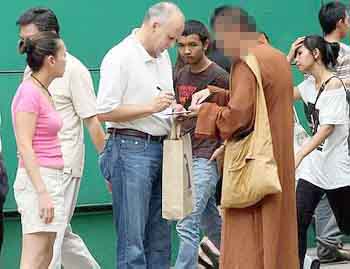
Kuala Lumpur, Malaysia -- BOGUS monks are roaming the streets of the Klang Valley, cashing in on the generosity of the people to make money.


Charming: A man clad in a monk’s attire selling amulets to a tourist in Bukit Bintang.

These imposters can be seen going from table to table in restaurants in the commercial areas, and even approaching people at the public car parks.

According to Buddhist Chief High Priest of Malaysia, Venerable K. Sri Shammaratana, monks who begged for money are violating the Buddhist code of ethics. The alms bowl is strictly meant for food.

According to the owner of a coffee shop in Damansara Utama, who asked not to be identified, the imposters would make their rounds at the various eating places in the commercial area at various time.

“You won’t see them at a specific time. Sometimes they come at about 10am, sometimes they target the lunch crowd,” she said.

There were also reports of such monks stationing themselves at the morning and night markets.

StarMetro also observed the movements of these spurious monks at the busy Bukit Bintang area on a Saturday afternoon.

A man wearing an ankle-length saffron robe with a cloth bag on one shoulder was seen taking a breather outside the Lot 10 shopping centre when a security guard motioned him to move away.

He then walked across Jalan Bukit Bintang and stopped at the junction just in front of the Pavilion Kuala Lumpur.

The man, in his mid-30s, targeted only foreign tourists and would not even bother to stop locals who walked past him.

He seemed to be holding a small amulet in one hand and trying to sell it to the foreigners.

After about 20 minutes, he then walked back to the area in front of Lot 10 to sit down for a short rest.

Bro. Wei Han: I am not sure if this is the first time this thing is being highlighted in the newspaper but I do believe that I have been telling everyone that I know that it is best not to be fooled by these bogus monks. They are definitely someone who tried to make easy money from the public and we, are the public, should not be encouraging them by giving them donations or buy anything from them in the name of Buddhism.

So, the only thing that I can tell you here is STOP being fooled by these scums!

Thursday, May 07, 2009

A momentous meeting gives reel life to extraordinary monk

by Kumudini Hettiarachchi, Sunday Times (Sri Lanka), May 3, 2009

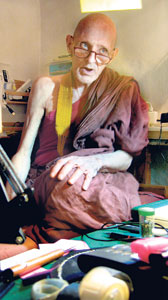
An encounter between an artist and Venerable Bhikkhu Sumedha gives rise to a film ‘The Truth is Unbelievable’

Colombo, Sri Lanka -- Their paths were not meant to cross until 20 days before his passing away, although many were the times she attempted to contact him.

The one and only meeting that did take place “at the right time” in a bare and humble cave up in the hills of Getambe in 2006, lasted from dawn to dusk, though he was very feeble and frail having had no solids for three weeks and no water for 10 days because “he had a problem with his throat and lungs and found it difficult to swallow”.

That single defining moment has yielded not only a very moving exhibition but also a meaningful film for posterity. As Sri Lanka celebrates the thrice-blessed day of the birth, attainment of enlightenment and passing away of Lord Buddha, audiences here will be able to witness not only the life and times of a man who cast aside worldly pleasures to follow in the footsteps of the Master but also messages and links between Buddhism and the modern world.

‘The Truth is Unbelievable’ is the result of that one and only “encounter of a different kind” between Venerable Bhikkhu Sumedha and dynamic Argentinian painter Cora de Lang.

Bhikkhu Sumedha passed away when he was 75 years old. His body had been ravaged by cancers that he had overcome but when I met him he was after a bad bout of pneumonia, says Cora who is in Sri Lanka with husband Richard Lang, the Director of the German Cultural Centre. Cora had got to know of Bhikkhu Sumedha through Richard who had to read up about important and interesting people when he took up a new posting.

“The first connection came when we saw a catalogue of the paintings of Bhikkhu Sumedha which had been put out by Deutsche Bank,” says Cora, explaining that Richard had pointed out the similarities between those paintings and hers.

Soon after, when she was in Kandy on a painting trip she tried to contact him but was not able to meet him, for he was in hospital. However, later she had got an address and a phone number for his humble abode, Manapa Dassana Lena, hidden away from the madding crowds up 108 steps, in Dulwela village close to the Getambe temple from Ven. Metta Vihari whom they were in contact with.

Richard, however, had gone to the cave earlier to invite Bhikkhu Sumedha to a conference and also to exhibit his paintings on the theme ‘Buddhism in Art’ during the 50th anniversary celebrations of the German Cultural Centre.

The monk while explaining that he was just a hermit had declined to attend the conference but agreed to the exhibition as he was “trying to paint the Dhamma”. Painting for Bhikkhu Sumedha was a form of meditation, says Cora. “It was a spiritual exercise. He sacrificed his art to Lord Buddha.”

He indulged in some “incredible works where you could actually go inside the paintings” and did sell some of his works, while also giving away many to friends and relatives, but Cora believes that as an ardent follower of the Buddha he did not handle cash. He had made arrangements for the funds to go to charities and to develop the Intensive Care Unit of the Peradeniya Hospital.

Although he agreed to be part of the exhibition to be held in August 2007, he clarified one small detail. “I will participate but I won’t be there,” he told Richard, who couldn’t believe his ears. Soon after, Cora had an exhibition in 2006 at Barefoot and it was then that Bhikkhu Sumedha, even though he had never met her, laid down a small condition, sending an e-mail to Richard asking whether she would agree to be the curator of his exhibition.

She was surprised -- it was a very Buddhist thing. Could she handle it?

Why did he pick her? She was assailed by doubts.

The exhibition was held in the meditation room of the Sambodhi Viharaya in Colombo 7, but he had passed away by that time, recalls Cora. If certain things were not meant to be they were not meant to be, she says adding that it was as if he was guiding the whole thing. She cites the example of a huge table that couldn’t be taken out of the room. Wracking her brains how to deal with it she had decided to cover it with white cloth, bought metres of it and hired a tailor to stitch it up. The day before the exhibition when they attempted to fit the cloth, it just would not. Desperate she wondered what to do when an idea crossed her mind – why not use his robes and “that was perfect”.

Cora reveals how Bhikkhu Sumedha who was Aja Iskander, a good artist back home, across the seas, in Switzerland came to don the robes of a monk in Sri Lanka forfeiting all worldly comforts and living in a wet and insect-filled cave. Born to a German mother and Egyptian father, Aja had lived a comfortable life with his mother in Switzerland, after his parents separated. “He held a German passport but never lived in Germany,” she says.

Life took its usual course for Aja – he married twice, had children. “He was very fond of his grand-daughter,” says Cora explaining that many were the visits they paid him in the cave.

Suddenly, as young people do, he decided to travel the world and came to Sri Lanka. Getting into the whirl of Colombo’s social circuit, it was at a party that something happened and he decided, “that life was over”. He went to Kataragama, thinking he would become a Swami and lived in a cave there, only to realize that the only path for him was the path of the Buddha.

Bhikkhu Sumedha was in touch with Ven. Nyanaponika – who was the Editor of the Buddhist Publication Society – in Kandy and it was he who invited him to the Manapa Dassana Lena, earlier occupied by a German Bhikkhuni. That was where he lived for 26 long years until his passing away.

The one and only meeting Cora had with Bhikkhu Sumedha is vivid in her mind. She was painting in Galle when Richard called her and said that he had received a message that the monk who was very ill had left hospital saying that he had certain things to do.

Richard felt it was time to see him as Bhikkhu Sumedha had contacted him and said that the time was close. She came back home to Colombo from Galle and early next morning it was that they journeyed along with Ven. Metta Vihari to Dulwela. Having heard before that he was averse to being filmed, she just grabbed a not-so-sophisticated camera, more for taping his voice.

As they climbed the 108 steps, others had beaten them to it. A crowd had gathered, bringing with them small offerings such as king coconuts. Two nurses were also there, one weeping softly.

“He was very kind to simple people and helped the villagers, attending to their wounds,” says Cora.

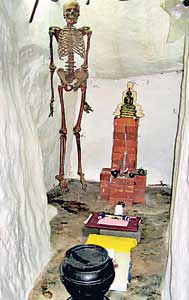
The moment they entered, he started speaking. “He was expecting us,” says Cora, explaining that he was sitting on his bed and in one corner of the cave there was a skeleton moving gingerly. When she gestured carefully that she would like to tape what he was saying he gave a sign that it was okay.

The simple cave seemed like a message……there was a bronze statue with the words scribbled on a piece of paper, “DNR” indicating do not resuscitate. Art installations were scattered everywhere. Even a small toilet constructed by Jagath Wijesiri who was by his side until the very end, had been turned into a work of art.

“He saw in advance his death,” says Cora who felt as if she was part of the process of accepting her own father’s death.

For 12 long hours he spoke, “heavy matter – non-stop”, while they filmed and wondered how this frail monk could hold forth like this. “First part was more for us and the second a kind of message to the world,” she says…..lot of material, speaking in German, English, Sinhala, Pali et al. He spoke of modern things – parallel worlds, the modern world with internet and the teachings of the Buddha. He was full of energy – sometimes provocative, also providing his own answers because he had experienced it all, marriage, kids, love, hate, separation.

As the evening shadows lengthened, they sensed he was tiring out and bade him goodbye, with the hope that they would see him again. But as they went down the steps, his voice rang out and still she hears the echoes in her mind ……..“Remember, remember, everything is anichcha (impermanent)”.

It was his final goodbye.

Cora knows of a wish Bhikkhu Sumedha had. He wished to be known as that “Sri Lankan monk” and not a German monk, truly reflecting his love for this land.

---------------
‘The Truth is Unbelievable’ will be screened on May 11 at 5 p.m. and 7.30 p.m. at the BMICH as part of the Vesak Film Festival. It was shown at the Swansea Bay Film Festival in Wales in 2008 and will go to the International Film Festival in Phuket, Thailand and also to Cairo and South Africa.