
Something Big is coming.
Stay tuned for more updates!


Singapore -- Buddhism and Islam are two religions we do not hear mentioned in one breath very often. So it was with great anticipation that I went to attend the conference, Buddhism & Islam – Encounters, Histories, Dialogue and Representation held at McGill University, May 29 and 30, 2009. The conference indeed turned out to be eye-opening.
Not many know that the encounters and relationship between the two religions commenced almost at the very beginning of Islamic history. The first panellist, Xinru Liu, opened the conference with her research on Tukharistan (northern Afghanistan), Sogdiana (southern Uzbekistan) from 6th to 8th century, which was the junction on the Silk Route for routes going east and west and north and south. This region was Buddhist an[]d Zoroastrian before the Muslims came in as invaders and traders. There was not a sudden conversion because of the fear of the Muslim armies as is generally believed, but close collaboration and cooperation in the region.
The people there greatly appreciated the opportunities that came with joining the Islamic culture and civilization. For some, it was also convenient to be Muslim under the Muslim regime and pay no taxes, since in Umayyad times Muslims did not need to pay taxes. However, once Muslim, they continued to be so and the region produced many philosophers,
scientists and mathematicians who took Islamic civilization to new heights, while as Liu argues, also preserving their pre-Islamic local cultural traditions.
Equally interesting in this panel was Alexandre Papas’ paper in which he discussed the writings of two Ottoman travellers to China in the early twentieth century. The dialogue between the Muslim authors and Buddhist monks was discussed. It was interesting to see that they discussed the similarities and dissimilarities between the two religions as well as political issues with both their countries facing Western domination.
However, the highlight of the day was Georgios Halkias’ paper on
Muslim Queens of Buddhist Kingdoms, which was about the practice of bride exchange in Ladakh and Baltistan. According to Halkias, “the Muslim Queens of the Himalayas stand witness to a rich cultural fusion, an old blend of Arab, Persian, Mongol, Indian and Tibetan elements. Ever since the conversion of the Baltis to Islam in the 14th century, the Muslim princess-brides stood as promises of unity and peace and as a means of alleviating conflict between the warring houses of Baltistan and the Buddhist
kingdoms of Ladakh.”
Interestingly, these Muslim queens ruled the Buddhist kingdoms as well, longest rule having been of 13 years, and were patrons of both Buddhist monasteries and mosques. Muslim and Buddhist interactions in Tibet discussed by José Ignacio Cabezón, was also quite absorbing. According to him, “Muslimsboth Muslims of Kashmiri origin and ethnic Chinese Muslimshave lived among Tibetans for centuries.” However, he argues that the “Chinese annexation of the Tibetan plateau has exacerbated the tensions between these two groups.”
The two papers presented on Buddhism in Muslim Indonesia by Karel Steenbrink and Hudaya Kandahjaya were complementary and explained a unique situation really well. Buddhism and Islam have lived together in the region since the arrival of Islam in 1200, Buddhism these days being mainly represented by the Chinese community. Indonesia, in spite of having the largest Muslim population in the world, does not call itself an Islamic state. Six religions are recognized by the state of Indonesia.
However, people of all religious communities have to accept the Pancasila ideology, one of its principles being, “belief in the one and high divinity.” This leads to the development of a unique situation for the Buddhists, since in their belief, the presence or absence of God is left undefined. Some Buddhists in compliance with Pancashila and also because of Muslim influence are using the concept of Adi Buddha, a form of divinity. This is seen as problematic by others who perceive it as forming a
new kind of theistic Buddhism.
The two papers on Thailand brought about two contrasting pictures of the region. Charles Keyes of University of Washington gave more of a historical perspective telling us that by the beginning of twentieth century, Muslims were a distinct minority in Thailand, they came from South Asia, China, Malaysia and some were also ethnic Thais. However, with the restructuring of the state in the late 19th century and growth of nationalist feelings, promotion of Buddhism became fundamental to Thailand. The result of this being that the Muslims then became the “others” or what is called khaek in Thailand.
This rhetoric of difference has led to “some Muslims, especially Malay-speaking Muslims, have embraced fundamentalist versions of Islam and some Thai politicians and Buddhist leaders have accentuated Buddhist nationalism.” On the other hand, Alexander Horstmann’s paper focused on the small village of Ban Tamot in Southern Thailand, where the Muslims are mainly concentrated. He talked about an ancestor-worshipping ritual held in the cemetery, in which local Imams as well as Buddhist monks participate. Very interestingly, “the basis of this ritual is the mutual bond of kinship relations that criss-cross through the religious communities and the local elites. Thus, the Imam of Ban Klong Nui is related to the old Buddhist abbot of Wat Tamot. Second, the village spirit is believed to be of Malay-Muslim origin ... Thus, while not explicitly announced, the participation of Muslims is crucial to the ritual.”
An interesting project on Islam in Tibet has just been finished by the Warburg Institute of the University of London. Two of the papers presented on Rashid al-Din’s (1247-1318) Life of the Buddha were part of the project. Rashid al-Din’s book is considered the oldest World History book, in which he dedicates a separate section on the life of the Buddha. Ronit Yoeli-Tlalim highlighted the aspects from Tibetan Buddhism that are present in the work and also attempted to give evidence of the presence of Buddhists in the Ilkhanid court.
Commenting on the same text, Anna Akasoy brought out the use of Islamic terminology by Muslims in trying to understand Buddhist concepts. This is what the two scholars called a 'cultural translation', where Buddhists concepts were Islamicized in order to be understood.
The conference ended with another interesting panel on Religion and Local/Global Identities, where an effort was made to understand how one community perceives another in various places, Japan, India, Thailand and Malaysia.
And how contemporary scenarios like the 9/11 affect relations, although needless to say, do not alter them completely. This conference gave a much needed comparative religious perspective. More such efforts are needed to bring out the fact that most religious people when left to themselves are able to live together in a collaborative and cooperative way, enriching all the cultures and religions involved.
This “cultural translation” is an ongoing process, in spite of the hoopla surrounding fundamentalisms of all sorts today. (The picture shows the mosque in Lhasa).
Excerpted from Juhi Shahin's book "Rethinking Islam".
Kandy, Sri Lanka --The latest attempt to proselytize the Buddhist world comes in the form of a book entitled ‘Peoples of the Buddhist World: A Christian Prayer Guide’ by Hattaway Paul. Anthropologically speaking, the book deserves credit for its excellent well-researched materials as it deals with 238 distinct people-group profiles, photographs and maps of the Buddhist world – something that Buddhists are capable of producing, but are lazy to do so.

Make no mistake: this most conspicuous book is enterprisingly well done. But it has a hidden agenda: This book serves as a layout and roadmap of Christian evangelical interests and zeal. It is a precise blueprint, a battle plan drawn to craftily attack the peoples of the Buddhist world.
Educated and affluent Buddhists, however, should thank the author, an active evangelic leader for producing such an enlightening overview of the peoples of the Buddhist world because not many at all know about the majority of these 238 groups mentioned by him.
Indeed, many of these Buddhist communities are little-known and often forgotten. They are some of the most neglected peoples of the world. Much has been said on the evil intentions of the Christian evangelical missionaries for trying to ‘pray and touch the souls of ordinary people’ and bringing them into ‘the merciful rescue of God, the ruler of heaven’.
My intention here is neither to write a review of the book condemning it as anti-Buddhist nor to parrot the accusations labeled against such greedy evangelical missionaries but to urge my fellow educated and affluent Buddhist brothers and sisters of the civilized world to understand that the wisest solution to such proselytization of the Buddhist world.
It does not lie on how logically and convincingly we criticize such undertakings and how many anti-conversion laws we need to enact. The intention is to undertake an honest, objective re-examination of our own Buddhist system within.
It is often proudly claimed by us Buddhists that Buddhism has survived for 2550 years armed with its teachings of non-violence, tolerance, ability for different adaptation, and compassion. Perhaps we have forgotten the lost history of Buddhist lands of the entire Indian subcontinent.
We have lost Afghanistan and Pakistan (East and West) to Muslim invaders, India and Nepal to Hindus and far eastern regions of the Middle East to hard-line Muslims. Having lost so much, how much more are we waiting to lose? This is a question that every progressive Buddhist needs an answer to.
Despite having survived the historic onslaught of Islamic invaders, these unknown Buddhist lands face the grim reality of losing their communities to the onslaught of Christian evangelism. 20th century South Korea is an example of how easy it is indeed for Buddhism to fall prey to aggressive evangelism.
Historically speaking, the strength of Buddhist evolution centered on the members of its monastic - the Sangha. The Sangha institution became the backbone of the entire Buddhist community in any given social context, be it Theravada, Mahayana or Tibetan throughout its 2550 years of history.
The success of Buddhism is often measured by the strength of the Sangha. The traditional defenders of Buddhism have been and are still, the monks and nuns. As a natural consequence, Buddhist adherents tend to look up to the monastic Sangha for guidance. Unfortunately, this dependency has brought forth a devastating paralysis, especially at a time when the monastic priesthood is losing its pristine social and spiritual position as moral models and embodiments of love, compassion and wisdom.
For the last many decades the Buddhist monastic Sangha in every Buddhist country have not been faring well enough to retain its followers and attract new converts. Some monks have been busy filling up pockets while some others are poorly trained to cope with modern challenges. And yet some of these monks keep themselves busy by fighting for ecclesiastical ranking and power within the monastic system.
All these unsavoury activities leave behind great gaps, neglecting the development of promising and creative social and religious leadership within Buddhist circles. Christian evangelicals have been quick to fill up this "Sangha-lay followers" vacuum.
It is believed that private properties owned by the monastic sangha may well surpass the private properties owned by the government of any given Buddhist country. Enormous public generosity have produced some of the richest monks and temples ever seen in Buddhist history, while millions of Buddhists unknown to many of us have been left out on their own, neglected and forgotten.
Even the very existence of the small but distinct minority Buddhist communities such as the Chaungtha people of Burma, the Khamiyang tribe from India, the Huay tribe of Thailand, the Kutangs of Nepal, the Gtsang of Tibet and the Brokkats of Bhutan - to name but a few - are hardly ever known to more educated and affluent Buddhists.
The Buddhist communities from this part of the globe somehow managed to survive with the harshest realities of existence by sticking to their Buddhist identities under oppressive and unfriendly governments. Is it their karma? How long more do we expect them to continue under the banner of Buddhism faced with everyday realities? Can't Buddhism change their karma? Can't the call of Buddha give them a hope, and a chance to live with less poverty?
Any one claiming that even Buddha cannot alter the course of peoples’ living standard, say unto him that this is "utter nonsense". In any case, if Buddha cannot promise to help these desperate people who have been yearning for change and a better life, then why shouldn’t they look up to a foreign God who promises them immediate prosperity, wealth and change here and eternal heaven hereafter? Indeed, the ‘new God, new country’ – a phrase often utilized by missionaries to pinpoint modern Korea under Christianity – has been an enticing and eye-catching example of change brought about by Christian evangelism.
It is time for the progressive Buddhists to meditate on this.
Yes, these Buddhist communities are illiterate and poor. They are easy targets for evangelism. But they deserve education and material prosperity before they could think of religion. And evangelical missionaries are providing just that.
Why can't the richest monks, richest temples and richest Buddhist organizations of the affluent world mobilize work teams to visit and look into the grievances of these forgotten fellow Buddhists? Why are we just shouting at others who are helping them when we chose not to act ourselves?
The Buddhist teachings of karma, rebirth, suffering, selflessness, and contentment have all been part and partial of a deeper level of misunderstanding of Buddhism even among the most educated and affluent civilized Buddhists, and their misunderstanding has been a boon for the greedy missionaries to take advantage of these Buddhist teachings.
Maybe somebody is born poor because of his karma. And someone else out there is suffering and dying without proper hospice care. So what? He's got lots more rebirths coming up next. Somebody is poor but wants to have a better life. So instead of providing skills and opportunities, they are asked to "practice contentment". This is the unfortunate mentality of Buddhists towards those who are at the bottom rung of society.
No matter how openly they deny, sadly this has been proved to be the case over and over again. Highly spiritual monks and committed practicing lay Buddhists tend to overlook the necessity of material development.
But what these people forget to realize is that there cannot be spirituality where there is widespread hunger and poverty; and healthy spirituality cannot exist where there is widespread illiteracy, ignorance and superstitions. It is only in the very recent time that the affluent Buddhist world has felt the need to counter evangelism by establishing parallel institutions like schools, colleges, hospitals, aged homes and carry out relief works but the fact that this is largely to meet the needs of the local community, this is yet to affect the millions of forgotten Buddhists in unknown parts of the world.
And this raises the extreme Buddhist need to establish cohesive, well-financed, dedicated and inspired international Buddhist organizations to safeguard the very existence of the peoples of the Buddhist world through active participation on field.
But it is easier said than done. Believe it or not, Buddhists tend to be very proud and suspicious of fellow Buddhists. The powerful ecclesiastical monastic sangha of Thailand would not allow temples from other Buddhist countries to be built on its soil, while the building of aTheravada temple in the Korean soil is most likely to be seen as an attempt to Theravadize the Mahayanist Koreans. Such is the suspicion and pride among Buddhists of different countries.
Some other Buddhists yet take pride in promoting so-called inter-religious dialogues between Buddhists and Christians, between Buddhists and Muslims but the irony is that Buddhists of Theravada, Mahayana and Tibetan seldom get along together.
Sadly there is hardly any effective contactsbetween and among these three major Buddhist dominations. Economically weak Theravada Buddhist temples and monks of Sri Lanka, Thailand, Burma, Laos and Cambodia have been struggling to cater the needs of their respective native followers living in the West. Meanwhile the economically stronger Mahayana Buddhist temples and monks of China, Taiwan, Korea and Japan have been struggling to expand their influences throughout the rich West. And despite having poured millions of dollars for building temples and universities there, yet Tibetan monks have been struggling to get fame and popularity to draw the attention of the world to their Tibetan issue.
All these trends have effectively left millions of native Buddhists forgotten and neglected. In their unknown lands, it is they who are in dire need of financial investments, education, creative leadership and social betterment more than the West.
It cannot be denied that the West needs promising monks and Buddhist leaders more than anyone else. The Western public is intelligent and affluent but it is we, the Asians, who have taught them the Dharma. But while we try to meet their spiritual needs with our limited spiritual Asian resources, we must also never never forget Buddhists from these unknown lands
They have been, and are our fellow Buddhists for centuries. We share identical Buddhist culture and history but are not getting what they deserve from their more fortunate and affluent fellow Buddhists.
So this being the case, how ethical correct are we to oppose anyone who goes to standby, help and live with these unwanted peoples of the Buddhist world? What Buddhist doctrine can we possibly use to justify and declare that such an action is immoral?
Even the most fanatic Buddhists among us would have to accept the fact that no matter with what ulterior motives the Evangelicals choose to help such forgotten and neglected peoples, the intrinsic goodness of their action is something that cannot be denied or downplayed.
And this only questions our inability and unwillingness to help our own fellow Buddhists.
Indeed, evangelical groups are proving to be very successful with their slogan - ‘believe in Jesus, he will be always with you’. Many things would change if we Buddhists could learn to say ‘we are your friends in your need’ and prove our say with our active social engagement. The kind of Humanistic Buddhism promoted by some creative and progressive Buddhists or Engaged Buddhism as promoted by some is not inclusive enough because it has effectively failed to address and respond to the acute needs of these forgotten Buddhist communities who are now the targets of Christian evangelism.
Indeed, the greatest challenge of sectarian Buddhist traditions and organizations is the unwillingness and hesitation to help those who are not following the form of Buddhism each of them follows.
There seems to be the demand of internal evangelization within and among various sectarian Buddhists before they could be considered fit for help. The most affluent Mahayana Buddhists of Korea and Taiwan, for example, might not be willing to go and help those neglected Buddhist ethnic groups scattered throughout the border areas of Thailand, Burma, Bangladesh and India who are followers of Theravada Buddhism, while the able Theravada Buddhists of Thailand, Sri Lanka and Burma might not be willing to come out for the ethnic minorities of the Himalayan regions who are mostly followers of Tibetan Buddhism.
This is certainly not the kind of mentality the Buddha would very much like his followers to have towards fellow Buddhists. The result is that this has effectively barred the interaction between and among the various sectarian groups of Buddhism.
Let’s not deny the historical fact that Buddha was the first and a successful leader of missionary activities hundreds of years before Christ got the smell of this earth. Let’s not pretend that we Buddhists do not convert followers. We do but the difference in us is that we love to target the most educated, the most affluent, and the most intelligent pundits of the world rather than taking advantage of peoples’ poverty and illiteracy.
We take peoples’ intelligence and wisdom to our advantage which is the uniqueness of Buddhist evangelism. Perhaps this very prospect is leading us to the other disadvantage: losing our fellow poor, neglected and illiterate Buddhists. And this only calls for the implementation of the much acclaimed Buddhist ‘Middle Way’.
The well established large monastic sanghas and lay Buddhist organizations of the known Buddhist world are effectively failing to perform their duties well enough due to unscrupulous remnants of corruption, misbehaviors, mismanagement and inefficiency within.
Some of these monastic sanghas need internal reformation to cope with modern challenges. The high rate of disrobing among the intelligent, educated, energetic and promising young clergy is indeed a headache for many of us. Yet despite all these weaknesses and shortcomings there are lots more that can be done, if we are only willing and are truly selfless – ‘for the welfare and happiness of many’, the slogan used by the Buddha himself to denote his kind of evangelism.
So how and when will these 238 or so people-groups of the Buddhist world fall as victims of Christian evangelism? Is there something that we - as informed Buddhists - can do, or should we just fold our arms and rant in our chests about these "evil evangelists"?
It is time for Buddhists to get our act together, look out for one another and redeem ourselves by rallying to Buddha's call to "go forth... for the good of many, for the benefit and well being of many." Failing which, predatory Christian groups will only be too happy to forage by the wayside, preying on our inaction.
And if we were to let this happen, then the only ones to blame will be us - the indifferent, indolent, complacent Buddhists.
Original article can be found here.

 Having fun time!
 Most of us there... A few went missing at this time...
Ulu Tiram, Johor (Malaysia) -- Large numbers of Singaporean faithfuls flock to Buddhist temples in Johor to pay homage, pray and make donations, and these donations have expedited the development of temples there.

Thanks to the contribution of a Singaporean collector who is also a devout Buddhist, thousands of ancient Buddha statues as well as time-honoured stone, wooded and copper statues have been placed at the Fa Yu Chan Si temple in Ulu Tiram.
These relics include 500 Luo Han statues, thousand-year-old stone tortoise statue, statues of Bodhidharma and the God of Mercy, among others. Such a rich collection has made the temple look like an ancient temples teeming with ancient ruins.
Penang in the northern part of the country, is renowned for its Kek Lok Si temple, and now in the country's southern gateway Johor, a garden-style temple with hundreds of stone, wooden and copper statues as well as epitaphs, the Fa Yu Chan Si temple is fast taking shape.
Other than the Sakyamuni Valuable Palace, the God of Prosperity Temple, Di Zhan Dian Cinerarium Pavilion and the Hall of Spirit Tablets which have been completed within the compound of the Fa Yu Chan Si temple, the remaining buildings such as Buddhist Relics Hall, Cultural Relics Hall and the Bodhidharma Pavilion are under construction.
Rare collection
Even though Fa Yu Chan Si is still undergoing beautification, renovation and further development at this moment, once you step inside the temple, you will be able to find countless of stone statues of Buddha. Other than the most notable Big Buddha's Head and half-body Buddha statues, the most eye-catching relics are the Buddhist columns and pagoda. These masterfully crafted carvings have created an atmosphere of a thousand-year-old ancient temple.
Besides, rows of intricately carved Buddha statues have been neatly placed on both sides of the pagoda and Buddhist Columns.
The Cultural Relics Hall, meanwhile, looks like a relic site full of inscribed texts, stone statues of Buddha, etc, the most outstanding being the 500 Luo Han statues in different postures, costumes, and names. There are also relics from the Tang, Yuan and Han dynasties.
In an interview with Guang Ming Daily, the temple's admin secretary Ms Chen Yi Ping said there are currently many different kinds of relics in the temple, and the most notable include the Crystal Sarira Pagoda containing the sarira of Buddha and and other Buddhist masters, relief carved with the Heart Sutra, the dragon statue said to be the incarnation of Bu Dong Ming Wang, the thousand-year stone tortoise, the five hundred Luo Han, the statue of Bodhidharma made of thousand-year old Longan wood, Buddhist pagodas, etc.
She also disclosed that there is a special statue of the God of Mercy in the temple. Unfortunately, due to technical problems, the statue is not ready for public viewing.
Age of statues yet to be verified
Chen said many of the stone carvings in the temple have been inscribed with the years of manufacture, including the stone tortoise, which almost a thousand years old. According to findings, it is within the period of the Tang Dynasty and it contains thousands of years of history. However, she said as these relics have not been verified by specialists, the temple is unable to ascertain the authencity of these historical items.
She said since the historical backgrounds of these stone carvings have yet to be verified, she advised the public to view these carvings as works of art.
Devotee from land-scarce Singapore builds temple across the Causeway
Land is a scarce commodity in Singapore. Other than the existing temples, there isn't much land to build new temples in the city-state. As a result, Buddhist devotees and monks build their temples on the side of the Causeway, or contribute towards the expansion of the existing temples in Johor.
The abbot of the temple Master Shi Zhen Guan told Guan Ming Daily the thousands of Buddha statues and artworks in the temple have been contributed by a Singaporean Buddhist cum collector.
"By chance I came to know this collector. Originally I only intended to purchase the statues of Hua Yian Shan Shen (Three Sages), i.e. Buddha, Manjuri Bodhisattra and Pu Virtuous Bodhisattva for display at the Sakyamuni Valuable Palace for the purpose of veneration. I never expected that after knowing about my concept of developing the temple, he kindly contributed his collection to Fa Yu Chan Si."
"To me, these relics are invaluable, and their market value is not important to me because the owner's offering came when we were going through the toughest time building the temple. Nothing can replace his generosity and I truly appreciate his kind contribution."
Public viewing welcome
Master Shi Zhen Guan said that initially he felt that many devoted Buddhists gave up their faith when they got old. So he had a vision to build a this Buddhist enclave to provide a quiet retreat for these people.
"Although the temple has already been given a large number of cultural reliefs, due to insufficient funds, we have problem fulfilling the concept of a Buddhist enclave. However, it will remain the focus of our development in the future."
The Master said he hoped to develop the temple to something similar to the renowned Kek Lok Si temple in Penang. While encouraging Buddhist devotees to study the Doctrine and retreat, he also hoped to open the temple for public viewing so that more people could appreciate the relics of great artistic values.
Founder of Fa Yu Chan Si, 38-year-old Master Shi Zhen Guan became a monk when he was only 19. A Malaysian, he used to do his religious studies at Guan Yin Shan in Bukit Timah, Singapore. He moved back to Johor after he decided to build a Buddhist enclave.
He said, "We faced a lot of problems initially, such as the sudden suspension of work due to insufficient funds. Nevertheless, the public have given us their generous support and assistance so that the temple could eventually be completed."
As for the origins of the thousands of stone and wooden carvings in the temple, the Master said he could not be sure whether the collection included those which were hundred or thousand years old.
"The Singaporean collector who presented the relics to us did not reveal the origins of these carvings. Therefore I cannot confirm the values of these items"
Contact
Fa Yu Chan Temple
Lot 380, Jalan Sungai Tiram
Batu 133/4 Kampong Sungai Tiram
81800 Ulu Tiram, Johor, Malaysia
Contact: 016-717 9633 (Ms Chen Yi Ping)
Malaysian director Ng Lid Sine’s films, The Oil Lamp and The Abbot & The Orphan, clinched awards at the Vesak 2009 International Buddhist Film Festival recently
Kuala Lumpur, Malaysia -- TWO animated films produced by the Buddhist Institute Sunday Dhamma School (BISDS) at the Buddhist Maha Vihara in Brickfields, Kuala Lumpur, won awards at the recent inaugural Vesak 2009 International Buddhist Film Festival (May 9 to 15) in Sri Lanka.
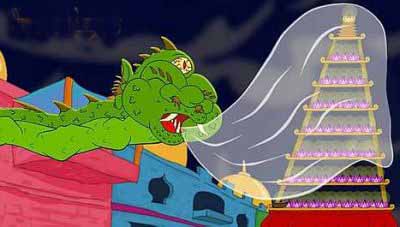 Tale of devotional offering: Mara, the evil one, blowing with all its might to extinguish a tower of oil lamp offerings.
The Oil Lamp clinched the first prize in the International Short Film Competition while The Abbot & The Orphan – The Shrine, Ep 1 received a merit award (the only merit award given by the organising committee) as it exceeded the 12 minute restriction for each short film. Both films were by Malaysian director Ng Lid Sine.
Satoshi Hirayama took second prize for his entry entitled Heart Sutra, a video poetry of the sutra that depicts oneness with the universe. Another Japanese director, Kazuhiko Mizushina, won third prize for Sneakarma, a black comedy, which tells the story of a youth’s intense attachment to sneakers.
Seven shortlisted entries for the International Short Film Competition were showcased on Sri Lanka’s national television during the duration of the film fest. It is hoped that the film fest will continue to grow annually culminating to a grand event in time for the celebration of 2,600 years of Buddhism in 2011.
Ng, 47, director of Cartoon Workshop, received the awards in a ceremony at the New Theatre of the National Film Corporation Sri Lanka in Colombo on June 16. The Oil Lamp tells the tale of a devotional offering of light to Buddha by an old beggar woman. Her devotion is so strong that even Mara, the evil one, is defeated.
“The animation was done some years ago, hence the retro feel to it,” Ng explained. “Characters were based on Indian comic styles with a bit of Asterix thrown in. It took us about three months to complete it,” says Ng.
“The moral behind this nine-minute animation is not how much you give but how you give it.”
The Oil Lamp, says Ng, has never been shown to the local Buddhist community but was presented once to the late Chief High Priest of Malaysia and Singapore, Ven Dr K. Sri Dhammananda.
“The BISDS is continuously searching for ways to propagate the Buddha Dhamma (the Buddha’s teachings) in line with its 80th anniversary theme, ‘Dhamma in Motion’. This animation will most likely be among the movies that BISDS will screen from time to time.”
Presently, Ng is working on a local animated television series and The Abbot & The Orphan animation series, which revolves around an orphan who is cared for by an old and blind abbot.
According to a press release, the Chief High Priest of Malaysia Ven K. Sri Dhammaratana Nayaka Maha Thera was instrumental in getting the films submitted for the competition. He was happy with the success of the BISDS’ first foray in film production and hoped that the BISDS will receive more support for future film productions.
The BISDS principal, Ven. K Sridhamma Thera, said: “The two animated films which were co-produced with Cartoon Workshop were projects undertaken by the BISDS to propagate the Dhamma in its outreach programmes.
“We hope to produce more contemporary productions to enable us to reach out and touch the young minds who have embraced the digital world.”
The BISDS was established in 1929 by Sasana Abhiwurdhi Wardhana Society with the aim of educating children on the Buddhist teaching. It celebrated its 80th anniversary this year and is the oldest Buddhist Sunday School in the country.
The BISDS welcomes sponsors for the production of the The Abbot & The Orphan series as a novel way to disseminate the Buddha Dhamma. The Abbot & The Orphan DVD series which are in English and Mandarin are available from the Buddhist Maha Vihara (% 03-2274 1141).
For further enquiries, contact: Vineeta Serisena (tel: 012-2173 310), Catherine Heng (tel: 012-3921 683), Lau Kai Kong (tel: 012-6757 959) or Jackie Chong (tel: 012-3218 006).
Kuala Lumpur, Malaysia -- The Buddhist Maha Vihara Brickfields in Kuala Lumpur launched the Sri Lanka Aid fund to assist some 400 orphans in an Internal Displaced Camp in Northern Sri Lanka. These children are mentally affected by the conflict- traumatized, socially disoriented and psychologically vulnerable.
It is important to reach out to the children as they are the most vulnerable section of the population in any conflict. In a serious disorientation condition, they can be easily removed away from safety nets and trained to become child soldiers due to naivety, anger, etc or exploited by unscrupulous elements into child labor or prostitution. They are the most vulnerable section of the population in any domestic, localized or full scale conflict.
To help the children, the Buddhist Maha Vihara Brickfields is organizing a project to raise money to educate and provide assistance to these children. Launching the project was Deputy Federal Territories Minister Datuk M. Saravanan who also pledged RM10,000 from the Ministry. The President of the Malaysian Hindu Sangam, Datuk A. Vaithilingam and the Head of the Pure Life Society, Mother Mangalam and Datin Indrani Samy Vellu who is the wife of the President of the Malaysian Indian Congress (MIC), Datuk Seri Samy Vellu also participated in the launching.
The MIC is the largest Indian based political party in Malaysia. The Hindu Sangam is the umbrella body of all the Hindu temples in Malaysia. Mother Mangalam, a socio-welfare activist has been closely associated and worked with the Buddhist Maha Vihara for decades to promote inter-faith fellowship and cooperation.
Joining them to launch the project was the Chief Incumbent of the Buddhist Maha Vihara and also the Chief Sangha Nayaka of Malaysia, Ven K Sri Dhammaratana Nayaka Maha Thera who will be going to the IDP Camp in Sri Lanka to distribute goods and educational aid to the children.
The Venerable is no stranger to helping orphans as he is also the founder and Spiritual Director of the Tiratana Welfare Society which runs an orphanage, old folks home, half-way home for runaways, welfare centers and a mobile clinic. The Tiratana Orphanage has more than a hundred and fifty children of whom, about 40 percent are Tamils. Some of these Tamil children from the Orphanage too came forward to participate and donate to the fund to alleviate sufferings of fellow children in another part of the world.
The Buddhist Maha Vihara has to date collected about RM30,000 for Sri Lanka Aid. A limited amount of donations in kind is being collected too.
In the period 2004-2005, the Buddhist Maha Vihara has helped Sri Lanka heavily too for Tsunami Relief sending container loads of aid by air and sea for immediate relief providing relief items such as ready to eat food, dried food, clothes, medicines, generators, etc which found its way to all parts of the country affected by the Tsunami including the Northern Region and the Eastern Province.
In Kalmunai, the Vihara funded the rebuilding of 2 Hindu temples destroyed by the Tsunami and sponsored a daily refugee feeding program. These projects were undertaken by the Triple Gem Society of USA led by Ven Y. Wimala. The Vihara also sponsored the building of the outpatient and specialist wing of the District hospital in Tangalle which was equipped later by AmeriCare of the USA.
A Sri Lankan Buddhist monk is tickled as he recalls his early days in the United States
Kuala Lumpur, Malaysia -- BHANTE Walpola Piyananda, a Buddhist monk from Sri Lanka, arrived in the West Coast of America on July 4, 1976. He was 33 then. During his early days in the United States, people had never heard of a Buddhist monk. He was ridiculed, humiliated and ignored; at times, he was a victim of mistaken identity.
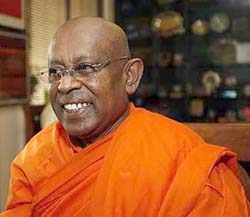 However, all the nasty incidents did not deter Piyananda from settling down in the United States where he has been residing for 33 years.
 At Rachel and Regina's place
 Shin Dhee doing the initial trial (training)
 Swing to the net
 Climbing the Big Ladder
 Regina is abit afraid of going up...
 Walking on the net...
 harness... the equipment to keep you safe
 Zig-zag...
 Doing a flying fox...
 The pipeline (one of the hardest here)
 The long bridge
 again...
 Swinging to the big net
 Group photo before going off...
Temples have been built across cultures since there have been human settlements, from the massive Egyptian temples, to the ornate examples in the Indian sub-continent, to the palatial edifices in the Far East.
Temples are not just places of worship, but also an enduring testimony to humanity’s faith in the sublime and the infinite. Some temples are humble structures, but others are humbling.
Here are 10 spectacular temples that take the breath away and inspire in us a sense of wonder.
Tiger’s Nest Monastery (Bhutan)
Perched precariously on a 3,000m high cliff above Paro Valley, Tiger’s Nest Monastery is one of the holiest places in Bhutan and its most spectacular. It is not especially big but its beauty and dangerous-looking location never fail to take the visitor’s breath away.
Tiger’s Nest appears to float in midair, especially on a misty day. Its Shangrila-like setting makes it look like a surreal dream palace rather than a place of worship. Amazingly, it was completed in 1692 without the aid of modern technology. Even today the place is accessible only by foot.
Its official name is Taktshang, but it is more popularly know as Tiger’s Nest because it is said that the great sage and guru Padmasmabhava flew there, once upon a time, seated on a tiger.
Wat Rong Khun (Thailand)
Wat Rong Khun in Chiangmai is unlike any Buddhist temple in the world. It is pristine white, as opposed to the riot of colour that is the traditional Thai temple with its signature red, gold and green roofs, multi-coloured deities and guardians.
This relatively new temple was initiated by one of Thailand’s most famous artists, Chalermchai Kositpipat, in honour of the King of Thailand. Work is still ongoing, and it is expected that three generations of artists will take another 60 years to complete painting the artwork inside.
Chalermchai, 53, expects to devote another 20 years of his life to the project, which now attracts some 1.8 million visitors annually.
Prambanan (Indonesia)
Prambanan is the biggest Hindu temple dedicated to Shiva in central Java. Built in 850AD, it has eight main shrines and many smaller ones that reportedly make up a grand total of 1,000.
Many visitors are overwhelmed by its elegant spires and refined architecture, which seem both ancient and modern. Quite a few have compared it to the Petronas Twin Towers!
Legend has it that Princess Lara Jonggrang demanded that her suitor, Prince Bondowoso, build 1,000 temples within a single night if he wanted to win her hand in marriage. Evidently, she did not fancy him and thought the task an impossible one.
But her determined suitor summoned supernatural spirits to do his bidding and was just one temple short of reaching his goal when Princess Lara lit a bonfire and roused the cockerels, which began crowing even though it was not yet dawn. The spirits, thinking morning had arrived, fled back into the bowels of the earth.
Gleeful, the princess laughed at her suitor, and this so infuriated him that he turned her into stone. Her statue, apparently, can still be found in the vicinity of the temple.
Shwedagon Pagoda (Myanmar)
Shwedagon was first built in the 6th century when Yangon (or Rangoon) was still known as Dagon. Its name shwe dagon means “Golden Dagon”, and this is due to the fact that the temple is filled with thousands of statues of the Buddha in solid and plated gold.
 Shwedagon Pagoda in Myanmar
One, in particular, is said to be so efficacious in granting wishes that crown princes were forbidden from entering its chapel lest their wish for the king’s speedy demise was granted!
Still in use, Shwedagon is the holiest temple in all of Myanmar and comparable in splendour to Angkor and Borobudur. The main stupa reached its present height of 98m in the 15th century. Its tip glitters gloriously from 5,448 diamonds (totaling 1,800 carats) and 2,317 Burmese rubies. The pinnacle is crowned by a flawless, 76-carat diamond and the entire edifice is plated with 24-carat gold.
Shwedagon is said to be the only temple to contain relics from all the four known Buddhas, including eight strands of hair from Gautama Buddha. The last and fifth enlightened being, the Buddha of the future, is called Maitreya and will appear to save humanity in its darkest hour.
Temple of Heaven (China)
The Temple of Heaven is a Taoist temple in Beijing. It was the most important temple for the emperors of yore because it was here that he came twice a year to commune with heaven.
The temple was constructed in the 14th century by Emperor Yongle during the Ming Dynasty. In keeping with the yin-yang concept, there is also a Temple of Earth — a clone of Temple of Heaven. In addition, the Temple of Sun and the Temple of Moonhelp to complete the four cardinal points.
The Ming and Ching emperors wore special robes and abstained from eating meat for a week before coming here to offer prayers to heaven for a good harvest. The famous Echo Wall in the temple vicinity spans 193m and is an acoustic marvel. A person listening at one end would be able to hear words whispered at the other end.
At 2.7 million sq m, the temple’s overall area is bigger than the Forbidden City’s, and this was because the Son of Heaven dared not live in premises larger than the heavenly realm.
Chion-in Temple(Japan)
Chion-in Temple was built in 1234 to honour the priest Honen, founder of Jodo (Pure Land) Buddhism, who fasted until death here in 1212. This famous temple in Kyoto is considered one of the most important in Japan.
Honen taught that everyone could be reborn into the Pure Land and escape the cycle of rebirth. His simple teachings and practical advice made the Jodo branch of Buddhism one of the most popular in the Land of the Rising Sun.
The temple’s two-storey main gate is a famous landmark that moviegoers may be able to recognise since it appeared in the 2002 blockbuster, The Last Samurai, standing in for Edo Castle. The bell in Chion-in is Japan’s heaviest at 74 tons, and requires 17 priests to ring it during the New Year ceremony.
Borobudur(Indonesia)
One of the wonders of the world, Borobudur was built with 55,000 cubic metres of stone and boasts 504 Buddha statues and 2,700 relief panels that tell a story as they are viewed in clockwise direction as you walk towards the top.
The main dome at the apex of this nine-tier monument has 72 life-sized Buddha statues, each seated inside a perforated stupa. However, the central stupa is empty, denoting the state of nirvana when everything is one and all is nothing.
Built in the 9th century when Mahayana Buddhism was at its peak, Borobudur fell into disrepair in the 14th century when Java embraced Islam. The temple was reclaimed from the jungles in 1814 when Sir Stamford Raffles was notified of its existence.
This Unesco World Heritage site is still used as the focal point of a pilgrimage route once a year during Wesak Day. Borobudur is Indonesia’s single biggest tourist attraction and requires at least four hours to explore.
The Golden Temple of Amritsar(India)
Shimmering like a golden dream on a lake, the Harmandir Sahib (Abode of God) or simply the Golden Temple of Amritsar in Punjab, India, is the most sacred shrine of Sikhism. The Adi Granth or Holy Book of the Sikhs is kept here and constantly recited within its walls.
 devotee lights candles at the holy Sikh shrine of the Golden Temple in Amritsar, India;
Also known as Temple of God or Divine Court, the Golden Temple, conceived by Guru Arjan Sahib, the 5th Guru Nanak, was completed in 1601.
The temple has four main doors that are always open. They represent the four compass directions and welcome everyone from everywhere regardless of caste, creed, religion or sex. The temple is open 24/7.
Sri Ranganathaswany Temple (India)
Sri Ranganathaswany Temple in Tiruchirapalli, Tamil Nadu, encompasses 156 acres and is the largest functioning Hindu temple in the world. Dedicated to Lord Raganatha, a manifestation of Vishnu, the temple is considered the first and most important of the 108 holy abodes of Vishnu.
It is enclosed by seven concentric walls stretching over six miles and guarded by 21 towers. The celebrated Hall of 1,000 Pillars actually has only 953 and is considered a masterpiece of Hindu architecture. Non-Hindus can visit up to the sixth wall but may not enter the gold-topped inner sanctum. Devotees believe Lord Narayana actually resides here.
Angkor Wat, Cambodia
Last but not least is the largest and perhaps most breathtaking temple in history — Angkor Wat.
Its architecture is simply amazing. Unlike other Khmer temples, Angkor Wat faces west instead of east, giving rise to speculation that it was also meant as a tomb for its builder, King Suryavarman II, who ruled from 1113 to 1150.
 The many faces of Buddha that adorn the towers of Bayon Temple in Cambodia.
Angkor was originally meant as a capital city, palace and state temple dedicated to Vishnu. It is meant to represent Mt Meru, the celestial abode of the gods in Buddhism and Hinduism. By the 15th century, it had become a Theravada Buddhist temple.
Angkor is the most spectacular of among more than 100 temples here but the famous, enigmatic smiling faces of Suryavarman II carved in stone are at the nearby Bayon Temple. Angkor’s fame lies in its graceful architecture and its elaborate stone friezes which detail scenes from Buddhism and Hinduism.


