Wednesday, May 18, 2011


Tuesday, April 05, 2011
The End

After running OutReach for the past 6 years, I am sorry to announce that we are finally coming to an end.
We shall be embarking on a new journey soon and more announcements shall be make later regarding our new journey to the future.
Anyway, thanks for the supports that you have shown to us for the past 6 years.
weihan
Tuesday, March 08, 2011
The ‘Black Swan’ Mara
by Shen Shi'an, The Buddhist Channel, March 6, 2011
Singapore -- ‘Black Swan’ tells the story of extreme clash of conflict in body and mind. A ballerina feels compelled by her idealism and expectations of others to play both the pure and restrained white swan and the malevolent and seductive black swan in a revised version of Swan Lake. In order to embody her roles perfectly, she swings to and from between goodness and evil. Can she play a perfect white and black swan at almost the same time? A whole list of other paradoxical extremes are explored too…

Perfection in dance is not just about hard discipline, but about letting go for natural ease too – even as the black swan. Where does creativity and control find a balancing point, or are the meant to be balanced at all? How much effortful grit is needed for effortless grace? There is control in true letting go and letting go in true control. Can stiff control and wanton passion be moderated? Is a good dancer ultimately repeatedly and robotically precise in the same old ways? If so, how is it original, raw and creative art? Even the revamped take on Swan Lake had to be covered repeatedly in rehearsals, rebirthing through heaven and hell.
Too schizophrenically improbable, perhaps it is not realistic for one person to rapidly and alternatively play both swans. Overly immersed in the roles and challenged by not being used to playing the doppelgänger ‘evil twin’, the ballerina develops psychosis, as she starts to internalise the black swan, who expresses her metamorphosis inside out by hallucinating the sprouting black feathers out of her body. The more she externalises the black swan, the more she internalises the black swan. In a vicious cyclic manner, she become the performance as the performance becomes her. The darker her consciousness became, the more she imagined another ballerina who plays the black swan too to be truly black-hearted too. This is the externalisation of inner demons.
In an artistically sickening way, the more indulgent she is, the more expressive she is. The more punishing her practice became, the more ‘rewarding’ it twistedly became. The creative arts for bettering the psyche can be damning and destructive too when taken to its extremes, as with any other thing. As with other controversial arts and even films, perhaps the Buddha’s teaching of the Middle Path should be heeded – to recognise that nothing should be taken to any extreme. Is this movie an extreme one then, of how the arts can become dark? Yes, in a way, but yet paradoxically extremely good as a cautionary tale!
Perhaps the performance arts for serious actors who become the acting is not karmically neutral after all? If one always plays villainous roles as if they are real, does one create some negative karma? Must drama always be so dramatic to be real, or is real life a subtler and grayer mix of light and darkness? Paralleling real life, she dies in the last scene of as the white swan, with her innocence killed by the black swan within. Seemingly a tragically bleak and beautiful ending, as she exclaims her last dance to be perfect. But is art worth dying for, especially that based on illusion? As her instructor advised earlier, ‘The only person standing in your way [of performing well] is you. It’s time to let her go. Lose yourself.’ But she had lost too much – she had lost sight of her perfect Buddha-nature too, overwhelmed by her inner Mara.
Friday, February 25, 2011
Nun's devotion gives hope to orphan kids

VNS, Feb 22, 2011
Ben Tre, Vietnam -- Nearly 20 years have passed since the Pagoda's doors were opened to orphans under the guiding hand of nun Thich Ngo Mai, an orphan herself. Thu Trang report.
As visitors enter the pagoda, a smiling three-year-old boy with round eyes welcomes visitors and sings, "Grandmother, I love you so much. Your hair is white like clouds... "
Minh Thong is one of the 23 orphans who are being raised at Phat Minh Pagoda in Giao Hoa Commune, Chau Thanh District in the southern province of Ben Tre.
During the past 18 years, nearly 50 orphans have been raised in the pagoda, which is chaired by nun Thich Ngo Mai.
Mai, whose real name is Nguyen Thi Lieu, was born in Sai Gon. Her father died when she was only three years old and she was later abandoned by her mother.
Mai, enrolled at Bo De School – a Buddhist school and eventually became a Buddhist nun at Anh Quang Pagoda in District 10.
Eighteen years ago, she moved to the Phat Minh Pagoda when the structure still lacked running water and electricity.
Nun Ngo Mai partnered with charitable organisations and began reaching out to street children. She decided to open the pagoda's doors to down and out juveniles.
To date, Mai has helped raise about 50 orphans. Some of the children's parents died, while others left home because of abuse or neglect.
Nearly 20 years have passed since she opened her doors and some of the children that she helped raise have married, while others are studying at vocational schools and some have become Buddhist nuns and monks.
The first child to be raised at the pagoda, whose religious name is Minh Chi and real name is Nguyen Dinh Tien, now is a student at the Land Forces Military Academy No 2. Currently, there are more than 20 children living at the pagoda and studying in nearby schools.
Two siblings Dieu Tam and Dieu Tuong, whose real names are Nguyen Thi Nguyen and Nguyen Thi Thanh Chi, are from Dac Lac Province. They are happy living in the pagoda.
Tam is three years older than Tuong, but they are both third graders at Giao Hoa Primary School.
"I want to become a doctor or a nun because I love Ngo Mai so much," said 10-year-old Dieu Tuong.
Three ethnic minorities siblings H'Nhien, H'Lin and H'Uk also love Ngo Mai and there other mothers here.
"Sometimes I return home to visit my family, but I want to live here forever," said H'Nhien.
Older children often take care of the younger ones during meals and studying hours. They consider each other to be family. In the pagoda they also have fathers and mothers who provide the pagoda with donations. The donors set up a volunteer team with 20 members, 15 women and five men. The team helps Ngo Mai care for the children.
Ngo Mai said that watching the children eat and play brings her joy.
"Bringing happiness to others makes me happy," she said.
Although she raises several children, Ngo Mai lives off limited means. Phat Minh Pagoda is located in a remote area so few people visit the grounds. Moreover, local residents are not rich so their donations are modest.
A Buddhist named Hue said that every month, donations to the pagoda amount to about VND1 million (US$50).
"Ngo Mai has had to ask for donations from everywhere to have money to raise the children," she said.
Ngo Mai also recites Buddhist scriptures and cooks vegetarian food at parties to earn money.
She has suffered from heart disease, which required her to have surgery, but this set back has not dampened her enthusiasm.
The nun is not afraid to ask for money if the pagoda runs out of rice or if diseases break out among the children.
Ngo Mai said she worries the most about outbreaks.
"Last year, was the hardest year so far at the pagoda," she said.
Within a few months, a boy developed appendicitis, another was hit by acute gastritis, and nearly 10 children were hospitalised with fever. The pagoda did not have money to pay the hospital fees, so the Buddhists had to borrow money to make ends meet.
Some people used to ask Ngo Mai if they could adopt her orphans, but she refused.
"I do not want the children to be abandoned again. Although I have to work hard, the children still eat and can go to school," she said.
Monday, February 21, 2011

Thursday, February 17, 2011
Some ‘Shaolin’ Showdown!
by Shen Shi'an, The Buddhist Channel, Feb 17, 2011
Singapore -- As usual, reflective of the prevalent Chinese Buddhist custom, the monks in the movie ‘Shaolin’ (which is an independent ‘sequel’ to ‘The Shaolin Temple’ made in 1982) chant ‘Amituofo’ (the name of Amitabha Buddha) a lot, in the face of various challenges, come what may. (This was also the case in the first Shaolin movie!) Also reflective of prevalent erroneous English subtitling, the words say ‘Buddha be praised!’
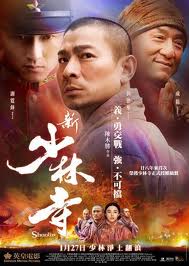
This is an improvement from ‘Oh my God!’ - that I witnessed in another Buddhist film! Who is Amituofo? His name means ‘the Buddha (fully enlightened being) of immeasurable light (of compassion and wisdom) and life (due to his immeasurable merits). ‘Namo Amituofo’, which is also commonly chanted, would mean ‘Praise to, or refuge in Amituofo’.
When fellow Buddhist greet one another with an exclamation of ‘Amituofo’, this expresses one’s wish for another to be aligned with Amituofo’s blessings, and with one’s own Buddha-nature, which is not different from Amituofo’s Buddha-nature. This is why his name is recited both in times of rejoice and empathy, for there is simply no moment when it is not beneficial to be mindful of Buddha. Ultimately, faithful single-minded mindfulness of Amituofo leads to birth in his Pure Land, where enlightenment is guaranteed. So prevalent are the Pure Land teachings that it becomes a catch phrase of the Chan (Chinese Zen) Shaolin monks too. Tragically yet inspiringly, many monks, including the abbot, are featured uttering ‘Amituofo’ as they sacrifice themselves to save the masses.
In the story, a power-crazed warlord, played by real-life Buddhist Andy Lau who wrote the film’s thoughtful Dharma-themed song ‘Awakening’, strives to wipe out every potential enemy, including his sworn brother. Despite the self-delusion that he is in total control, he was really controlled by his immense greed, hatred and suspicion, that gave him no peace of mind. In his words on his enemy, ‘If he does not die, I cannot sleep.’ What he needed to eradicate were his defilements, not anyone else. As his paranoia goes overboard, he endangers his family, the very ones he wanted to protect… leading to his daughter’s death and separation from his wife.
Stripped of his status and wealth, he remorsefully returns to Shaolin for refuge – both in the physical and spiritual sense. He becomes thoroughly humbled by the magnanimous monks, whom he had arrogantly ridiculed earlier. As we can guess, the path to true redemption from his grave negative karma isn’t going to run too smoothly. While he releases his grief and anger through training in the famed Shaolin martial arts, his past returns to haunt him, and he has to confront the archenemy who betrayed him. There is no escape from one’s conscience and karmic consequences! It wasn’t exactly with guns and swords this time though, but with power of the Buddha’s teachings.
Earlier as a warlord, he had budged into the monastery in murderous pursuit of a man. About to kill him, he was interrupted by the abbot, who advised that if only he lets go of his fear (of losing power) and deluded thinking, and abides in kindness instead, he would be able to see everywhere as a Pure Land, thus not ‘needing’ to kill. Rebutting him, he asked the abbot where Pure Land was, since war is raging right at the gates of the monastery. Indeed, this is tension between the ideology of an internal and an external Pure Land. One might be able to abide in peace and calm personally, but what about the countless others in turmoil and those who cause it? Recognising this, the monastery steps up its social engagement with its humanitarian efforts to help the needy.
It is challenging indeed to influence everyone to realise their internal Pure Land, which would make this world an instant Pure Land for all. This suffering ridden world is no Pure Land to most of us, which is precisely why we aspire to be reborn in an actual one adorned with Amituofo’s blessings. Between the desire to escape and that to stay to help is the Middle Path of doing one’s best to make this world a Pure Land, even as one practises to be born in a real Pure Land, so as to train swiftly under the tutelage of the enlightened, and to swiftly return to Samsara to guide the rest to the same liberation. In the Mahayana sutras, Amituofo’s Pure Land is universally recommended by other Buddhas to be the best spiritual school. This explains his great popularity!
The warlord renounces his worldly ways and becomes a diligent monk who finally redeems himself by showing his enemy that he needn’t become the demon he once was, that there is an alternative, by choosing to make peace with oneself and others. In saving the villain from himself, he also redeemed himself from the villain that he once was. In the Shaolin showdown that unfortunately destroyed the monastery, what left indestructible was the Buddhist spirit of selfless sacrifice for the greater good. The story also exemplifies how difficult it is for monastics to steer clear from convoluted human politics. Even Shaolin is not a Pure Land. There is no hard line between worldliness and spirituality. Yet, it also shows how fugitives of unjust law can always take refuge in the laws of the Buddhadharma. ‘Amituofo!’
Tuesday, February 08, 2011
Thousands of visitors throng Buddhist temple for Chinese New Year
The Star, February 5, 2011
KUALA LUMPUR, Malaysia -- The Buddhist Maha Vihara Temple in Brickfields was abuzz with visitors on the first day of Chinese New Year (CNY).
“Usually, we get a few hundred visitors a day, but on CNY, the temple receives about 2,000 visitors,” said Sri Lankan monk Rev Witiyala Bodhi Vathana Theo.
The monks organise prayer services daily, but for special occasions like CNY and Wesak Day there are several services held throughout the day.
The monks also organised a charity luncheon to raise funds for the temple, where only vegetarian food was served.
“I’ve been coming here for more than 10 years, not just on CNY,” said Chang See Chew.
Chang came to the temple to pray for a good year ahead.
According to Rev Witiyala, scented joss sticks are believed to clear the air of last year’s ill fortune and encourage better luck.
Devotees can also light special lotus shaped candles to bless their families.
In the spirit of the Year of the Rabbit, there were several rabbits on the temple grounds that visitors could pet.
Originally founded by the Sinhalese community to provide a place of worship for their Sri Lankan Theravada tradition, the temple has since grown from a humble hall and now includes a shrine, a prayer hall and even a pagoda.
Monday, January 24, 2011
Where Is Your ‘Hereafter’?
by Shen Shi'an, The Buddhist Channel, Jan 24, 2010
Singapore -- ‘Hereafter’ proposes something ‘simple’ yet mysterious. It speaks of the great possibility of existence hereafter, which seems certain to exist, yet being beyond the scope of our clear understanding.

Even the protagonist psychic featured, who is masterful in communicating with the deceased is unsure of where they go to after ‘hanging around’ for a while. In the Buddhist teachings, ‘hereafter’ can be many places indeed, for there are 31 planes of existence, which are more broadly classified into 6 main realms. And there is no fixed hereafter in the ‘forever and ever’ sense, due to the cycles of rebirth and dynamic changes in karma. This is why it takes more than an ordinary psychic to be able to discern the whereabouts of long deceased ones.
While the nihilistically ‘pragmatic’ might feel that the question of what lies hereafter to be the most irrelevant existential question of all, a sound answer does however gives us crucial spiritual bearings. As uttered in the film, ‘a life about death is no life at all’. True, but to really live life is to be concerned with death too, for it puts this short and vulnerable life in perspective.
The Buddha spoke against the erroneous romanticism of the hereafter as eternal nothingness (that’s nihilism), and as eternal heaven or hell (that’s eternalism). Well, the subtle life force that is the consciousness is too powerful to be simply snubbed out at the end of this physical life, and what natural or supernatural justice is there to deserve everlasting pleasure or pain due to limited good and evil done?
The hereafter depicted in the film is one that is supposedly experienced by many – of blurred silhouettes against bright white light. In the Buddhist context, these figures can be other denizens of the in-between, of the weightless bardo state (when the consciousness stripped free from the body), or even the (de)forming manifestations of personal demons and guardians. With many coloured lights representative of various spiritual tendencies, a precarious state this is, as described in great detail in the Bardo Thodol (‘The Tibetan Book of the Dead’). When one follows the lights or beings one is attached to, one would be reborn accordingly. In the Mahayana teachings, the safest way out is to be mindful of Amituofo (Amitabha Buddha) by reciting his name with utmost sincerity, to which he will manifest and lead one to his Pure Land, where enlightenment is guaranteed.
Dying is not universally blissful, as often relayed by those with Near-death Experiences (NDE). If death is always nice, there would be no encounters with woeful wandering spirits! Though there are many culturally conditioned NDE accounts due to collective perceptions, there are many other different ones too. Those with unpleasant experiences seldom return to share them. This is due to the intensity of their negative karma, that barred them from second chances at the expired lives. Perhaps accidentally, the film might promote the use of psychic services to communicate with the deceased. While this can be comforting as a means to relay final messages, it can be dangerous if attachment and regret on both sides of the living and dead is reinforced, which might prevent the deceased from taking a good rebirth. And yes, as the story warns, beware of false prophets, fake mediums and pseudo psychic scientists!
On the science of the afterlife, the recently deceased Dr. Ian Stevenson of Virginia University had meticulously documented more than 3,000 cases of those with recollections of their past lives. Many children were discovered with such detailed memories, which upon rigorous investigation, correspond to persons who lived before they were born. In over 40 cases, there were discoveries of unusual birthmarks and birth defects, which matched post-mortem records of those the children claimed to have been. They even displayed familiar habits towards their previous surviving family members. While playing, many would also incorporate elements of their claimed past professions! Tellingly, they also had phillias and phobias linked to their manner of death.
Curiously, the director Clint Eastwood featured a scene where a boy shook his head upon hearing a preacher say there is nothing to fear about death if one believes in Christ. Perhaps he is open-minded enough to explore the possibility of making his next movie based on the phenomenon of rebirth? Still skeptical of the existence of any hereafter (and the worth of doing good)? Here is a sound fourfold way of reasoning to solve this problem, as advised by the Buddha in the Kalama Sutta. Firstly, if there is afterlife, and if there is the law of karma, you will have a good rebirth if you do good. Secondly, if there is no afterlife, and if there is no karma, you will live happily now, as you are free of ill will (since you do good). Thirdly, if evil befalls the evil, it will not affect you as you do no evil. Fourthly, if evil does not befall the evil, as you do no evil and do good instead, you are pure both ways. There you have it, the very assuring Four Assurances!
Original article here.
Thursday, January 13, 2011
Music in Buddhism
The Bangkok Post, Nov 26, 2010
Bangkok, Thailand -- The first impression the general public may have of Buddhism is how it turns its back away from worldly pleasure. While that might be true, there is a role for music, one of life's worldly and heavenly pleasures, in Buddhism.
For example, when Prince Siddhattha left his worldly life behind and became an ascetic, he first studied under many respected gurus of the time and found no effective way to reach the end of all physical and mental sufferings. That was when he decided to embark on his own path and tried different experiments.
During his time, there were two major schools of thought regarding how to reach the end of sufferings. The first school taught that, in order to conquer all your mental defilements and thus reach the end of sufferings, you have to follow your heart's every desire. Their reasoning is that, once you have fed your desires to one point, you will feel bored of it all and would not have any more desires and become Enlightened.
But Prince Siddhattha was a crown prince who has had it all and still felt that he is nowhere near Enlightenment. Therefore, it was natural for him to choose the second school of thought, which is to deprive yourself of all worldly pleasures and to torture yourself to the extreme. This school of thought believed that, when you have deprived yourself of everything, your desires will become weak and eventually disappear.
Being a very determined man, the Prince took to his task seriously. It could be said that he took all the extreme measures of torturing and went even further. At one point, he went as far as not eating more than one single pea a day in order to starve his body and hopefully to kill his desires.
Again, as we now know, that extreme measure did not work. In fact, Prince Siddhattha was on the verge of dying as he collapsed one day. The Devas, heavenly sentient beings, saw what happened and thought they had to give the Prince some clues. So, one Deva disguised himself as a young man travelling on a boat along the river, passing by where the Prince was collapsing.
And what did the Deva-cum-young man do? He played a harp. At first, he tuned the strings of his harp too tight and the sound did not come out right. The second time, he tuned the strings too loose. Naturally, the sound was also awful. It was only the third time, when the young man tuned his strings just right _ not too tight and not too loose _ that the music came out perfect.
Upon hearing what happened, Prince Siddhattha , with his innate wisdom, knew instinctively what to do. He realised that neither the harshest way nor the most lax would yield the best result. It's got to be the Middle Path _ not too harsh, yet not too lax. That was when he decided to eat again, but moderately, and tried cultivating his mind along the same idea, meaning not getting too deep into the samadhi, or concentration, but merely observing things as they are in the present moment. The latter practice is vipassana meditation and is also the heart of Zen practice.
After the Prince changed to the Middle Path, it did not take long for him to become Enlightened. And since the harp playing helped trigger his wisdom, it can be said that music also held a great role in the Enlightenment of the Prince who would then be known as Lord Buddha.
Centuries afterwards in Japan, music also had a role in the spread of Buddhism. Around the 12th century, travelling monks would recite The Tale of the Heike, a war chronicle teaching the Buddhist Law of Impermanence, to the accompaniment of the biwa, a musical instrument similar to the lute.
Then, between the 13th to 19th centuries, there was this practice called suizen where Fuke monks would play the shakuhachi bamboo flute as a form of meditation in order to attain self-realisation. Fuke monks would play the shakuhachi while wearing a large woven basket hat that covered their entire head as they went on pilgrimage. The idea was perhaps to shield their eyes from the worldly pleasures and helped them concentrate better on their musical meditation.
However, the sect started to see its demise during the Tokugawa Period (1608-1868). Totally oriented to retaining their dictatorship, the Tokugawa government imposed a travel ban on the citizens. They could not travel to other provinces freely and needed difficult-to-obtain travelling documents. The exception, however, was given to the Fuke monks, since they were considered pilgrims. This way, the Tokugawa government disguised many masterless samurai, the ronin, as monks so they could travel across the country as spies.
After the demise of the sect with the modernisation of Japan, Fuke Zen has seen a slow recovery today. If the monks can play flutes as a form of meditation, so can we. Do you play any kind of musical instrument? If so, have you ever considered using it to cultivate your mind and develop your wisdom so that you might attain self-realisation and thus Enlightenment one day?
If you are interested in how music and the power of being here and now can turn your life around, you may want to consider going to a mindfulness meditation retreat first to learn the ropes of what it is like to practice vipassana or Zen meditation.
From there, you can easily apply the idea to your musical pastime. Hey, you never know - Enlightenment might just be around the next few notes!
Tuesday, January 11, 2011
Gulliver's Travels Vs Moggallana's Journey
by Shen Shi'an, The Buddhist Channel, Jan 7, 2010
Singapore -- The movie tagline of the 2010 take on 'Gulliver's Travels' says, 'A magical land. A comedy of epic proportions.' The protagonist's encounter with Lilliput, though fantastical, shares real lessons too.

That's what makes fantasy stories truly magical - when they are creatively practical! Comedic as this version is, it does tell of a common tragedy too, of faulty habitual perceptions, of how we tend to judge one another by appearances.
Literally 'huge' discrimination by size is featured in the film! Big guys are not always beasts or monsters; they can be gentle or funny giants too. (Oh yes, you won't miss the 'giant' product placement of a mega-sized iPhone as seen by Lilliputians!)
Gulliver the office mailman is used to belittling himself, calling himself one of the 'little people', who should preferably not even be seen or heard while he does his work. When he reaches the land of the tiny, he is forced to be the inverse, the big star, the centre of attraction. And hey, he starts to enjoy his status after being customarily demonised for a while at first. The ordinary guy became extraordinary in an extraordinary environment, simply by virtue of his relative size? He does have a genuine virtues too - a good heart, which is given the chance to shine.
A small nobody can indeed become a big somebody - but only if one's heart is big enough. Size does matter to some extent, but physical size does not matter as much as the size of the heart! This is another way of looking at 'mind over matter'!
His was a case of reversal of fortune... which reverses to its extreme opposite when he later stumbles into a land of giants. This reminds me of Moggallana, the Buddha's disciple foremost in supernormal powers, who travelled to a distant world system, where he 'came' to be worm-sized, humbled in the mind-blowing presence of giant humans... with a giant Buddha! Buddhism is in tune with the reality of relativity - in terms of cosmic dimensions too.
And any size is ultimately 'empty' of any inherent significance unless there is relative comparison!
Original article here.
Thursday, December 30, 2010
What would Jesus and Buddha do … on holiday?
by Jolyon Baraka Thomas, The Guardian, 22 December 2010
A new manga novel lightheartedly depicting the two as everyday young men may inadvertently raise interest in religion in Japan
Tokyo, Japan -- What would Jesus and Buddha do if they were suddenly thrust into contemporary society, and how would they react to what they found?
Japanese author-illustrator Nakamura Hikaru has sketched an answer to this provocative question in a very popular manga, or illustrated serial novel, entitled Saint Young Men (Seinto oniisan).

Nakamura (her surname) depicts the adventures of the two religious founders as they room together in Tachikawa (a suburb west of Tokyo) while vacationing in Japan.
Humour, rather than veneration, sets the tone for the series, which is replete with visual gags and puns. For example, when the roommates discover that the prizes they have won at a shrine festival are cheap imitations of coveted handheld videogames, Nakamura quips: "The two were enlightened as to the true flavour of Japanese festivals," playing on a double sense of the word daigomi, which can either mean sublime Buddhist teaching or – more colloquially – the "true charm" of something.
Similarly, quirky interactions that juxtapose episodes from Jesus's ministry with hilarious social faux pas provide opportunities to chuckle. When Jesus says that he "just wants to wash his [disciples'] feet," a local gangster who overhears him misinterprets this phrase in its figurative sense as an indication of one's desire to start afresh after a life of crime. Jesus, oblivious to this misunderstanding, unwittingly gains notoriety among the mob as a particularly tough villain.
Nakamura's protagonists, though saintly, are hardly infallible. Jesus's all-encompassing love makes him excessively enthusiastic (Nakamura portrays him as a compulsive shopaholic), while Buddha's ascetic tendencies make him seem – as the back of one volume states – like "the parsimonious lady next door". The roommates drink beer, update blogs, and play online games, generally trying to have a good time while assiduously attempting to blend into contemporary. Like many tourists, however, they stick out like sore thumbs.
Teenage girls swoon over Jesus because of his resemblance to Johnny Depp, while neighbourhood boys tease Buddha for the auspicious tuft of hair on his forehead. Inadvertent performance of miracles also threatens to reveal their true identities. Jesus, for example, mistakenly turns the water of the local public bath into wine, while Buddha literally glows in moments of excitement.
Nakamura's rather irreverent depiction of these religious founders may seem blatantly sacrilegious, but upon investigation something more intriguing is apparent in her work.
Statistically speaking, levels of religious belief and affiliation are strikingly low in contemporary Japan, and most people prefer to describe their participation in apparently religious activities as custom or amusement. This has led some observers to anticipate the incipient demise of religion in the country, and no doubt some might be tempted to use Nakamura's work as evidence in support of this hypothesis. However, whereas some author-artists have tended to downplay religion in their works or have used manga as a vehicle for criticism of the allegedly pernicious nature of marginal religious groups, Nakamura makes religion startlingly normal.
Her story is not an introduction to abstruse religious doctrines, nor does it feature much overt commentary on the role of religions in contemporary society. Rather, she invites her readers to view contemporary Japan through the eyes of protagonists who are unambiguously religious.
While Saint Young Men hardly exhibits strict fidelity to canonical sources, Nakamura has done her homework. She seamlessly weaves tales of the Buddha's former lives and gospel accounts of Jesus's ministry into her narrative, loosely citing the biographies of these founders while (literally) drawing those stories into the present. While it is doubtful that her audience reads the manga for religious inspiration (and it is similarly doubtful that Nakamura intends to proselytise), one possible result of the work may be increased audience familiarity with – and even interest in – such canonical stories. It is therefore not insignificant that Nakamura's farfetched plot demands willing and sustained suspension of disbelief.
While it remains to be seen how Saint Young Men will be interpreted over the long term, for the moment it has successfully captured the mercurial interests of contemporary Japanese audiences.
The incongruous juxtaposition of ostensibly sacrosanct figures with mundane situations such as overpriced cafes, busybody landlords and free refills at family restaurants is inherently humorous, and through their eyes quotidian Japan suddenly looks exciting and new. Jesus and Buddha enter the audience's imagination not as staid preachers, but rather as the adventurous boys who live next door. The manga therefore demonstrates that venerable religious figures lead active lives outside the hallowed halls of church and temple and beyond the margins of scripture.
While religion may be a laughing matter for Nakamura and her audience, the role this manga might play in building and sustaining familiarity with the biographies of religious founders is certainly not to be scoffed at.
On the web: http://en.wikipedia.org/wiki/Saint_Young_Men
Monday, December 27, 2010
How and why this Buddhist celebrates Christmas
by Judith Sainsbury, Guelph Mercury Community Editorial Board, December 22, 2010
Guelph, Ontario (Canada) -- I’ve been a practising Buddhist for almost 30 years now, and I often get asked if I celebrate Christmas. I do. I love Christmas.

I just don’t celebrate it the same way a devout Christian would. I was raised Christian, and there are some traditions I just won’t give up and Christmas is one of them. So how does a previous Christian and now Buddhist celebrate Christmas? First of all, let me get some things straight. Buddhism is not a religion that believes in a God. Buddha is not regarded as a God or a deity. Buddha was a human being, so there is no theistic God belief in Buddhism. Which means that I am an atheist as well as a Buddhist.
So, how do I reconcile Christmas which celebrates the birth of the son of God? Dec. 25th was chosen as the birth date of Christ because it is near the winter solstice and the church wanted to stop those darn pagans from celebrating the rebirth of the sun, so it changed it to celebrate the birth of the son. It was unsuccessful at wiping out all the pagan traditions such as Christmas trees and the various incarnations of Santa Claus, although it tried pretty hard with the inquisitions and witch burnings. But the traditions around the winter solstice prevailed. It is these traditions that I am most attached to and I’ve also created my own traditions.
Every Christmas Eve I cuddle up with my children and watch A Christmas Carol: the original, with Alastair Sim. I have never liked any of the remakes. They just don’t measure up to Alastair Sim’s incredible performance as Scrooge. We can now pretty much quote the movie word for word. But nothing puts me in the Christmas spirit more than this movie. It’s a story about human transformation. It is the scene where Jacob Marley’s ghost appears before Scrooge that affects me the most.
There he is, with his long chain of bad causes which he has forged in life. He says “I made it link by link and yard by yard; I girded it of my own free will, and of my own free will I wore it,” and he warns Scrooge that his chain is longer. Scrooge replies that they were only being good men of business, Marley passionately screams: “Mankind was my business. Their common welfare was my business; charity, mercy, forbearance, and benevolence, were all my business.” He then points Scrooge in the direction of the window where there are a number of spirits with huge chains similar to Marley’s surrounding a homeless women and her baby on the street below. They are screaming and moaning and Scrooge asks why they lament. Marley replies they lament because they have lost the power to do anything; now that they are merely spirits. When I was a child this scene horrified me, now as a Buddhist it has significant meaning.
We all forge chains of causation good and bad. What matters is what we do while we are living. Whatever belief system one may have, I think we can agree it is our behaviour as humans that is the most important thing. Scrooge’s transformation as he realizes he can change is a scene of a man full of joy. He actually says he doesn’t deserve to be this happy. Realizing he can now work to do good transforms his life.
Humanity becomes his life tendency.
Christmas is one of those holidays that embodies this potential and acts as a reminder for me, that there is hope for the world. Some of us may not need to be reminded of this, and many of us struggle to feel hopeful. But if we can hang on to that feeling and do just one good thing the chain reaction is tremendous. We can forge a chain of hope, and humanity will become the life tendency of society.
I will always celebrate Christmas or solstice even though I’m not a Christian. It brings out the best in people, and for me as a Buddhist, is reason to celebrate.
Blessings, everyone!
Jesus the Christ and Siddhartha Gautama the Buddha
By JULIA CORBETT-HEMEYER, The Star Press, December 23, 2010
Yorktown, Indiana (USA) -- The figure of Jesus as it's presented in the sacred writings of Christianity and developed over centuries of Christian tradition differs in several significant aspects from that of the Buddha, Siddhartha Gautama, as his story is told in the Buddhist sacred scriptures and elaborated over the centuries.

To note just two: Most Christians believe that Jesus is the single, unique incarnation of the one holy God. The Buddha is believed by Buddhists one of untold numbers of manifestations of Buddha nature. And for most Christians, Jesus is the savior of humankind, sent by God to rescue women and men from the inevitable effects of human sinfulness. While some Buddhist teachings present the Buddha as something like a savior, most do not. I don't want to gloss over these differences because they are important and have given rise to very distinctive religious perspectives.
However, there are also striking similarities between these two great religious founders, similarities that have to do with their both being manifestations of a wide-spread mythic figure known as the hero. First, however, we need to be clear what I mean by "myth" here, because a lot of misunderstanding surrounds the use of the word.
As I use the term, a "myth" is not an untrue story. Myths are not the same as fables, folktales, fairy tales, anecdotes or simple fiction. Myths are accounts which convey symbolic truths of great meaning and value for those who accept them. They often form the bedrock of cultures and religions. There are striking similarities in certain types of myths across many cultures. If the story of Jesus is the defining one for our faith, or if the Buddha is our guide on the spiritual path, our understanding can be enriched by a wider acquaintance with the hero myth as a type, and with the variations on that theme represented by these two great religious founders.
My understanding of the hero myth and its significance is informed by Joseph Campbell's work in The Hero with a Thousand Faces and by Otto Rank's The Myth of the Birth of the Hero. Campbell identifies a three-part sequence in this myth: separation, initiation and return. But prior to that, there are the birth narratives.
The accounts of heroes' births are marked by their unusual features, their miraculous character. They serve to set the hero apart from more ordinary people right from the beginning. To note just a few examples: According to tradition, Jesus was born to a virgin, conceived by God without human intervention. Siddhartha Gautama was born from his mother's side, according to one account, without causing her any pain or discomfort, having been conceived by supernatural means as well. Although Queen Maya and King Suddhodana were married and no mention is made of her being a virgin, Queen Maya's moral purity is spelled out in detail in the birth narratives of the future Buddha.
An angel appeared to Joseph in a dream to announce that Jesus would save his people from their sins. Hindu priests told Siddhartha's father that if the baby to be born were to remain in the household of his birth he would become a world conqueror. However, if he were to leave the household, he would become a Buddha. (There is also a notable difference here: While Jesus' birth is recorded as being humble, attended by the animals surrounding the manger, Siddhartha was born in a palace and his childhood was spent in luxury.)
An angel appeared to Joseph in a dream to announce that Jesus would save his people from their sins. Hindu priests told Siddhartha's father that if the baby to be born were to remain in the household of his birth he would become a world conqueror. However, if he were to leave the household, he would become a Buddha. (There is also a notable difference here: While Jesus' birth is recorded as being humble, attended by the animals surrounding the manger, Siddhartha was born in a palace and his childhood was spent in luxury.)
As the story of Jesus unfolds, we learn that his life was threatened by King Herod, and an angel appeared to Joseph to warn him to flee with the child into Egypt. While there is no parallel threat in the Buddhist tradition, Siddhartha's childhood was marred by the death of his mother a week after his birth. In light of the seer's prediction, King Suddhodana struggled, unsuccessfully as it turned out, to prevent anything happening to his son that might lead him to abandon the life into which he had been born and thus become a Buddha.
As noted above, the birth narratives of mythic heroes set them apart from the time of their birth and often, before it. The hero is one whose life is marked by trials and challenges, often great danger. The culminating point of the story of the hero comes at the end of the cycle: Heroes successfully navigate the challenges presented, and return with great gifts for humankind. Jesus became known as a savior of humankind. The Buddha became known as one who showed people the way to enlightenment. Both founded religions that have helped to make life meaningful and good for untold numbers of people since their births so long ago.
Article's link: Buddhist Channel
Friday, December 24, 2010

Wednesday, December 22, 2010
Another Chapter Closed
KCBA Dhamma Youth Camp 15: Buddha In Jeans has finally come to an end. A great and eventful camp which would be remember by all those that comes...
Some facts of the camp:
No. of Participants: 87 pax
No. of Group: 8 Group
Day of Camp: 4 days
Record broken:
Number of people with same name (3 Wei Han, 3 Jason, 2 Mandy)
Highest Number of Player in a game: 87 person playing pepsi-cola.
Fair Game of Captain Ball: G6 vs Committee Selection
Photos of the camp would be uploaded within this week....
Some facts of the camp:
No. of Participants: 87 pax
No. of Group: 8 Group
Day of Camp: 4 days
Record broken:
Number of people with same name (3 Wei Han, 3 Jason, 2 Mandy)
Highest Number of Player in a game: 87 person playing pepsi-cola.
Fair Game of Captain Ball: G6 vs Committee Selection
Photos of the camp would be uploaded within this week....
Saturday, December 18, 2010
Thursday, December 16, 2010
Youth Camp 15: Buddha In Jeans
It is finally here.
Updates on the camp after 21st December 2010. Stay tuned.
Wednesday, December 08, 2010
Saturday, November 20, 2010
COUNTDOWN
Are you ready?
KCBA Dhamma Youth Camp 15 - Buddha In Jeans is just around the corner. Less than 30 days...
Have you signed up?
Dont know the details? It is there in the sidebar...
Will I be seeing you?
* Gosh... I am so excited... Cya!
KCBA Dhamma Youth Camp 15 - Buddha In Jeans is just around the corner. Less than 30 days...
Have you signed up?
Dont know the details? It is there in the sidebar...
Will I be seeing you?
* Gosh... I am so excited... Cya!
Monday, November 15, 2010
Buddhist secrets for everlasting love
by Nash Siamwalla, The Bangkok Post, Nov 12, 2010
Nash Siamwalla looks into Buddhist teaching that will guarantee couples everlasting love
Bangkok, Thailand -- Buddhist secrets for everlasting love. Sounds too good to be true? Not at all. Lord Buddha himself gave these tips in the following story that is retold in the Pali Canon's Samajivita Sutta.
Once during Lord Buddha's time, there was a loving merchant couple by the name of Nakul who invited Lord Buddha to receive alms and preach at their home. Throughout their life, they had been perfectly devoted to each other, never once being dishonest or going astray. Wanting to be together forever in perfect bliss, both in the present life and ever after, they asked Lord Buddha:
"Dear Lord, since our youth, we have been perfectly devoted to each other. Never once did our minds stray. We wish to remain in this loving bliss forever both in this present lifetime and all the future lifetimes. Please, Lord, tell us what we have to do."
Hearing their question, Lord Buddha answered: "Nakuls, if husband and wife wish to be together in loving bliss both in this lifetime and the lives after, they should endeavour to achieve the same level of faith, morality, generosity and wisdom. They should also be modest, live by the Dhamma, and converse with loving words. They should also never have ill-will towards each other. If they can practice this, they will enjoy the worldly pleasure and happiness together, both in this life and in Heaven."
The first part of Lord Buddha's teaching is called Samajividhamma 4 which is sometimes known as "the qualities which make a couple well-matched". If you do not have that special someone in your life yet, Samajividhamma 4 will serve as a fool-proof guideline for you in finding someone that you want to spend the rest of your life with.
If you are already in a relationship and want to make it last in a loving bliss, this timeless advice of Lord Buddha is also useful.
The same level of faith applies even if you each follow different religions. The author is fortunate to know many couples who live together happily in full loving bliss despite different faiths. It is the same level of faith that counts, not the same faith itself.
As for the same level of morality, Lord Buddha used the term Sila, or precepts. For typical laypeople, there are five precepts, which are to refrain from killing; stealing; committing adultery; lying and intoxicating your mind. To be a decent human being in Buddhism, these five precepts are required. In Buddhism, the five precepts are what separate us from animals.
Talking about precepts, if you want to be a real Buddhist, you should also aim to try living by the eight precepts now and then, say, every Buddhist holiday _ that is, every half moon, full moon, and black moon on the lunar calendar. It comes roughly once a week. In the eight precepts, in addition to the five precepts, you refrain from any worldly pleasure and also do not eat after noon.
The same level of generosity refers not only to the idea of "giving" per se, but also to the sacrifice each person is willing to make. As for the idea of giving, we can already visualise how couples can get into trouble if one partner prefers to give more to society than the other partner.
The same goes for the level of sacrifice. For every relationship to last, one partner has to sacrifice him or herself at some point. It goes without saying that the willingness to sacrifice for the other should be mutual. The sacrifice should be without condition, though, for condition leads to the idea of "give and take". You want the other party to do something for you in return for what you have to sacrifice. Real love, the author presumes, should be about "give and give", don't you think?
The last advice on Samajividhamma 4 is perhaps the most difficult one to achieve: "To have the same level of wisdom."
By wisdom, Lord Buddha refers to the Buddhist type of wisdom, which means true understanding of Dhamma. In other words, it is the true understanding of life and of how the world operates. To achieve this type of wisdom, one needs to practice mindfulness training, either Theravada's vipassana style or Zen's mindfulness practice.
Yet, even if this last advice is the most difficult to achieve, it should be the first goal of any couples who wish for an everlasting love to try. Why? Because the wisdom from mindfulness practice will serve as a natural guideline as to how to achieve the same level of faith, morality and generosity.
Still, from the author's observation, in general, people seem to be oblivious to the true benefits of mindfulness. If you and your loved one haven't tried it yet, it is never too late to do so. The first step is to find a proper teacher because this is something that you can not just learn to do by yourself. It needs proper and constant guidance.
Secondly, the setting that will yield the true benefits of mindfulness is a proper meditation retreat.
Find one that has scheduled sessions throughout the day under close supervision. The key to successful mindfulness practice is continuity. That is why retreats offer a better chance of success.
See you in two weeks' time. Until, then, let us stay mindful. And all the best to couples and couples-to-be out there. To have an everlasting love, you have to work at it. Hey, if you love each other enough, you would work hard for it, wouldn't you?
Subscribe to:
Posts (Atom)


